Last Updated: October 26, 2026
Quick Summary
Sourcing high purity laboratory peptides means treating every purity claim as unproven until batch-level documentation confirms it. Qualify the supplier first, then read the Certificate of Analysis line by line, checking identity, HPLC and mass spectrometry methods, and traceability. Verify the issuing laboratory independently before accepting any purity figure.
- Supplier qualification comes first because a good certificate from a bad supplier is worth very little.
- A vial can be 99% pure and still contain the wrong peptide entirely.
- HPLC without mass spectrometry can confirm a sample is clean without confirming it is the right compound.
- Two suppliers can both report 99% purity with very different impurity profiles.
- Write acceptance criteria down before you order, not after the certificate arrives.
Table of Contents
- Why Purity Claims Need Proof, Not Promises
- Check 1: Qualify the Research Peptide Supplier Before the Product
- Check 2: Confirm Product Identity and Amino Acid Sequence
- Check 3: Read the Research Peptide Certificate of Analysis Line by Line
- Check 4: Peptide Purity Testing Methods That Actually Confirm Quality
- Check 5: What a Purity Percentage Does and Does Not Tell You
- Check 6: Batch Traceability and Documentation You Can Defend
- Check 7: Research Peptides vs Therapeutic Peptides: Know the Difference
- Check 8: Independent Testing and Verification of Supplier COAs
- Check 9: Risk-Based Acceptance Criteria and Total Cost
- Frequently Asked Questions
Why Purity Claims Need Proof, Not Promises
Sourcing high purity laboratory peptides starts with a simple shift in mindset: treat every purity claim as unproven until documentation says otherwise. A supplier's homepage can promise anything. A Certificate of Analysis tied to a specific batch number is a different matter entirely.
At OptiPeps, we publish batch-level Certificates of Analysis. The nine checks below show you what to demand before a single vial enters your lab.
Check 1: Qualify the Research Peptide Supplier Before the Product
Supplier qualification comes first because a good certificate from a bad supplier is worth very little. Start with the basics: a registered business presence, a physical facility, and clear contact details you can verify independently.
Then ask the harder questions. Does the research peptide supplier publish testing methods, or only results? Do they name the analytical laboratory? Do they have a documented process for handling complaints and replacements?
A common mistake is judging suppliers purely on price per milligram. The risks of unregulated peptide suppliers in Australia are worth understanding before you commit, because a cheap vial with no traceability is expensive in wasted time.
Check 2: Confirm Product Identity and Amino Acid Sequence
Identity is not the same as purity. A vial can be 99% pure and still contain the wrong peptide entirely.
Ask for the full amino acid sequence and confirm it matches your intended molecule. Check the molecular weight against the theoretical value for that sequence. Any discrepancy beyond normal analytical tolerance needs an explanation before you proceed.
This is where many buyers get caught out. They read "high purity" on a label and stop there. Product identity confirmation is a separate, equally important question, and it should be documented for every batch you receive.
Check 3: Read the Research Peptide Certificate of Analysis Line by Line
A research peptide certificate of analysis is only useful if you actually read it. Most buyers scan the purity figure and move on. That habit hides problems.
Work through the document field by field:
- Batch number: does it match the vial label exactly?
- Analytical method: is it HPLC, RP-HPLC, mass spectrometry, or all three?
- Sequence and molecular weight: do they match your order?
- Purity figure: what method produced it, and what does the chromatogram show?
- Testing laboratory: is it named, and is it independent of the supplier?
- Date of analysis: is it recent, and does it correspond to this batch?
If any field is missing, ask why. A supplier who cannot answer is telling you something useful.
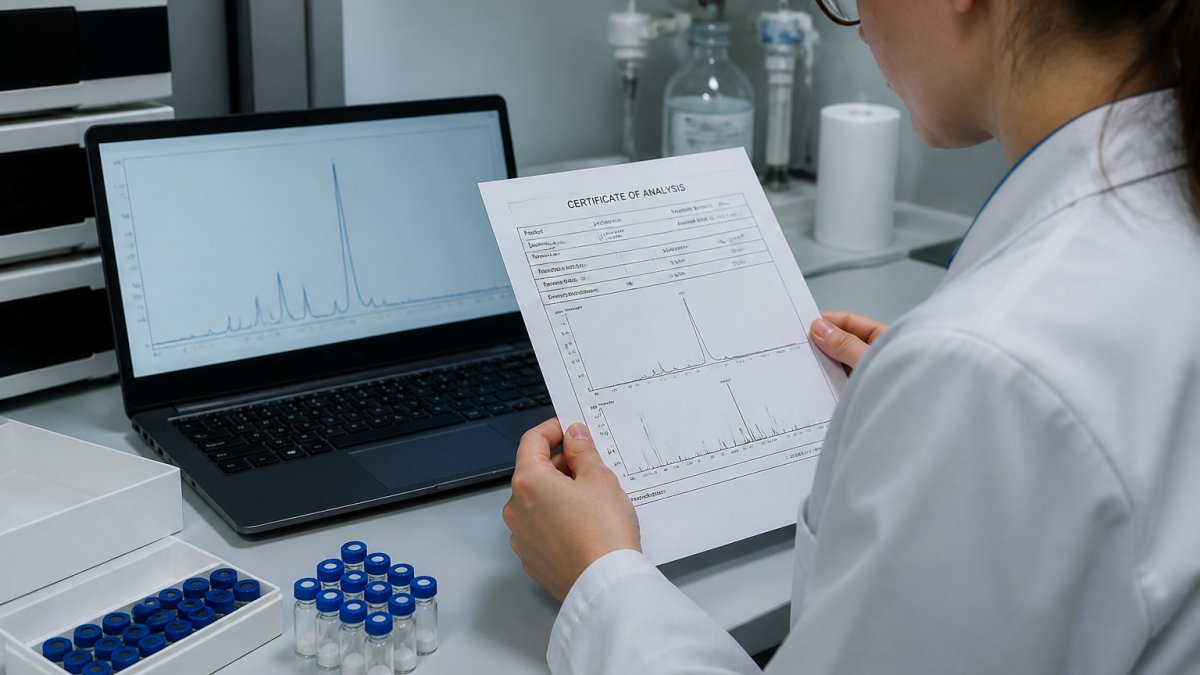
We publish batch-level Certificates of Analysis for every OptiPeps product. If you want a field-by-field walkthrough first, our guide to the peptide Certificate of Analysis explained covers what each line means.
Check 4: Peptide Purity Testing Methods That Actually Confirm Quality
Peptide purity testing rests on two complementary techniques. HPLC separates the components of a sample and shows how much of it is the target peptide versus related impurities. Mass spectrometry confirms the molecular weight, which tells you whether the molecule is what the certificate says it is.
Neither method alone is sufficient. HPLC without mass spectrometry can confirm a sample is clean without confirming it is the right compound. Mass spectrometry without HPLC confirms identity but says little about impurity load.
Reverse-phase HPLC is the standard for purity work because it resolves closely related impurities well. Ask which column, which gradient, and which detection wavelength were used. Suppliers who test properly can answer these questions quickly. For a fuller technical walkthrough, see our guide to HPLC-MS testing for research peptides.
Check 5: What a Purity Percentage Does and Does Not Tell You
A purity percentage tells you how much of the detected material is the target peptide. It does not tell you what the remaining fraction is, whether the peptide is the correct sequence, or whether the batch is suitable for your specific assay.
Two suppliers can both report 99% purity with very different impurity profiles. One might have trace deletion sequences. Another might carry residual solvents from synthesis. The number alone cannot distinguish them.
Watch out: treating a purity figure as a complete quality statement can be misleading. Read the chromatogram, check the impurity profile, and confirm the analytical method before you accept the number. Our article on peptide purity standards for in vitro research explains what thresholds actually mean in practice.
Check 6: Batch Traceability and Documentation You Can Defend
Batch traceability means being able to trace a vial back to its analytical results. In a peer review or an audit, that documentation can support your work.
Keep these records for every order:
- The batch number on the vial label
- The matching Certificate of Analysis
- The date of receipt and storage conditions from that point
- Any in-house testing you performed on arrival
Check 7: Research Peptides vs Therapeutic Peptides: Know the Difference
That distinction matters for procurement. If you are sourcing high purity laboratory peptides for in vitro work, you need documentation that supports research reproducibility, not a therapeutic claim. If you are sourcing high purity laboratory peptides for anything else, you are in the wrong supply chain.
Check 8: Independent Testing and Verification of Supplier COAs
A Certificate of Analysis can be assessed by checking the report and the laboratory that issued it. Independent testing by an accredited third-party laboratory can provide additional evidence, but verify the chain between the report and the laboratory that issued it.
Distinguish independent testing from supplier-generated documentation
Certificates labelled "third-party tested" can differ in how the testing and reporting are arranged. Three patterns are:
Ask the supplier directly how the testing and reporting were arranged.
Verify the report with the issuing laboratory
A certificate is only as good as your ability to confirm it. Work through these steps before you rely on any report:
- Identify the issuing laboratory. The report should name the laboratory, not just a logo. Note the report number and the date of analysis.
- Confirm the laboratory exists and performs the method. Check that the laboratory has a verifiable presence and that HPLC and mass spectrometry are within its stated scope.
- Contact the laboratory independently. Use contact details you source yourself, not the ones printed on the supplier's certificate. Ask the laboratory to confirm the report number, the sample description, and the result.
- Check the report for internal consistency. The batch number on the report should match the vial label. The sample receipt date should precede the analysis date. The method description should be specific enough to be reproducible, column type, gradient, detection wavelength, and mass range, not just "HPLC".
- Look for signs of alteration. Inconsistent fonts, missing page numbers, cropped chromatograms, or a purity figure that does not match the integrated area on the chromatogram are all reasons to treat the document as unconfirmed.
Build your own verification into the workflow
For high-stakes work, consider arranging your own verification on arrival. A sample sent to an independent laboratory can provide additional evidence to compare with the supplier's documentation.
Retain the correspondence with the issuing laboratory alongside the certificate.
For a field-by-field walkthrough of what each line on the report means, see our guide to the peptide Certificate of Analysis explained.
Check 9: Risk-Based Acceptance Criteria and Total Cost
Not every batch needs the same scrutiny. Set acceptance criteria from what the peptide is for, then compare suppliers on total cost rather than headline price.
Set acceptance criteria from the research question
Work backwards from the consequence of a failed batch. The higher the cost of being wrong, wasted grant time, irreproducible results, a retraction risk, the more evidence you should require before the vial enters the freezer.
| Research use | Minimum checks | Verification level | Typical acceptance criteria |
|---|---|---|---|
| Exploratory screening | COA review, identity confirmation | Supplier documentation | Purity figure consistent with the stated method; sequence and molecular weight match |
| Method development | COA review, chromatogram review, mass spec confirmation | Supplier documentation plus spot testing | Impurity profile reviewed, not just the headline percentage; retention time and mass consistent with the target |
| Publication-grade work | All of the above plus independent verification | Third-party confirmation on arrival | Independent laboratory confirms identity and purity within your stated tolerance |
| Regulated or audited work | Full documentation chain, retained samples | Independent verification plus audit trail | Documented chain from synthesis run to receipt, with retained samples for re-testing |
Two practical rules make this usable. First, write the acceptance criteria down before you order, not after the certificate arrives, it prevents you from rationalising a marginal result. Second, state the tolerance explicitly. "99% by RP-HPLC" is not an acceptance criterion unless you also specify the method, the detection wavelength, and what you will do if the result falls just below it.
Compare total cost, not price per vial
A transparent comparison accounts for:
- Price per usable quantity. A 5 mg vial at 95% purity delivers less target peptide than a 5 mg vial at 99%, and the difference compounds across a study.
- Testing documentation included. If independent verification is not provided, add the cost of your own testing to the effective price.
- Shipping and handling. Shipping and any import clearance costs belong in the comparison.
- Retesting and replacement costs. Factor in the probability of a failed batch and the time cost of reordering.
OptiPeps holds stock domestically and dispatches same-day from our Melbourne facility, which avoids international customs delays.
Frequently Asked Questions
How can researchers verify the purity of a laboratory peptide?
Start with the batch-specific certificate of analysis and check that it reports HPLC-MS verification. Where the compound matters to your study, you can send a sample to an independent analytical laboratory and compare the results with the supplier's documentation.
What should a research peptide certificate of analysis include?
A research peptide certificate of analysis can be reviewed for the batch number, analytical methods, and results. OptiPeps publishes batch-level Certificates of Analysis, and its peptides are HPLC-MS verified to meet a 99%+ purity standard.
Is HPLC testing enough to verify peptide quality?
HPLC-MS verification combines HPLC and mass spectrometry. Purity percentage and identity are separate questions.
What is the difference between research-grade and therapeutic peptides?
Research peptides and therapeutic peptides are distinct categories. OptiPeps supplies research-grade peptides for in-vitro laboratory use.
How should laboratory peptides be stored after delivery?
Most freeze-dried synthetic peptides should be stored desiccated at around -20 degrees Celsius, protected from light, and allowed to reach room temperature before opening to prevent condensation. Once reconstituted, follow the supplier's stated conditions, which are often 2 to 8 degrees Celsius for short-term use with aliquoting for longer storage. Record the batch number and reconstitution date on the vial. Repeated freeze-thaw cycles degrade peptides, so split working stocks into single-use aliquots and check the certificate of analysis for any sequence-specific storage notes.