Last Updated: November 8, 2026
Quick Summary
Australian peptide manufacturing benefits research supply by removing the customs bottleneck, shortening lead times and keeping batch records inside an auditable regulatory framework. Domestic suppliers hold stock locally, so restocking does not depend on an international freight schedule, and fewer handling points reduce the risk of temperature excursions in transit.
- Verified purity requires both HPLC separation and mass spectrometry confirmation of molecular identity, not a purity percentage alone.
- The lot number on the vial matters more than the certificate, because it links your result to a specific manufacturing run.
- Domestic dispatch removes the import clearance step, giving a lead time you can plan an experiment around.
- Check the physical facility address, CoA lot number, testing laboratory and batch-failure policy before committing.
- OptiPeps offers Express Post free on orders over $100, with no card surcharge on Australian bank transfers.
Table of Contents
- Why Local Peptide Manufacturing Changes Research Supply
- Peptide Purity Testing HPLC MS: What Verified Purity Really Means
- Peptide Batch Documentation That Supports Peer Review
- Peptide Shipping and Customs Delays: The Domestic Advantage
- TGA Peptide Import Requirements and What They Mean for Researchers
- How to Verify Australian Peptide Manufacturing Claims
- Choosing a Domestic Peptide Supplier for Your Laboratory
- Frequently Asked Questions
Why Local Peptide Manufacturing Changes Research Supply
Australian peptide manufacturing changes research supply by removing the customs bottleneck, shortening lead times and keeping batch records inside a regulatory framework researchers can actually audit. Research-grade compounds should not sit in a bond store while a time-sensitive assay waits.
The practical benefits of Australian based peptide manufacturing come down to three things. First, supply-chain resilience. A domestic supplier holds stock locally, so a restock does not depend on an international freight schedule. Second, accountability.
What most guides miss is that the quality question and the logistics question are the same question. A peptide that degrades in transit is a purity problem, not a shipping problem. Domestic production collapses that gap.
For a broader look at why local supply has become the default choice for research groups here, read our breakdown of why Australian researchers choose local suppliers.
Peptide Purity Testing HPLC MS: What Verified Purity Really Means
Peptide purity testing by HPLC-MS combines two techniques: high-performance liquid chromatography separates the components in a sample, and mass spectrometry confirms the molecular identity of what eluted. A purity figure without the mass confirmation tells you a peak is large. It does not tell you the peak is your peptide.
That distinction is where a lot of marketing language falls apart. A certificate quoting a purity percentage from chromatography alone is a partial result.
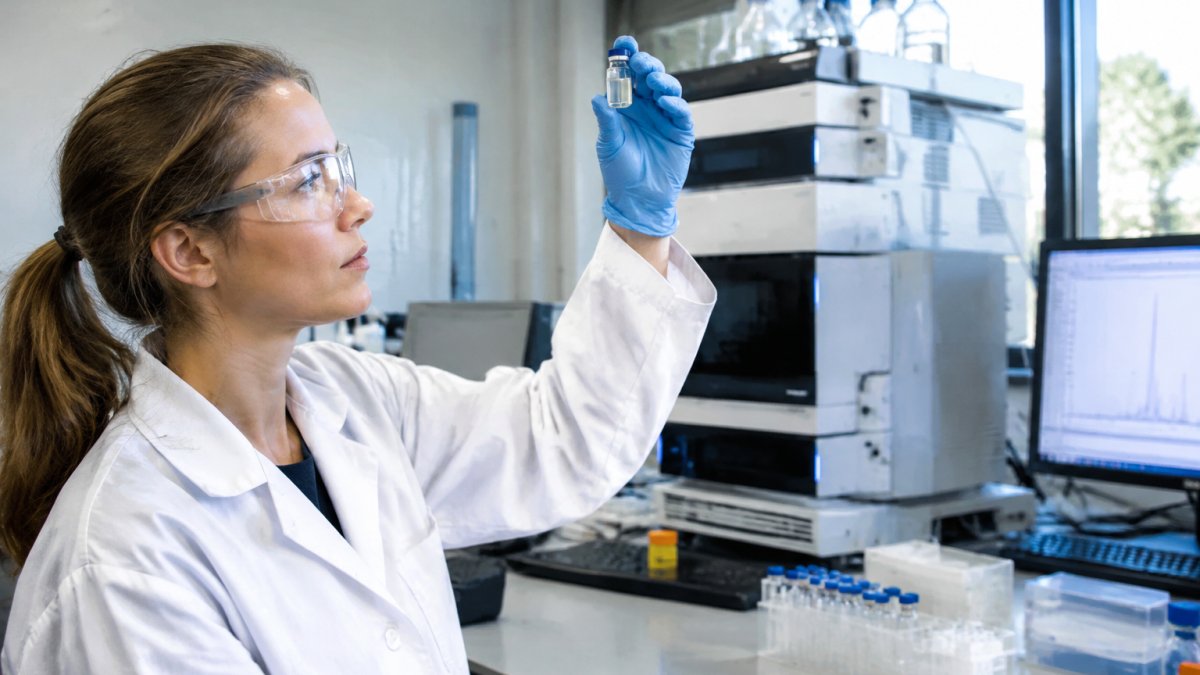
Where the purity number actually comes from
A purity result is the end of a chain, not a standalone measurement. In a domestic manufacturing setting the chain usually runs through five stages, and each one can introduce the impurities that later show up on a chromatogram.
- Synthesis. Solid-phase peptide synthesis builds the chain residue by residue on a resin. Incomplete coupling at any step produces deletion sequences, peptides missing one or more amino acids, that are structurally close to the target and therefore hard to separate later.
- Cleavage and deprotection. The peptide is cleaved from the resin and side-chain protecting groups are removed. This step generates scavenger by-products and can cause aggregation if the conditions are not controlled.
- Purification. Preparative reverse-phase HPLC fractions the crude peptide. The number of passes and the gradient profile determine how much of the deletion and truncation load is removed.
- Analytical testing. The purified pool is tested by analytical HPLC for purity and by mass spectrometry for identity. Some suppliers also run amino acid analysis or sequence confirmation for higher-risk compounds.
- Batch release and documentation. The lot is approved against a specification, a Certificate of Analysis is issued, and the batch record is retained.
Reading the report properly
Three things to look for on any analysis report:
- Method stated: the column, mobile phase and detection method should be named, not implied.
- Full chromatogram: a peak table with retention times, not just a percentage.
- Mass confirmation: observed versus expected molecular weight, with the difference shown.
A common mistake is accepting a purity figure with no method attached. If the report cannot tell you how the number was produced, the number is decoration.
Watch out: a single purity percentage can hide a poor impurity profile. Two vials both quoted at 98% may carry very different deletion-sequence loads, and the chromatogram is the only place that difference is visible.
What domestic manufacturing changes about testing
Our HPLC-MS testing guide for research peptides walks through the full method, including how to read an impurity profile.
Peptide Batch Documentation That Supports Peer Review
Batch documentation is the paper trail that lets a reviewer trace a specific vial back to a specific manufacturing run, its analytical results and its handling history. Without it, a methods section cannot be defended.
What belongs in a defensible batch file:
| Document | What it proves | Why reviewers ask |
|---|---|---|
| Certificate of Analysis | Identity and purity for that lot | Confirms the compound is what the label says |
| Chromatogram and mass spectrum | The raw data behind the CoA | Lets a reviewer check the interpretation |
| Batch/lot number on the vial | Traceability from bench to record | Links your result to a specific run |
| Testing laboratory identification | Independence of the analysis | Rules out self-certification |
| Storage and dispatch record | Chain of custody | Explains any handling variance |
The thing nobody tells you about batch documentation is that the lot number on the vial matters more than the certificate itself. A certificate with no matching lot number on the physical container is a document about a batch, not about your batch.
If you want a practical process for checking this before you commit to a supplier, our guide to verifying peptide batch transparency before you buy sets out the questions to ask and the answers that should raise a flag.
Peptide Shipping and Customs Delays: The Domestic Advantage
Customs delays are not a minor inconvenience in research. A shipment held for clearance can sit for days or weeks, and temperature-sensitive material does not pause while it waits. The practical case for domestic supply is easiest to see when you map the two routes side by side.
What an international order actually involves
An overseas peptide order typically passes through more handling points than the checkout page suggests:
- Export clearance at the origin country.
- International freight, often with a handover between carriers.
- Import clearance, where the consignment is assessed against the applicable import requirements.
- Biosecurity inspection, which can add time for biological or chemical materials depending on classification.
- Domestic linehaul to the final address.
Each handover is a chance for a temperature excursion, a documentation query or a mis-routed parcel. None of these are exotic failures; they are routine features of cross-border logistics. The researcher experiences them as an assay that cannot start.
What domestic dispatch removes
Domestic dispatch removes the import clearance step from the route. The parcel moves on the national postal network from a local facility to the delivery address.
The domestic advantage in practice:
- Predictable lead time: dispatch and delivery happen on a schedule you can plan an experiment around, rather than a window set by a freight forwarder.
- Fewer handling points: each transfer is a chance for a temperature excursion, and domestic routes have materially fewer of them.
- Local recourse: if something goes wrong in transit, the resolution conversation happens in the same time zone and under the same consumer framework.
- Continuity of supply: a domestic supplier holding stock locally can restock without waiting on an international freight schedule, which matters when a protocol runs across multiple weeks.
Cold chain is the failure mode that hides
Watch out: cold-chain integrity is the failure mode that does not announce itself. A vial that arrived warm may still look fine, and a lyophilised peptide can survive short excursions that a reconstituted solution would not. Ask any supplier how the parcel is packed, not just how fast it ships.
The procurement side of the same question
Supply-chain resilience is also a procurement question.
For the specifics of dispatch timing and cold-pack handling, see our Express Post shipping options.
TGA Peptide Import Requirements and What They Mean for Researchers
The Therapeutic Goods Administration regulates therapeutic goods in Australia, and peptides intended for human therapeutic use fall inside that framework.
This is where research context matters. Material supplied for in-vitro laboratory work sits in a different category from a product intended for therapeutic use, and the obligations attached to each are not interchangeable. Researchers should confirm the intended use classification before ordering, and check the current requirements directly with the regulator rather than relying on a supplier's summary.
According to the TGA's guidance on unapproved therapeutic goods, the approval requirements depend on the product and the circumstances of importation. The Therapeutic Goods Act 1989 sets the statutory framework those requirements sit within.
How to Verify Australian Peptide Manufacturing Claims
Verification is a process of elimination, not a leap of faith. Any supplier can write "Australian made" on a page. Fewer can show you the chain that supports it.
Run these checks in order:
- Ask for the physical facility address. A manufacturing claim needs a manufacturing site.
- Request a Certificate of Analysis with a lot number. Then confirm the lot number appears on the vial you receive.
- Ask which laboratory performed the testing. Independent third-party analysis is a different claim from in-house results.
- Check whether the CoA is publicly accessible by batch. Batch-level transparency means you can look it up, not request it by email and wait.
- Ask what happens if a batch fails. A replacement or refund policy tells you whether the supplier stands behind the analysis.
The real difference between a verified claim and a marketing claim is whether the evidence arrives before you ask twice.
Choosing a Domestic Peptide Supplier for Your Laboratory
Choosing a supplier comes down to four procurement criteria: verified purity, traceable documentation, dispatch reliability and a clear resolution process when something goes wrong. Price sits fifth, because a cheap vial that fails verification costs more than the experiment it ruins.
Our position is straightforward. We hold stock domestically, publish batch-level Certificates of Analysis backed by independent third-party HPLC-MS testing against a 99%+ purity standard, and offer Express Post free on orders over $100. Australian bank transfers carry no card surcharge.
What we would tell any lab manager weighing a switch: revalidation is real work, so make the decision on evidence rather than on a price sheet. Ask for a sample batch record and read it before you commit.
If you are at the comparison stage, our quality checklist for evaluating peptide suppliers gives you a scoring framework to run against every option on your shortlist.
OptiPeps supplies research-grade peptides with 99%+ HPLC-MS verified purity, public batch-level Certificates of Analysis, and same-day dispatch from a Melbourne-based facility. Get started with OptiPeps and put a verifiable batch record behind every assay.
Frequently Asked Questions
What are the benefits of sourcing peptides from a local manufacturer?
Local peptide manufacturing cuts delivery times and avoids customs holds that can degrade temperature-sensitive compounds. With domestic production, you can verify purity through independent HPLC-MS testing and request Certificates of Analysis before your experiment starts. For time-sensitive in-vitro studies, same-day dispatch from a local facility means reagents arrive when you need them, not weeks later.
What does HPLC-MS testing tell you about peptide purity?
HPLC-MS combines chromatographic separation with mass spectrometry to confirm both the purity percentage and the molecular identity of a peptide. HPLC reveals impurity peaks, while MS verifies the correct mass, catching sequence errors or truncations. A 99%+ purity result from an independent third-party laboratory gives you confidence that the vial contains the intended compound at the stated concentration. Always request the actual chromatogram and mass spectrum, not just a summary statement, so you can assess the data yourself.
Are research-grade peptides approved for human use?
No. Research-grade peptides are supplied for in-vitro laboratory use only and are not approved therapeutic goods. They are not evaluated by the Therapeutic Goods Administration for safety, efficacy or quality in human applications. Researchers should handle them according to institutional safety protocols and never administer them to humans or animals outside approved ethics frameworks. If your work requires therapeutic-grade material, you need a prescription medicine manufactured under GMP and supplied through a licensed pharmacy or sponsor.
What should laboratories check before importing peptides?
Before importing peptides, confirm whether the compound is listed as a prescription medicine or controlled substance under TGA rules, as research use may carry specific import obligations. Check that the supplier provides batch-specific third-party HPLC-MS certificates and that shipping uses validated cold-chain or ambient conditions appropriate to the peptide's stability. Factor in customs clearance times, which can extend lead times unpredictably, and keep records of import documentation to satisfy institutional compliance reviews.