Last Updated: November 1, 2026
Quick Summary
High purity peptides are worth it for drug discovery because impurity content is measured, documented and kept low enough that biological activity can be attributed to the intended sequence rather than contaminants. The right grade depends on your stage, from 90-95% for screening to the highest grade for preclinical work.
- A 95% pure peptide contains 5% unplanned material that can skew screening assays.
- Use 95-98% purity for lead optimisation and structure-activity work.
- HPLC-MS confirms both purity and molecular identity; one method alone is never enough.
- Store lyophilised peptides at -20°C or colder, desiccated and protected from light.
- Check for a batch-specific certificate of analysis with method details and an impurity profile before ordering.
Table of Contents
- 1. Why High Purity Peptides Decide Drug Discovery Outcomes
- 2. Peptide Purity Guidelines by Discovery Stage
- 3. HPLC Peptide Purity Analysis and Orthogonal Confirmation
- 4. Reading a Peptide Certificate of Analysis Before You Order
- 5. Peptide Stability and Storage: Protecting Purity After Delivery
- 6. Batch Consistency, Impurity Profiles and Assay Reproducibility
- 7. Building a Supplier Checklist for High Purity Peptides
- Ordering Verified Peptides for Your Next Study
- Frequently Asked Questions
1. Why High Purity Peptides Decide Drug Discovery Outcomes
A peptide that is 95% pure contains 5% material you did not plan for. In a screening assay, that 5% can bind, inhibit or fluoresce, and you will spend weeks chasing a result that came from an impurity rather than your compound. This is why high purity peptides for drug discovery are not a premium upgrade but a baseline requirement for anyone generating data intended to survive review.
Research-grade peptides with documented purity help keep early-stage work interpretable. High purity peptides are peptides whose impurity content has been measured, documented and kept low enough that biological activity can be attributed to the intended sequence rather than to contaminants.
The stakes are practical, not theoretical. Deletion sequences, truncated chains and residual solvents all travel with a crude peptide into your assay plate. A single missed truncation can shift an IC50.
2. Peptide Purity Guidelines by Discovery Stage
There is no universal purity specification. The right number depends on what you are doing with the material, and this is where most sourcing decisions go wrong.
- Screening and lead identification: 90-95% is often adequate when you are ranking many compounds and confirming hits later.
- Lead optimisation and structure-activity work: 95-98%, because small differences in activity now matter.
- Assay development and validation: 98%+, since you are establishing a reference standard.
- Preclinical and clinical-enabling studies: the highest grade available, with full documentation.
A common mistake is buying the cheapest grade for a stage that demands better. The saving disappears the moment you repeat an experiment.
3. HPLC Peptide Purity Analysis and Orthogonal Confirmation
HPLC peptide purity analysis is the chromatographic measurement of how much of a sample elutes as the target peptide versus related impurities. Reverse-phase HPLC separates components by hydrophobicity, and the main peak's area percentage becomes the purity figure you see on a certificate.
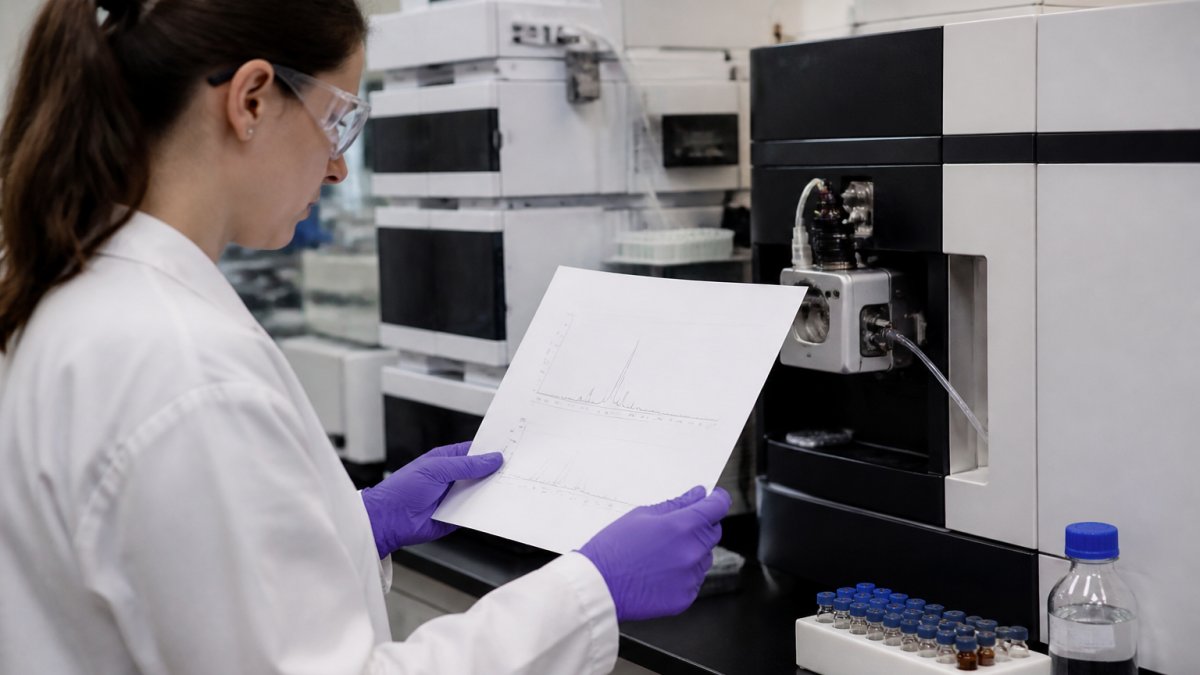
One method is never enough. HPLC tells you how many things are in the vial; mass spectrometry tells you what they are. Run together as HPLC-MS, they confirm both purity and molecular identity, catching the mislabelled and underdosed material that circulates in this market. For a practical walkthrough of the verification process, see our guide on how to verify peptide purity, and for a deeper look at confirmatory testing, read HPLC-MS testing for research peptides.
4. Reading a Peptide Certificate of Analysis Before You Order
A peptide certificate of analysis is the document that ties a specific batch to its analytical results, and it is only meaningful if it is batch-specific and independently generated. Before you order, check four things.
- Batch number matching the vial you receive.
- Method details for both HPLC and MS, not just a purity figure.
- Impurity profile, including the largest individual impurities.
- Testing laboratory, ideally a third party rather than the seller's own bench.
If any of these are missing, the number on the label is a claim, not evidence. Our guide on how to interpret a certificate of analysis walks through each section line by line.
5. Peptide Stability and Storage: Protecting Purity After Delivery
Purity measured at dispatch is not purity at use. Peptide stability and storage determine whether the 99% you paid for survives the trip and the freeze-thaw cycle.
Store lyophilised peptides at -20°C or colder, desiccated and protected from light. Once reconstituted, aliquot before freezing and avoid repeated freeze-thaw cycles, which degrade material faster than most researchers expect. Use sterile technique and appropriate buffers; a peptide that adsorbs to a plastic tube is functionally lost.
Watch out: reconstituting an entire vial and refreezing it repeatedly is the single most common way labs destroy good material.
6. Batch Consistency, Impurity Profiles and Assay Reproducibility
Batch consistency is the difference between an experiment you can repeat and one you cannot. Two vials of the same sequence from different batches can differ in impurity profile, and that difference shows up as assay variability you will misattribute to biology.
Ask suppliers how they control batch-to-batch reproducibility. An impurity profile that shifts between batches signals a synthesis process you cannot rely on. For reproducibility, the documentation matters as much as the peptide.
7. Building a Supplier Checklist for High Purity Peptides
Use this checklist before committing a research programme to any supplier. You can also review our checklist of checks when sourcing high purity laboratory peptides. For a side-by-side comparison, see our quality checklist comparing peptide suppliers for labs.
- Purity specification stated as a number, not a claim
- HPLC-MS verification, ideally by an accredited third party
- Batch-specific certificate of analysis available before ordering
- Impurity profile disclosed
- Domestic stock to avoid customs delays
- Clear replacement policy for quality issues
- Traceable batch numbers on every vial
OptiPeps offers batch-level transparency, public certificates of analysis and same-day dispatch from a Melbourne facility.
| Criterion | Why It Matters | What to Ask |
|---|---|---|
| Purity figure | Defines impurity load | Is it measured or claimed? |
| HPLC-MS | Confirms identity | Third party or in-house? |
| CoA | Ties data to batch | Batch-specific? |
| Storage guidance | Protects purity | Provided with order? |
| Replacement policy | Covers failures | What turnaround? |
Ordering Verified Peptides for Your Next Study
The hard part is not finding peptides; it is finding material whose purity you can defend in a review meeting. OptiPeps holds stock domestically, verifies batches to a 99%+ purity standard using HPLC-MS, and provides batch-level certificates of analysis so you can trace what arrived. Orders over $100 ship free via Express Post, with same-day dispatch from our Melbourne facility.
Get started with OptiPeps and put verified, traceable high purity peptides behind your next experiment.
Frequently Asked Questions
What purity level is recommended for peptides used in drug discovery?
For screening assays and lead optimization, 95% or higher is a practical baseline, while 98% to 99%+ is preferred for quantitative work, structure-activity studies and anything feeding into preclinical research. High purity peptides reduce the risk that a deletion sequence or residual solvent drives an apparent biological effect. For early exploratory work, lower grades can be acceptable if the impurity profile is documented, but confirm the specification against your assay sensitivity before ordering.
How is peptide purity measured, and what does HPLC peptide purity analysis actually show?
HPLC peptide purity analysis separates the target peptide from impurities and reports the area percentage of the main peak. It shows how much of the UV-absorbing material is your peptide, not how much peptide by mass is in the vial. Mass spectrometry then confirms molecular identity, and techniques such as amino acid analysis or nitrogen determination estimate peptide content. Read the chromatogram, not just the headline percentage, because a clean 98% peak and a messy 98% peak are different materials.
What quality documents should accompany a research peptide?
Ask for a peptide certificate of analysis that lists the sequence, molecular weight, HPLC method and result, mass spectrometry confirmation, appearance, counter-ion, water content and storage recommendation. Batch-level traceability matters: the COA should match the lot number on the vial. Independent third-party testing adds weight when you need documentation you can defend in peer review. Without a batch-specific COA, a purity claim is marketing rather than evidence.
How can impurities affect peptide drug discovery experiments?
Deletion sequences, truncated fragments and residual solvents can alter biological activity, shift dose-response curves and create false positives in screening assays. Impurities that are themselves active are the hardest to spot, because the assay result looks real. Batch-to-batch variation in impurity profiles also undermines reproducibility when you scale from a pilot study to a larger run. Reviewing the impurity profile before committing a compound to lead optimization protects both your data and your timelines.
How should peptides be stored to maintain their quality?
Store lyophilised peptides at -20°C, or -80°C for longer horizons, protected from light and moisture. Let vials equilibrate to room temperature before opening to avoid condensation. Once reconstituted, aliquot into single-use volumes and avoid repeated freeze-thaw cycles, which degrade many sequences. Use appropriate buffers and check pH, since some peptides are sensitive to hydrolysis or oxidation. Record storage conditions in your lab notebook so peptide stability and storage decisions are auditable later.