Table of Contents
- What is HPLC-MS Testing for Research Peptides?
- How to Read a Peptide Certificate of Analysis
- Peptide Purity Testing: Understanding the Numbers
- Mass Spectrometry for Peptide Identification
- Peptide Batch Testing and Independent Verification
- HPLC-MS Method Limitations and What Testing Cannot Establish
- Interpreting HPLC-MS Results: A Practical Walkthrough
- Frequently Asked Questions
Last Updated: October 19, 2026
What is HPLC-MS Testing for Research Peptides?
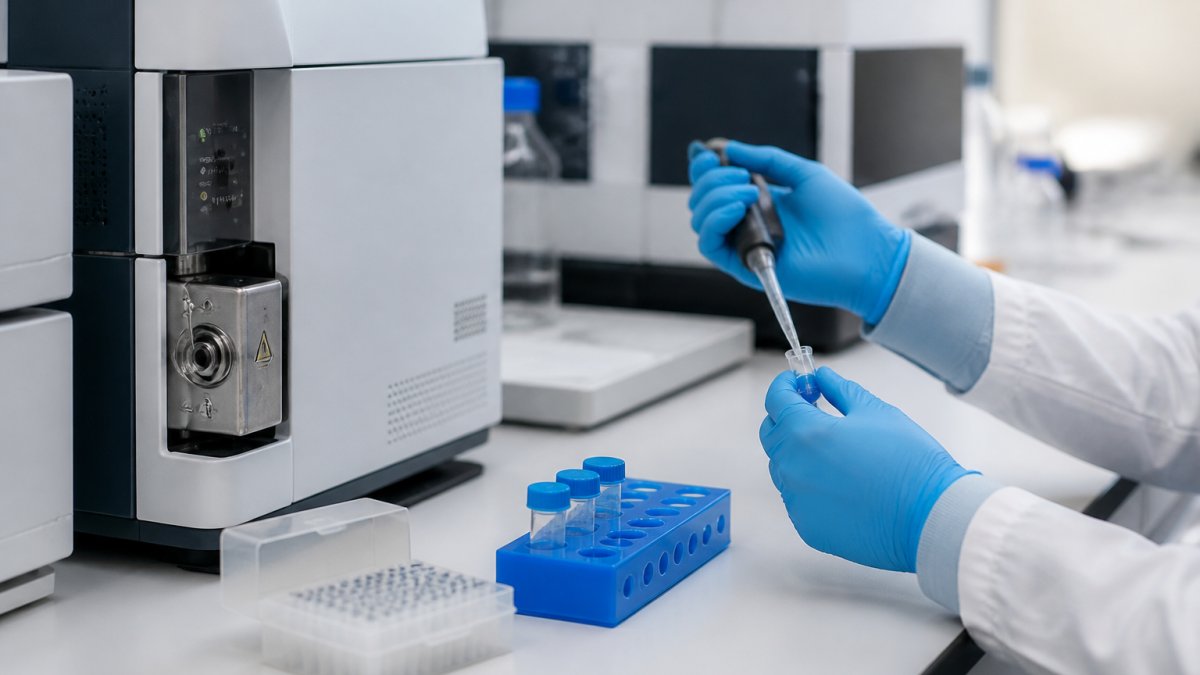
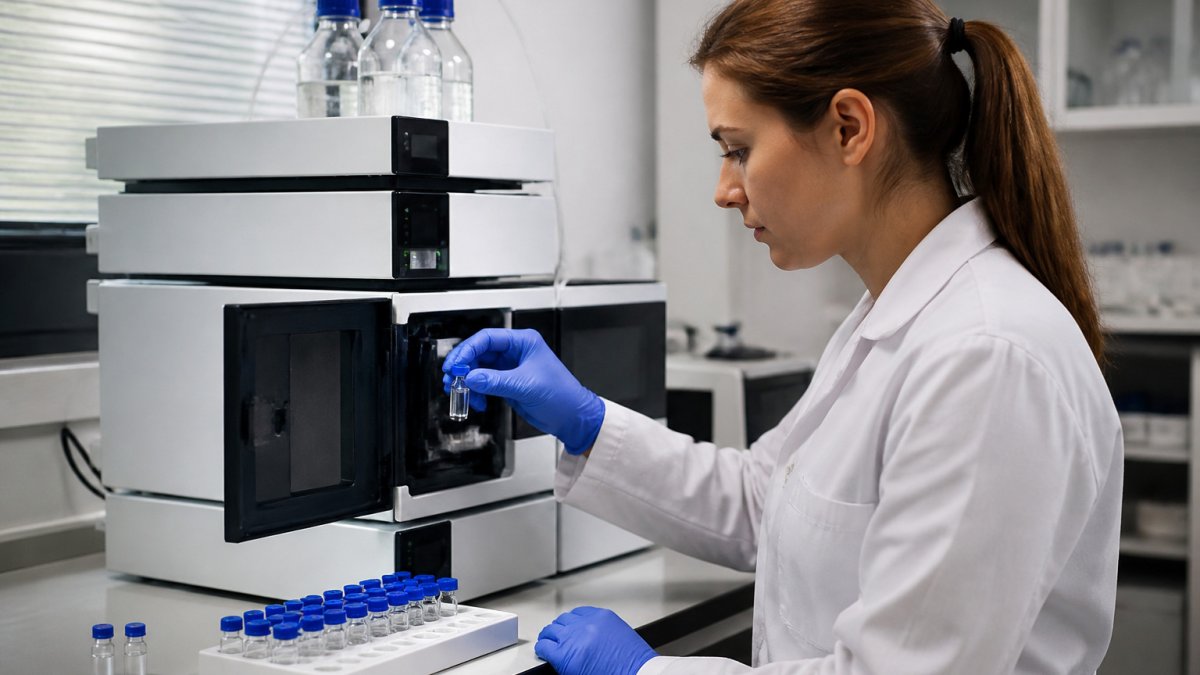
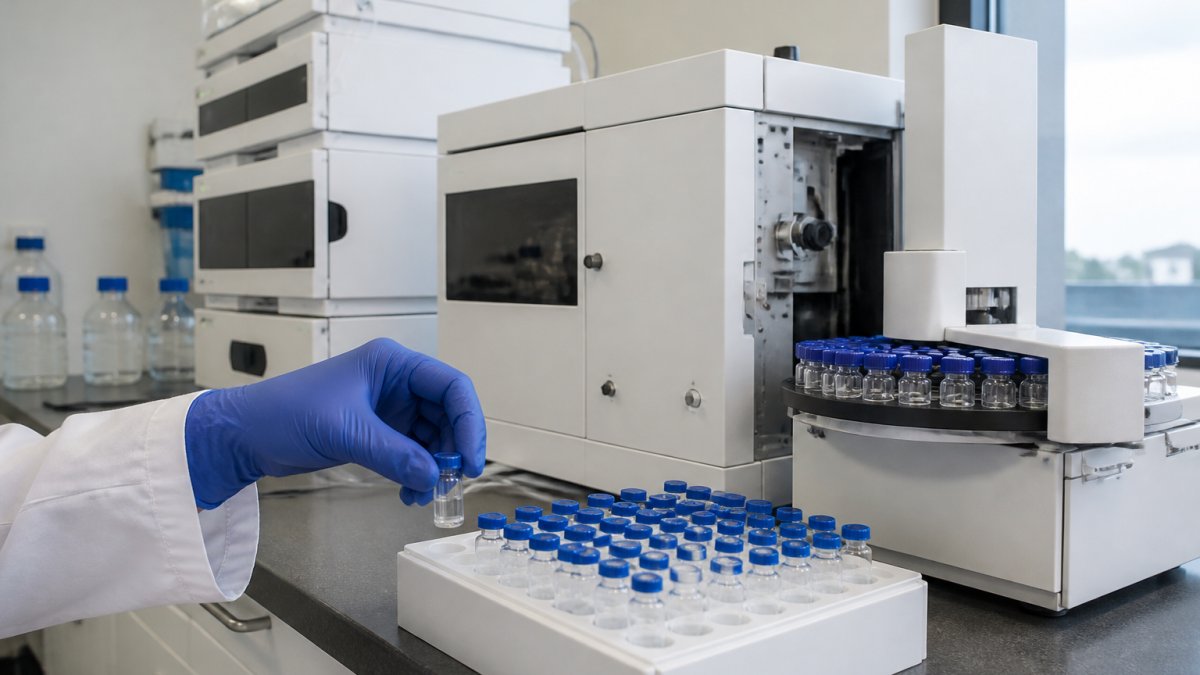
HPLC ms testing for research peptides is a combined analytical technique that verifies both the identity and purity of peptide compounds used in laboratory research.
Neither technique alone gives the complete picture: HPLC separates components and measures concentration, while MS identifies molecular weight and confirms structure. Together they provide the batch-level transparency researchers need.
The role of HPLC in peptide analysis
HPLC forces a liquid sample through a column packed with microscopic particles. Components move at different speeds depending on their chemical properties, and a detector measures how much material exits, creating a chromatogram of peaks.
Peak area indicates how much of each component is present: the main peak is your target peptide, smaller peaks are impurities and degradation products. Comparing peak areas to total material detected gives the percentage purity on a Certificate of Analysis.
HPLC is reproducible and sensitive, making it the industry standard for purity testing, but it cannot confirm what a compound actually is. That's where mass spectrometry comes in.
The role of mass spectrometry in peptide identification
Mass spectrometry ionises peptide molecules and measures their mass-to-charge ratio, creating a mass spectrum of the masses present and their abundance.
The molecular ion peak reveals the peptide's exact mass.
MS also reveals sequence indirectly: fragmentation patterns are characteristic of specific structures, so comparing your sample's spectrum to the expected spectrum confirms the right compound.
How to Read a Peptide Certificate of Analysis
A Certificate of Analysis (COA) documents test results for a specific batch or lot of peptide. Every COA should be batch-specific, applying only to the exact vial or batch number you received.
Essential sections of a COA
The purity section states the percentage purity by HPLC, reflecting the proportion of target peptide measured by peak area integration.
The testing methods section lists the techniques used, typically HPLC, MS, or both, plus the testing date and laboratory name.
Many COAs include chromatogram and mass spectrum images, letting you inspect the actual data rather than just summary numbers.
Batch-specific information and lot verification
The batch or lot number is non-negotiable.
The batch number on your vial label should match the COA. If they don't, you have the wrong COA or the wrong vial.
Lot-specific testing also protects reproducibility: a researcher using batch B of the same peptide might see different outcomes if its purity or impurities differ.
Identifying testing date and laboratory credentials
The testing date tells you how fresh the analysis is. A COA dated six months ago doesn't reflect the peptide's current state if it has been stored improperly; ideally, the testing date should be close to your receipt date.
The laboratory name and credentials matter. Look for statements like "ISO 17025 accredited" or "NATA registered." In Australia, NATA (National Association of Testing Authorities) accreditation is the gold standard, meaning the lab has been independently assessed against strict quality and competency standards (Testing & Calibration (ISO / IEC 17025) Accreditation).
If the COA lists only an in-house laboratory with no independent accreditation, ask whether independent third-party testing is available. OptiPeps uses accredited third-party laboratories for our HPLC-MS verification, so our COAs carry the weight of independent verification.
Peptide Purity Testing: Understanding the Numbers
Purity percentage is the most important number on a COA, yet often misunderstood. A 99% result means 99% of the material HPLC detected was the target peptide, not absolute purity.
What percent purity means in HPLC reports
HPLC purity is the area under the main peptide peak divided by the total area of all peaks.
This method assumes equal detector response to all components, which isn't true in reality: a small peak might represent a large amount of poorly UV-absorbing material, and vice versa.
A 99%+ purity result is high-grade for research peptides, but purity alone doesn't tell you whether the peptide suits your specific application; a 99% pure peptide might still contain impurities that interfere with your assay or cell culture.
Impurities, degradation products, and acceptance criteria
The smaller peaks on an HPLC chromatogram represent impurities and degradation products. Common impurities include:
- Incomplete synthesis intermediates (peptides missing one or more amino acids)
- Truncated peptides (fragments of the full sequence)
- Modified versions (oxidised methionine, deamidated asparagine)
- Salts and buffer components from the synthesis or purification process
- Aggregates (multiple peptide molecules linked together)
Degradation products form over time with exposure to light, heat, or humidity; oxidation and hydrolysis of the peptide backbone are common.
Acceptance criteria are the purity thresholds defining whether a batch is acceptable.
The COA should state the acceptance criteria used; if it doesn't, ask the supplier. At OptiPeps, our standard is 99%+ purity verified by HPLC-MS.
Mass Spectrometry for Peptide Identification
While HPLC tells you how much of your target peptide is present, mass spectrometry tells you what that peptide actually is. MS is the definitive test for molecular weight and sequence confirmation.
How MS confirms molecular weight and peptide sequence
For a simple peptide, the most prominent peak is the molecular ion peak, the intact peptide with one charge.
The observed molecular weight from MS should match the theoretical molecular weight calculated from the peptide sequence.
Peptides also fragment in the mass spectrometer, creating smaller ions that follow predictable patterns based on the sequence.
Reading mass-to-charge ratios and mass spectra
A mass spectrum is a graph with m/z on the horizontal axis and intensity (abundance) on the vertical axis.
For peptide identification, focus on the molecular ion region. This is usually the highest m/z region in the spectrum.
The presence of multiple peaks in the molecular ion region (a cluster) is normal for peptides.
Impurities and degradation products appear as additional peaks in the mass spectrum.
Peptide Batch Testing and Independent Verification
Batch-specific testing is the cornerstone of research-grade peptide quality. Every batch must be tested individually because each synthesis run is unique.
Why batch-specific testing matters for reproducibility
When you publish research using a peptide, you cite the batch number.
Batch-specific testing also protects you from silent failures. A supplier might have a quality problem that affects only certain batches.
The testing should be performed on a sample taken from the actual batch you receive, not a "reference sample" from the original synthesis.
Third-party laboratory verification and chain of custody
Independent third-party testing is the gold standard.
Chain of custody refers to the documented path of the sample from the manufacturer to the testing laboratory to you.
At OptiPeps, we use accredited third-party laboratories for hplc ms testing for research peptides verification. Our COAs are issued by independent labs, not our own facility.
HPLC-MS Method Limitations and What Testing Cannot Establish
HPLC-MS is powerful, but it has boundaries. Understanding these limitations prevents you from over-interpreting results or making incorrect decisions based on incomplete data.
Identity testing versus purity testing
Identity testing (what the peptide is) and purity testing (how much of it is there) are different.
Identity testing via MS confirms the molecular weight and, with advanced techniques, the sequence. However, MS cannot detect all structural variations.
Purity testing via HPLC measures the proportion of the target compound. However, HPLC cannot identify unknown impurities without additional data.
Sterility, endotoxin, and storage stability boundaries
HPLC-MS does not test for sterility or endotoxin. Sterility testing involves culturing the sample in growth media to detect bacterial or fungal contamination (pubmed.ncbi.nlm.nih.gov). Endotoxin testing uses the LAL (Limulus Amebocyte Lysate) assay to detect bacterial lipopolysaccharides (pubmed.ncbi.nlm.nih.gov).
Storage stability is not assessed by a single COA. A COA taken at the time of synthesis tells you the peptide's condition at that moment.
If your research requires sterility, endotoxin testing, or stability data, you must request these tests separately.
Interpreting HPLC-MS Results: A Practical Walkthrough
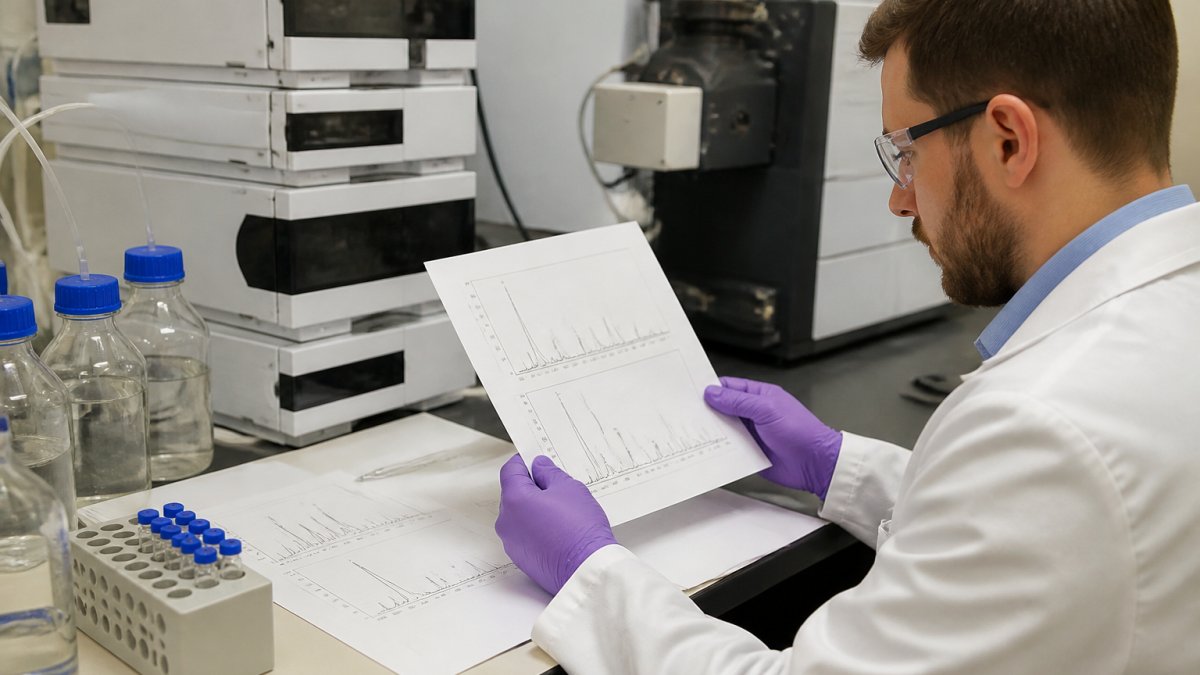
Reading an HPLC-MS report requires attention to several key elements.
Start with the chromatogram.
Next, examine the mass spectrum. Locate the molecular ion peak in the highest m/z region.
Look for unexpected peaks in the mass spectrum.
Check the testing date.
Verify the laboratory credentials. Is it NATA accredited or equivalent?
Finally, confirm the batch number on the COA matches the batch number on your vial label.
Measurement uncertainty and specification acceptance
Every analytical measurement has uncertainty.
Specification acceptance criteria should account for this uncertainty. If your specification is "≥99% purity," a result of 99.2% clearly passes.
Method validation is the process laboratories use to establish that their HPLC-MS method is reliable and reproducible.
Understanding HPLC-MS testing for research peptides puts you in control of your supply chain.
Frequently Asked Questions
What does HPLC-MS testing measure in research peptides?
HPLC-MS testing measures two critical properties: HPLC determines the purity of your peptide by separating components and quantifying the main peptide versus impurities and degradation products. Mass spectrometry confirms the molecular weight and peptide sequence, verifying that the compound you received matches the identity on the label. Together, they establish both what your peptide is and how pure it is, which is essential for reproducible in-vitro research.
How do I know if a peptide COA is batch-specific and not just generic marketing?
A genuine batch-specific COA includes a unique batch number or lot identifier, the exact testing date, the name of the third-party laboratory that performed the analysis, and the sample size tested. The report should reference the specific molecular weight and peptide sequence of your order, not a generic product description. Check that the laboratory name and credentials are verifiable and that the certificate is not a template reused across multiple batches.
What does a purity percentage on an HPLC report actually tell me about my peptide?
The purity percentage (typically expressed as percent area under the curve) indicates the proportion of your sample that is the desired peptide versus all other compounds present. A 99% purity result means 99% of the sample is your target peptide and 1% is impurities, degradation products, or synthesis by-products. This number is critical for calculating accurate dosing in your experiments. However, it does not guarantee sterility, endotoxin levels, or long-term stability under storage conditions.
Can HPLC-MS confirm a peptide's identity, or does it only measure purity?
HPLC-MS can confirm identity through mass spectrometry. MS measures the molecular weight and fragmentation pattern, which must match the expected peptide sequence. HPLC alone cannot confirm identity, it only separates and quantifies components. Together, HPLC provides purity data and MS provides identity verification. This combination gives you confidence that the compound is both the correct peptide and sufficiently pure for your research.
What are the main limitations of HPLC-MS testing for research peptides?
HPLC-MS establishes identity and purity but does not measure sterility, endotoxin levels, or long-term stability under storage. It tests the sample as prepared at the time of analysis, it cannot predict how your peptide will degrade over months if stored improperly. The method also cannot detect every possible contaminant, only those that separate or ionise under the testing conditions used. For research use, this is usually sufficient, but if your experiments require additional assurance (e.g., endotoxin limits for cell culture), request supplementary testing.
Why should I use an independent third-party laboratory for peptide testing instead of the supplier's own results?
Third-party laboratories provide an objective, verifiable assessment that is defensible in peer review and regulatory contexts. They operate under accreditation standards and have no commercial incentive to misreport results. When you cite a third-party COA in your research, reviewers can have confidence that the purity and identity data are reliable. A supplier's in-house testing, while faster, carries an inherent conflict of interest and may not be accepted as evidence of quality in formal publications or regulatory submissions.
How do I interpret the mass-to-charge ratio (m/z) values on a mass spectrometry report?
The mass-to-charge ratio (m/z) shows the molecular weight of ionised peptide fragments. For a peptide with a single charge, the m/z value equals the molecular weight in Daltons. If your peptide has a molecular weight of 1000 Da and appears as m/z 1000, it carries a single positive charge. Doubly charged ions appear at half the m/z value. The expected m/z values should match your peptide's known sequence and charge state. Unexpected m/z peaks indicate contamination or degradation products.