Table of Contents
- What Is a Peptide Certificate of Analysis?
- How to Read a Peptide Certificate of Analysis
- Peptide HPLC Testing: What the Results Mean
- Mass Spectrometry and Molecular Weight Verification
- Peptide Certificate of Analysis Example: Reading a Real Report
- Peptide COA Template: Essential Elements and Specifications
- What a Peptide COA Cannot Tell You
- Verification and Chain of Custody: Building Confidence in Your Supply
- Frequently Asked Questions
Last Updated: October 18, 2026
What Is a Peptide Certificate of Analysis?
A peptide certificate of analysis is a laboratory report documenting the identity, purity, and quality of a specific batch of peptide material. It is the official record of analytical testing performed on that exact batch before dispatch.
A datasheet describes what a peptide should be; a certificate of analysis proves what this batch actually is. It includes the batch number, testing date, laboratory name, and results from multiple analytical methods, down to the measured purity percentage and specific impurities detected.
Why batch-level verification matters for research
Peptide synthesis is not standardised: two batches of the same sequence, made weeks apart, can differ in purity, degradation products, and impurity profiles.
A batch-level peptide certificate of analysis proves the material you're using matches your protocol's specifications.
Independent third-party testing strengthens this assurance: when a neutral laboratory performs the testing and issues the report, the results carry credibility in-house testing cannot match.
How to Read a Peptide Certificate of Analysis
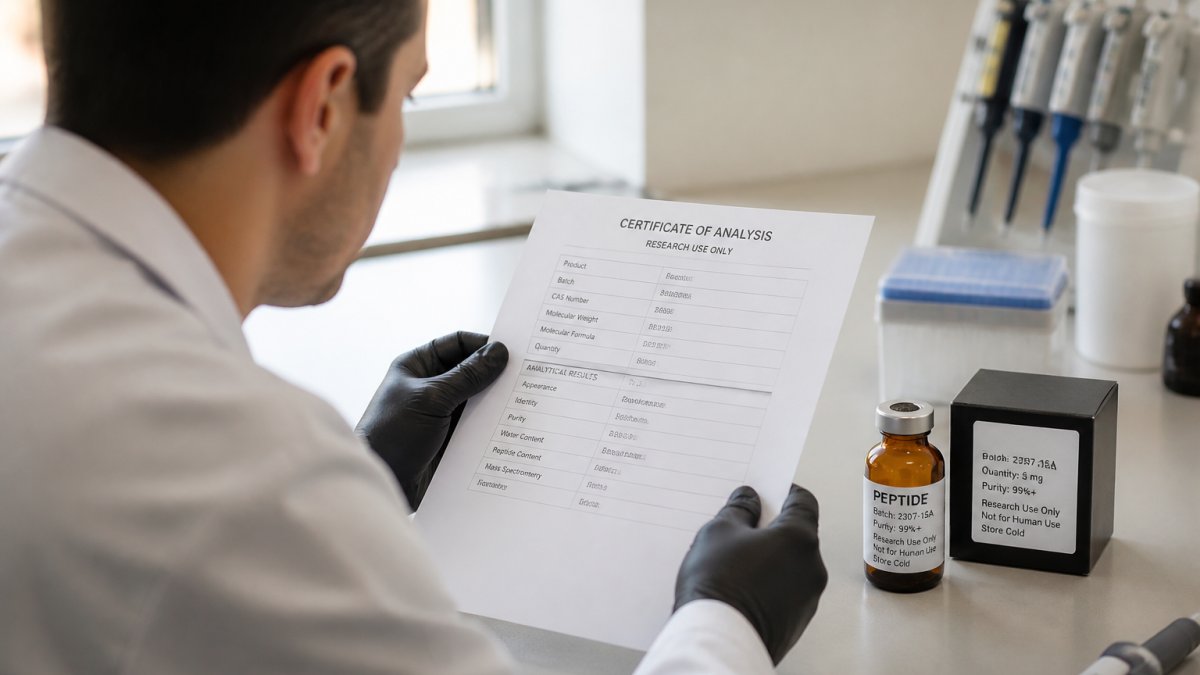
Interpreting a peptide certificate of analysis starts with locating the core identifying information, presented in a consistent format though layouts vary between laboratories.
Locating batch number and lot-specific data
Every peptide certificate of analysis begins with header information uniquely identifying the material. The batch number is your primary reference point, linking the vial in your freezer to the exact analytical results.
Look for these essential fields in the header section:
- Batch or lot number
- Peptide sequence (single-letter or three-letter code)
- Molecular weight (in Daltons)
- Quantity supplied (in milligrams or micrograms)
- Testing date
- Report issue date
- Laboratory name and accreditation status
The batch number must match the label on your vial; if they don't align, contact your supplier immediately, as you may have received the wrong material. OptiPeps includes batch numbers on both the vial label and the accompanying COA.
Understanding purity percentages and impurities
The purity result is the most critical number on a peptide certificate of analysis.
Impurities fall into two categories: related substances (synthesis byproducts such as truncated sequences) and degradation products (formed during storage or handling).
Research-grade peptides typically carry purity specifications of 95% or higher; OptiPeps guarantees 99%+ purity for all batches, verified by HPLC-MS. A lower purity result may still suit your application if the contaminants are inert or negligible.
Peptide HPLC Testing: What the Results Mean
High-performance liquid chromatography (HPLC) is the standard method for peptide purity assessment. A peptide certificate of analysis always includes HPLC results, typically reverse-phase HPLC (RP-HPLC), which separates peptides by hydrophobicity.
Reverse-phase HPLC and chromatogram interpretation
Reverse-phase HPLC passes the sample through a hydrophobic column while the mobile phase's organic content gradually increases, causing peptides to elute at different times depending on hydrophobicity.
On a peptide certificate of analysis, the chromatogram is a line graph with peaks: the largest is typically your target peptide, smaller ones are impurities.
Identify the main peak and note its retention time as your reference for future batches.
Peak area, retention time, and degradation products
Peak area drives the purity calculation: the peptide certificate of analysis divides the area under the target peak by the total area under all peaks, then multiplies by 100.
Retention time depends on the HPLC method (column type, temperature, solvent gradient).
Degradation products appear as smaller peaks earlier or later than the main peak, forming when peptides break down over time, especially if stored improperly (light, heat, humidity).
Mass Spectrometry and Molecular Weight Verification
Mass spectrometry (MS) confirms peptide identity by measuring exact molecular weight. A peptide certificate of analysis with MS data provides definitive proof the material matches the label.
Mass-to-charge ratio and identity confirmation
Mass spectrometry ionises peptide molecules and measures their mass-to-charge ratio (m/z); for a singly charged ion, m/z equals molecular weight in Daltons.
If observed m/z matches theoretical within a small tolerance (typically ±0.1% for high-resolution instruments), identity is confirmed.
OptiPeps employs HPLC-MS verification for all batches: HPLC for purity, MS for identity, ensuring your peptide is both pure and correct. MS data on a COA confirms no substitution or contamination has occurred.
Peptide Certificate of Analysis Example: Reading a Real Report
A step-by-step walkthrough of a realistic (anonymised) peptide certificate of analysis is more useful than abstract description.
Step-by-step walkthrough of a sample COA
Header Section:
- Peptide: MKTAYIAKQRQISFVKSHFSRQLEERLGLIEVQAPILSRVGDGTQDNLSGAEKAVQ
- Sequence Code: Custom Research Peptide (CRP-2026-A)
- Molecular Weight: 6,247 Da (theoretical)
- Batch Number: OPT-20260915-047
- Quantity: 25 mg
- Testing Date: 18 September 2026
- Report Date: 20 September 2026
- Laboratory: Accredited Independent Testing Lab, Melbourne
Purity Result:
- RP-HPLC Purity: 99.2%
- Method: Gradient elution, C18 column, 220 nm detection
Peak Summary:
- Main Peak (Target Peptide): Retention time 18.3 min, Peak area 99.2%
- Impurity 1: Retention time 17.1 min, Peak area 0.5% (truncated sequence, n-1)
- Impurity 2: Retention time 19.8 min, Peak area 0.3% (oxidised methionine)
Mass Spectrometry:
- Observed m/z (M+H)+: 6,248.1
- Theoretical m/z: 6,247.9
- Mass accuracy: 0.03% (within specification)
- Conclusion: Identity confirmed
Storage and Stability:
- Supplied as: Lyophilised powder
- Recommended storage: −20 °C, desiccated
- Expiry recommendation: 24 months from testing date
This COA tells you that batch OPT-20260915-047 is 99.2% pure, contains only minor truncation and oxidation products, and has been confirmed as the correct sequence. You can confidently use this material for your experiment.
Matching batch number to product vial
When your peptide arrives, immediately verify the batch number on the vial label matches the COA. If the quantity and batch numbers align, you have the correct material.
Record the batch number, testing date, and purity percentage in your lab notebook or electronic lab book. This links your experimental data to the analytical verification performed before dispatch, traceability that is invaluable in peer review or regulatory audit.
Peptide COA Template: Essential Elements and Specifications
Not all peptide certificates of analysis follow identical formats, but accredited laboratories include certain mandatory sections. Understanding what a complete COA should contain helps you spot gaps or omissions.
Laboratory name, testing date, and acceptance criteria
The laboratory name and accreditation status appear at the top of the report. Look for certifications such as ISO/IEC 17025 accreditation, which indicates the laboratory meets international standards for analytical competence (Testing & Calibration (ISO / IEC 17025) Accreditation).
The testing date is distinct from the report issue date. Testing date is when the analysis was performed; report issue date is when the results were compiled and released.
Acceptance criteria are the specification limits for each test. For purity, the criterion might be "≥95%". For identity, the criterion might be "observed m/z within ±0.1% of theoretical".
Independent third-party testing and report authenticity
An independent third-party laboratory has no financial interest in the outcome. It tests material supplied by the peptide manufacturer but issues its findings without bias.
Verify authenticity by checking the laboratory's accreditation number and contacting the accrediting body directly if needed.
Be cautious of COAs issued by the supplier itself without independent verification. While in-house testing is faster and cheaper, it carries inherent bias risk.
What a Peptide COA Cannot Tell You
A peptide certificate of analysis provides critical information, but it has boundaries. Understanding what a COA does not cover protects you from misinterpreting results or making unfounded assumptions.
Testing limitations, storage conditions, and sample representativeness
A COA reports conditions at the moment of testing. It does not guarantee that the peptide will remain at that purity level indefinitely.
The COA may include storage recommendations (e.g., "Store at −20 °C, desiccated"), but it cannot verify that you followed those instructions.
Sample representativeness is another limitation. The COA reflects the sample tested by the laboratory.
Testing methods themselves have limits. HPLC detects compounds that absorb UV light at 220 nm.
Verification and Chain of Custody: Building Confidence in Your Supply
Chain of custody begins with the supplier's internal records: when the batch was synthesised, which equipment was used, and how it was stored.
OptiPeps maintains full chain-of-custody documentation for every batch. From independent third-party HPLC-MS testing to Express Post dispatch, each step is recorded.
Request the full chain-of-custody trail if your research requires it. If a supplier cannot or will not document the complete pathway from testing to your bench, reconsider whether their material meets your research standards.
A peptide certificate of analysis is not merely a quality assurance document, it is evidence of rigorous verification and accountability.
Building trust in your peptide supply starts with understanding what you're receiving. A peptide certificate of analysis is your assurance that the material in your vial has been rigorously tested and independently verified. When your research depends on material quality, batch-level transparency and independent third-party testing are not optional, they are essential. Contact OptiPeps today to discuss your peptide requirements.
Frequently Asked Questions
What is a peptide certificate of analysis and why do I need one?
A peptide certificate of analysis is a batch-specific laboratory report documenting the analytical testing results for a particular lot of peptide. It confirms material identity, purity percentage, and the absence of major contaminants or degradation products through methods such as HPLC and mass spectrometry. For research use, a COA provides traceability and quality assurance, essential when publishing results or validating experimental protocols. Independent third-party testing adds credibility for peer review and regulatory compliance.
How do I know if a peptide COA's purity result is reliable?
Check whether the testing was performed by an independent, accredited third-party laboratory rather than the supplier alone. Verify the testing methods used (HPLC-MS is the gold standard for peptides). Confirm the laboratory name, testing date, and batch number are clearly stated. Look for acceptance criteria, the specification the peptide was tested against, and ensure it matches your research requirements. A reliable COA will specify the analytical method, sample preparation, and peak area or mass-to-charge ratio data, not just a purity percentage.
What is the difference between HPLC and mass spectrometry for peptide testing?
HPLC (high-performance liquid chromatography) separates peptide components by chemical properties and measures purity by peak area, showing you what percentage of the sample is the target peptide versus impurities. Mass spectrometry measures the mass-to-charge ratio of molecules, confirming the molecular weight matches the expected peptide sequence and verifying material identity. Together, HPLC-MS provides both purity quantification and identity confirmation, making it the most rigorous approach for research-grade peptides.
How recent should a peptide certificate of analysis be?
A COA should be dated close to the time of dispatch or manufacture, ideally within weeks, not months. Peptides degrade over time, especially if stored improperly, so an old COA may not reflect the current state of the material in your vial. Always check the testing date on the report and cross-reference it with the batch number on your product label. If significant time has passed between testing and receipt, ask your supplier about storage conditions and handling to confirm the peptide remains stable.
Does a high-purity result on a COA prove a peptide is safe for human use?
No. A peptide certificate of analysis confirms purity and identity for research purposes only, it does not establish safety for human administration. Research-grade peptides are intended for in-vitro laboratory use, not clinical or therapeutic applications. Safety assessment requires additional testing such as sterility, endotoxin, and toxicology studies, plus regulatory approval. Always verify the intended use on the COA and your supplier's terms; if human use is planned, you must follow appropriate regulatory pathways in your jurisdiction.
How can I verify that a peptide COA matches the batch I received?
Compare the batch number (or lot number) printed on your peptide vial label with the batch number stated at the top of the certificate of analysis. Confirm the peptide sequence, molecular weight, and any modifications listed on the COA match your order. Check the testing date to ensure the report is recent. If you are working with multiple batches, keep each COA filed with its corresponding vial to maintain traceability. Independent third-party laboratories will include chain-of-custody details confirming sample receipt and handling.
What should I look for in a peptide COA template to ensure it includes all necessary information?
A complete peptide COA template should include: laboratory name and accreditation status, testing date, batch/lot number, peptide sequence and molecular weight, purity percentage and analytical method (e.g., RP-HPLC), mass spectrometry data (mass-to-charge ratio), acceptance criteria and specification, sample preparation details, chromatogram or mass spectrum reference, presence or absence of endotoxins or contaminants, and signature or authentication by the testing laboratory. The report should also state the intended use (research only) and storage recommendations.