Table of Contents
- Why You Cannot Trust a Purity Claim Without Data
- How to Read a Peptide COA: A Step-by-Step Walkthrough
- HPLC Peptide Purity Testing: What the Chromatogram Tells You
- Mass Spectrometry Peptide Identity Testing: Confirming the Sequence
- Peptide Batch Testing: Verifying the Lab and the Report
- What HPLC Purity Does Not Measure
- A Practical Decision Tree for Evaluating Any Peptide COA
- Conclusion: Building a Verification Habit
- Frequently Asked Questions
Last Updated: October 15, 2026
Why You Cannot Trust a Purity Claim Without Data
A purity figure on a label is a claim, not proof.
That gap between claim and proof is where research gets derailed. At OptiPeps, we hold every batch to a 99%+ HPLC-MS verified standard before dispatch, and we publish the CoA so you can check the work yourself.
Most guides stop at "look for the CoA." The hard part is knowing whether the report is real, current, and matched to your lot.
How to Read a Peptide COA: A Step-by-Step Walkthrough
A Certificate of Analysis is a laboratory report showing what was tested, how, and the results for one specific batch. Reading it takes about five minutes once you know the sequence.
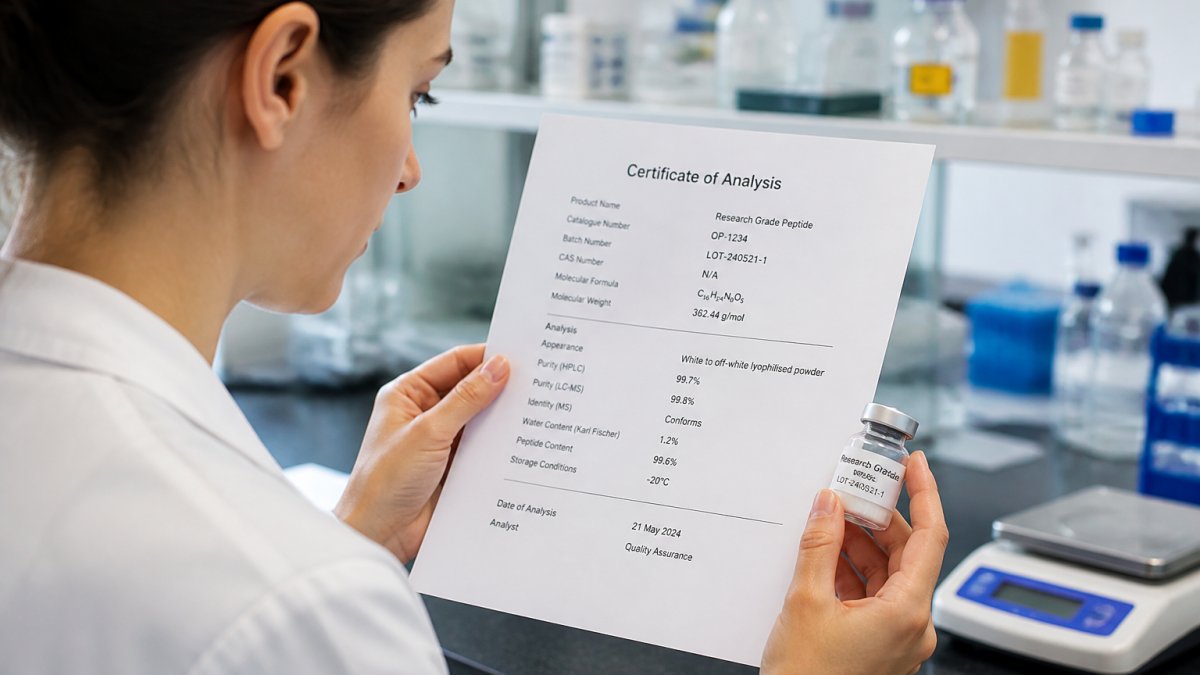
Work through it in this order:
- Match the lot number on the report to the lot number on your vial.
- Confirm the analysis date is recent.
- Check the lab's name, accreditation, and report reference.
- Read the purity method and result.
- Read the identity method and result.
- Check net content and any endotoxin result.
Step 1: Match the Lot Number to Your Vial
The lot number, also called a batch number, ties a report to a physical vial. If the CoA says lot A2409 and your vial says A2411, you are holding the wrong document, and no amount of reading the rest of the report fixes that.
Check the format too. A CoA with no lot number, or one that reads "generic" or "representative batch," tells you the report was not written for your material.
Step 2: Check the Analysis Date and Report Details
An analysis date that is years old says nothing about the vial in front of you. Peptides degrade in storage, so a current report matters more than a perfect old one.
Look for three details on every report:
- The testing laboratory's name and location
- A unique report or verification reference number
- The analysis date, not just the issue date
A report missing any of these is hard to defend in peer review.
HPLC Peptide Purity Testing: What the Chromatogram Tells You
High-performance liquid chromatography (HPLC) separates a sample's components and measures how much is your target peptide. The result is a chromatogram: a graph of peaks, each representing a compound that eluted from the column at a given time.
Most peptide labs use reverse-phase HPLC (RP-HPLC), where the column repels water and attracts non-polar molecules, so peptides separate by hydrophobicity. Your target peptide shows up as the dominant peak; everything else is a related impurity.
Calculating Purity from Peak Area Percentage
Purity compares the target peak's area to the total peak area of all detected peaks:
Purity (%) = (target peak area ÷ total peak area) × 100
A reported purity of 98% means 98% of detected peak area belonged to the target peptide. Peak-area percentage only counts what the detector could see, and a symmetrical peak with a clean baseline is a good sign, while a jagged or split peak suggests co-eluting impurities.
Mass Spectrometry Peptide Identity Testing: Confirming the Sequence
Purity tells you how much. Identity tells you what. Mass spectrometry peptide identity testing measures the mass of the intact molecule and compares it to the mass the sequence should have.
If the two match, your peptide is almost certainly the right compound. If they do not, the material is not what the label claims, however clean the chromatogram looked.
The common method is electrospray ionisation mass spectrometry (ESI-MS), which gives an intact protein mass reading.
Peptide Batch Testing: Verifying the Lab and the Report
Peptide batch testing means every batch is tested, not just a sample from a production run. The verification question is whether the issuing lab is real, independent, and traceable, and whether the document actually came from that lab.
Most guides tell you to 'check the lab is accredited' and stop there. The hard half is confirming the report is genuine, because a PDF is trivial to edit and a seller-controlled copy proves nothing.
The difference between a seller-supplied report and an independently verified one
A seller-supplied CoA is a document the seller chose to give you. An independently verified report is one you confirmed through a channel the seller does not control, worth far more, and the step almost every competing guide skips.
Work through these checks in order:
- Identify the issuing laboratory by its full legal name, not a trading name or a logo. A legitimate report names the entity that performed the analysis.
- Confirm the laboratory exists as a registered business. In Australia, you can search the ABN Lookup register maintained by the Australian Business Register to confirm the entity is real and active. A lab name with no matching registration is a red flag.
- Check for accreditation against a recognised standard. Look for accreditation to ISO/IEC 17025, the international standard for testing and calibration laboratory competence. In Australia, accreditation is granted by the National Association of Testing Authorities (NATA), which publishes its accredited facility listings publicly. If a lab claims accreditation, confirm it appears on the relevant register rather than taking the claim at face value.
- Verify the report reference through an independent channel. Many accredited labs offer a report verification portal, a unique verification code, or a direct contact address on their own domain. Use that channel, not a link or phone number printed on the seller's page, to confirm the reference number exists and matches your batch.
- Contact the laboratory directly using contact details you sourced yourself from the lab's own website or the accreditation register. Ask them to confirm the report reference, the sample description, and the analysis date. A lab that has never heard of the report is the clearest possible signal.
- Confirm the chain of custody if you are sending material out for your own testing. Ask how the sample was received, logged, and stored before analysis.
In-house versus independent third-party testing
In-house results are not worthless, but they are not independent: when the same organisation manufactures, tests, and reports, there is no separation between the party with an interest in the result and the party producing it.
Ask directly: was the analysis performed by the seller's own facility, or by an external accredited laboratory? A credible supplier will answer without hesitation and can point you to the lab.
What to do when a report cannot be verified
Not every unverifiable report is fraudulent, some small labs simply do not run public verification portals. But an unverifiable report is a claim, not evidence. If the seller cannot or will not connect you to the issuing laboratory through an independent channel, treat the purity figure as unconfirmed.
For material that sits anywhere near a regulated pathway, cross-check the framework against the TGA's guidance on therapeutic goods regulation to understand what evidence standard applies to your use case.
What HPLC Purity Does Not Measure
A high HPLC purity number is a narrow, method-dependent measurement, not a statement about safety, identity, or suitability. Understanding its boundaries separates a careful reader from someone who just trusts a percentage.
Purity is method-dependent, not absolute
The same sample can return different purity figures under different HPLC conditions, depending on:
- The column, its stationary phase chemistry, particle size, and dimensions determine how well components separate.
- The mobile phase, the solvent composition and gradient program change retention and resolution.
- The detection wavelength, UV detection at one wavelength may miss impurities that absorb at another. Peptides lacking aromatic residues can be nearly invisible at common wavelengths.
A result reported to two decimal places from a method with wide uncertainty is false precision. Ask for the method's validated uncertainty before treating 99.1% versus 98.7% as meaningful.
A visible impurity peak is not an identified impurity
A chromatogram may show a small secondary peak, but that does not tell you what it is. Distinguish three things:
- Detection, the peak was seen.
- Quantification, its area was measured as a percentage of the total.
- Identification, its chemical structure was confirmed, usually by mass spectrometry or a reference standard.
Most CoAs stop at quantification. An unidentified impurity could be a deletion sequence, truncated fragment, oxidised variant, salt, or residual solvent, each with different implications. A 97% result with one identified impurity is often more informative than a 99% result with no impurity data.
Co-elution can hide impurities
If an impurity elutes at the same time as your target peptide, it merges into the main peak and disappears from the purity calculation. This is co-elution, and it is why a clean, symmetrical peak is reassuring but not conclusive. Orthogonal methods, different column chemistry, a different detection mode, or mass spectrometry, catch what a single HPLC run cannot resolve.
What a purity figure never tells you
Even a well-run HPLC result does not establish:
- Whether the remaining percentage is harmless or harmful
- Whether the sample contains residual solvents, counter-ions, or heavy metals
- Whether the peptide is the correct sequence (that is identity testing, not purity)
Storage, handling, and the shelf life of a result
A purity result describes the material on the day it was tested. Peptides degrade with time, heat, light, moisture, and repeated freeze-thaw cycles, so a report from two years ago may no longer represent the vial in front of you even if the lot number matches. If a batch is old or storage conditions are unknown, request a fresh test or send a sample for independent analysis.
A Practical Decision Tree for Evaluating Any Peptide COA
Use this sequence every time a CoA lands on your desk. If a report fails at any step, query it before using the material.
| Step | Check | If it fails |
|---|---|---|
| 1 | Lot number matches your vial | Request the correct report |
| 2 | Analysis date is recent | Ask for a current test |
| 3 | Lab is named and accredited | Treat result as unverified |
| 4 | HPLC method and chromatogram present | Ask for the raw data |
| 5 | Target peak is dominant and symmetrical | Query the impurity profile |
| 6 | Mass spectrometry confirms identity | Do not use the batch |
| 7 | Net content and endotoxin stated | Request the missing data |
Two extra checks competitors rarely mention: confirm the laboratory report independently where the lab offers a verification portal, and confirm the sample chain of custody if you are sending material out for your own testing.
Conclusion: Building a Verification Habit
Verification is a habit, not a one-off task. Check the lot number, read the chromatogram, confirm the mass, and keep the report with your experimental records.
OptiPeps exists to make that habit easy. Every batch ships with a public Certificate of Analysis, HPLC-MS verified to a 99%+ standard by accredited third-party laboratories, and dispatched same-day from our facility with free Express Post on orders over $100.
Frequently Asked Questions
How can you verify peptide purity?
Start with the Certificate of Analysis. Check that the lot number on the vial matches the report, confirm the analysis date is recent, and review the HPLC chromatogram for a symmetrical dominant peak. Then verify the mass spectrometry data shows the expected molecular mass. Finally, confirm the testing laboratory is independent and accredited. If any of these elements are missing or inconsistent, request a fresh batch report before using the peptide in your experiments.
What does HPLC show on a peptide certificate of analysis?
HPLC, specifically reverse-phase HPLC, separates the peptide sample based on hydrophobicity. The resulting chromatogram shows a target peak representing the full-length peptide, plus any related impurities. Purity is calculated as the target peak area divided by the total peak area, expressed as a percentage. A symmetrical peak with minimal shoulders suggests fewer related impurities. However, HPLC does not confirm the peptide's molecular identity, only its relative abundance in the sample.
Can a certificate of analysis prove a peptide is pure?
No. A COA reports what the testing method detected, but it cannot prove absolute purity. HPLC purity only measures what absorbs at the detection wavelength, typically 214 nm or 220 nm. It misses water content, residual salts, counterions, and any impurities that do not absorb UV light. A reported 99% purity by peak area percentage means 99% of the UV-absorbing material is the target peptide. It does not mean the vial contains 99% peptide by mass.
What are the limitations of HPLC peptide purity testing?
HPLC purity testing cannot identify unknown impurities, detect non-UV-absorbing contaminants, or confirm molecular identity. It also cannot distinguish between the target peptide and a closely related sequence with similar hydrophobicity, such as a deamidated or truncated variant. Method details matter too: different columns, gradients, and wavelengths produce different results. Always pair HPLC data with mass spectrometry for identity confirmation, and request method details if you need to compare results across batches.
The challenge is not finding a supplier who claims purity. It is finding one who shows you the batch data, the method, and the lab behind it. OptiPeps backs every vial with public Certificates of Analysis, independent HPLC-MS verification, and traceable batches held domestically for same-day dispatch. Get started with OptiPeps and verify peptide purity before the vial ever reaches your bench.