Table of Contents
- Peptide Synthesis Quality Control Standards in 2026
- Peptide Purity Testing: Methods That Decide Your Results
- Peptide Mass Spectrometry: Confirming Identity, Not Just Purity
- How to Read a Peptide Certificate of Analysis
- Impurity Profiling and the Thresholds That Matter
- Peptide Stability and Storage: Protecting Purity After Dispatch
- Building a Batch-Release Workflow for Your Lab
- Conclusion: Standards Are Only as Good as the Paper Trail
- Frequently Asked Questions
Last Updated: October 13, 2026
Peptide Synthesis Quality Control Standards in 2026
Peptide synthesis quality control standards in 2026 rest on four pillars: documented purity, confirmed identity, a controlled impurity profile, and a batch record that survives audit.
The failure mode is rarely a bad molecule, it is a missing document.
Below: what regulators expect, how each method earns its place, and how to build a batch-release workflow that holds up to review.
What Regulators Actually Require for Research-Grade Peptides
Regulatory frameworks distinguish research-use peptides from therapeutic ones, and the documentation burden scales accordingly.
The internationally recognised baseline comes from ICH Q7 Good Manufacturing Practice Guide for Active Pharmaceutical Ingredients, which sets expectations for starting materials, process controls, and batch documentation.
For research-grade supply, most laboratories apply GMP-aligned principles rather than full GMP certification, a distinction worth understanding before accepting a supplier's claims.
| Requirement | Research-Grade Expectation | Therapeutic-Grade Expectation |
|---|---|---|
| Identity confirmation | Mass spectrometry | Mass spectrometry plus full structural characterisation |
| Purity measurement | HPLC with defined method | Validated HPLC with system suitability |
| Impurity profile | Reported against threshold | Full qualification of specified impurities |
| Batch documentation | COA per batch | Complete batch record with audit trail |
| Supplier qualification | Documented assessment | Formal audit programme |
Why 2026 Changed the Bar for Batch Documentation
Documentation expectations have tightened, driven less by new legislation than by demands for reproducibility and data integrity. Reviewers and auditors now want raw analytical data, not a summary sheet: a COA stating "purity: 98%" without method parameters, column details, or a chromatogram is increasingly treated as unverifiable.
The burden has shifted from supplier to buyer: if your institution is audited, you must demonstrate your starting materials were fit for purpose. Supplier qualification is now your responsibility, not a formality.
Peptide Purity Testing: Methods That Decide Your Results
Peptide purity testing quantifies how much of your sample is the intended sequence versus related impurities, and reversed-phase HPLC remains the primary method. The number on the COA means little without the method behind it.
HPLC: The Primary Purity Measurement
Reversed-phase HPLC separates peptides by hydrophobicity, showing the target peak alongside impurity peaks. Three parameters determine whether the result is meaningful:
- Column and mobile phase: different gradients resolve different impurities
- Detection wavelength: typically 214 nm for the peptide backbone
- Integration method: how peaks are defined and summed
Change any one and the purity figure moves, which is why method disclosure matters.
Acceptance Criteria by Research Application
A 95% pure peptide is fine for some work and disqualifying for others; the threshold should follow the application, not a marketing number.
| Application | Typical Purity Threshold | Notes |
|---|---|---|
| Screening assays | 90-95% | Impurities rarely affect gross readouts |
| Binding studies | 95-98% | Impurity peaks can interfere with kinetics |
| Structural work | 98%+ | Requires clean spectra and clean data |
| Reference standards | 98%+ with full characterisation | Used to calibrate other measurements |
Peptide Mass Spectrometry: Confirming Identity, Not Just Purity
Mass spectrometry answers a different question to HPLC: purity tells you how much of your sample is one thing, mass spectrometry tells you what that thing is.
For synthetic peptides, electrospray ionisation coupled to a mass analyser gives the molecular ion, compared against the calculated mass for your sequence.
That is why HPLC-MS is treated as a single verification step: purity without identity is a clean sample of the wrong molecule.
How to Read a Peptide Certificate of Analysis
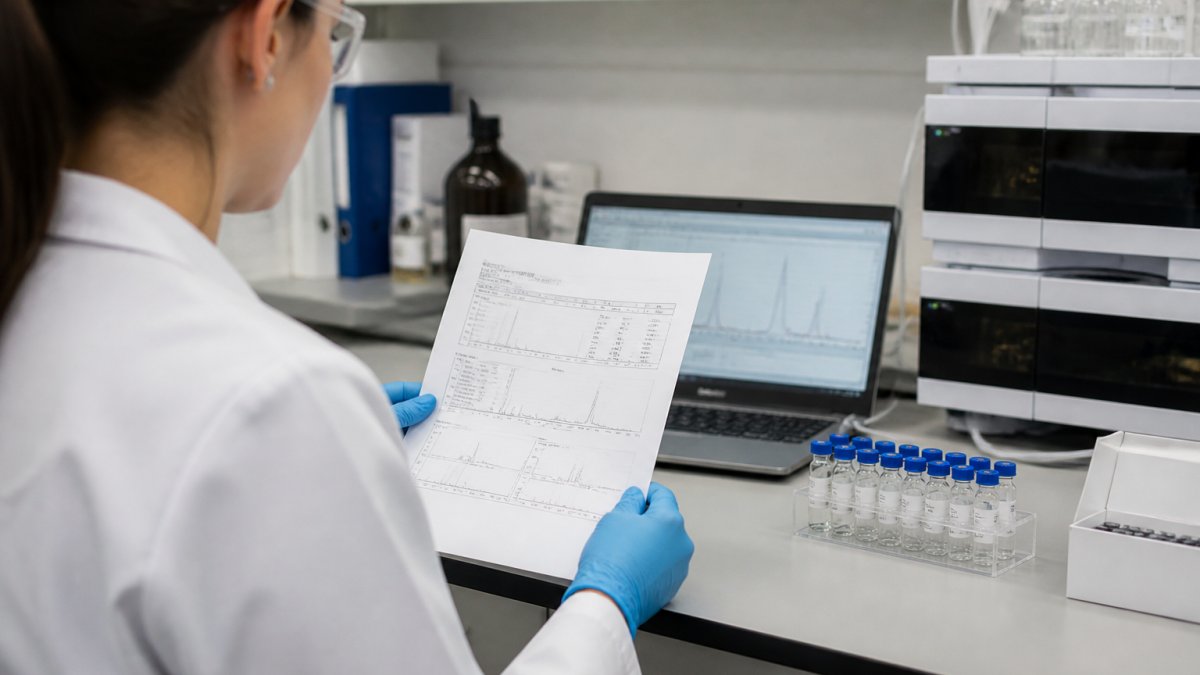
A Certificate of Analysis is only as useful as the information it contains. Read it the way an auditor would: field by field, checking that each claim traces to a measurement and every identifier reconciles across the document, the vial, and your records.
Field-by-Field Interpretation
| COA Field | What It Should State | How to Verify It |
|---|---|---|
| Batch or lot number | A unique identifier for the manufactured lot | Must match the vial label and your purchase order exactly; a mismatch invalidates the link between document and material |
| Peptide sequence | Full sequence including modifications and stereochemistry | Compare against your intended sequence; check that non-standard residues are named, not abbreviated ambiguously |
| Molecular weight | Calculated and observed values | Recalculate the expected monoisotopic or average mass from the sequence and confirm the observed value falls within the stated tolerance |
| Purity | A measured percentage with method context | Confirm the method (column, gradient, wavelength) is disclosed; a figure without method parameters is not verifiable |
| Chromatogram | Image with retention time and peak integration | Check axis labels, baseline, and that the reported purity matches the summed peak areas |
| Mass spectrum | Ion assignment and observed mass | Verify the charge state and that the assigned ion corresponds to the expected mass |
| Appearance and solubility | Physical description and recommended solvent | Cross-check against the vial contents and your intended reconstitution solvent |
| Testing laboratory | Name and location of the testing facility | Distinguish in-house testing from independent verification; the latter carries more weight in an audit |
| Date of analysis | The date testing was performed | Confirm it post-dates manufacture and precedes dispatch |
| Reference standard | Identity of the standard used for calibration | Where disclosed, verify it is a recognised standard and that its traceability is documented |
Reconciling the COA Against the Vial and Your Records
A COA is one leg of a three-legged stool; the other two are the physical vial and your receiving records. Before accepting a batch:
- Match identifiers. The batch number on the COA, the vial label, and the packing slip must agree. Any discrepancy is a hold, not a note.
- Check quantities. The stated fill mass or volume should match what you weighed or measured on receipt, within reasonable tolerance for handling.
- Confirm storage conditions. The COA's storage recommendation should match how the shipment was packed and how you will store it.
- File the raw data. If the supplier provides chromatograms and spectra, retain them alongside the COA; a summary sheet alone is weaker evidence than the underlying data.
Red Flags in Supplier Documentation
Documentation problems cluster: a supplier loose on one field is usually loose on others.
- Purity stated as a range rather than a measured value
- No chromatogram, or a chromatogram with no axis labels
- In-house testing presented as independent verification
Verifying the Reference Standard
Where a COA names the reference standard used for calibration, that standard anchors every quantitative claim on the document; a purity figure is only as trustworthy as the standard it was measured against. Check whether it is traceable to a recognised source, whether its own certificate is available, and whether it was within expiry at time of use.
Impurity Profiling and the Thresholds That Matter
Impurity profiling identifies and quantifies everything in the sample that is not the target peptide, and it is the COA section most often reduced to a single line.
Reporting thresholds vary, but the principle is consistent: impurities above a defined level should be identified, not just counted.
Risk assessment is application-specific: an oxidation product inert in a screening assay may be a serious problem in a receptor binding study.
Peptide Stability and Storage: Protecting Purity After Dispatch
Peptide stability and storage determine whether the purity you paid for survives the journey to your bench: a peptide released at 99% can arrive at 90% if mishandled in transit or stored incorrectly. Lyophilised peptides are generally more stable than solutions, and most sequences tolerate -20°C storage for extended periods when kept dry and protected from light.
A few practical rules we apply and recommend:
- Aliquot before freezing to avoid repeated freeze-thaw cycles
- Reconstitute with the solvent specified on the COA, not water by default
- For solution storage, keep at -80°C where the sequence allows
Purity is a measurement at a point in time, not a permanent property. The COA describes the batch at release; your handling determines what it looks like when you use it.
Building a Batch-Release Workflow for Your Lab
A batch-release workflow turns a stack of documents into a repeatable decision: nothing enters your freezer without a documented reason to trust it. What most guides omit is the sampling logic, in-process checkpoints, and controls that make the decision defensible under outside review.
Sampling and Testing at Each Stage
Quality control is not a single end-of-line test but a sequence of checks from receipt to release. A practical sampling plan covers three stages:
| Stage | What Is Sampled | What Is Checked | Why It Matters |
|---|---|---|---|
| Incoming materials | Each lot of peptide on receipt | Identity, appearance, fill quantity, COA reconciliation | Catches transit damage, mislabelling, and documentation gaps before the material is logged |
| In-process | Where you handle or aliquot material | Label accuracy, storage conditions, contamination control | Prevents mix-ups and degradation during internal handling |
| Final release | The batch as it will be used | Analytical data review, acceptance criteria, record completeness | Confirms the batch meets your specification before it is available for use |
For most research laboratories, incoming and final release checks are the minimum; in-process checks matter when material is subdivided, reconstituted, or stored long-term.
A Stepwise Release Workflow
- Qualify the supplier before the first order, recording what evidence they provided and how it was assessed.
- Receive and inspect the shipment, checking vial labels against the COA batch number and noting any discrepancy.
- Review the analytical data for identity, purity, and impurity profile, confirming that method parameters are disclosed.
- Verify the reference standard used for calibration, where disclosed, and note any gaps.
- Log the batch in your inventory system with the COA and any raw data attached.
- Apply your acceptance criteria, not the supplier's, and record the decision, including the rationale.
- Release or quarantine the batch; quarantined material must be physically segregated and clearly labelled.
- Retain records for the period your institution or funder requires, and ensure they are retrievable.
The last three steps are where laboratories cut corners most often, and what auditors ask about first.
Out-of-Specification and Deviation Handling
An out-of-specification (OOS) result is not a reason to discard the batch; it triggers a documented investigation. Treating an OOS result as a one-off leaves the underlying cause unaddressed. A defensible approach:
- Confirm the result by re-testing, where sufficient sample exists, using the same method and a fresh preparation.
- Investigate the cause, was it the sample, the method, the instrument, or the operator?
- Document the conclusion and the action taken, whether that is rejection, re-test, or acceptance with justification.
Data Integrity and Laboratory Controls
Records are only useful if attributable, legible, contemporaneous, original, and accurate. In practice:
- Audit trails on any electronic system used to record analytical data, with user identification and timestamps.
- Instrument logs showing calibration, maintenance, and any out-of-service periods.
- Controlled access to records, so entries cannot be altered without a trace.
A batch-release decision is only as strong as the record behind it. Sampling, in-process checks, OOS handling, and data-integrity controls are what turn a stack of documents into evidence an auditor can follow.
Conclusion: Standards Are Only as Good as the Paper Trail
The analytical methods in peptide quality control are well established. What separates a reliable supply chain from a fragile one is documentation that holds up under outside examination: chromatograms, mass spectra, reference standards, and batch records connecting every claim to a measurement.
At OptiPeps, we build that trail into every order. Each batch is HPLC-MS verified to a 99%+ purity standard, with public Certificates of Analysis and independent third-party testing behind the results.
Get started with OptiPeps and give your research a supply chain you can cite.
Frequently Asked Questions
What quality control tests are used for synthetic peptides?
Research-grade peptides typically go through high-performance liquid chromatography (HPLC) to measure purity, mass spectrometry to confirm molecular identity, and sometimes amino acid analysis or sequencing for sequence verification. Each test targets a different failure mode: HPLC catches truncated or deletion sequences, mass spectrometry catches wrong-sequence or modified products, and amino acid analysis confirms composition. A defensible peptide quality control program runs at least HPLC and mass spectrometry on every batch before release.
How is peptide purity measured by HPLC?
HPLC separates peptides in a sample based on how they interact with a stationary phase versus a mobile phase. The main peptide peak is measured as a percentage of total peak area, giving a purity figure. A 99%+ result means the target peptide accounts for 99% or more of the UV-absorbing material detected. The method, wavelength, and column conditions should be stated on the certificate of analysis so you can judge whether the measurement is comparable to your own in-house checks.
What does mass spectrometry confirm in peptide quality control?
Mass spectrometry confirms that the peptide's molecular weight matches the expected sequence. If the observed mass differs from the theoretical mass, the product may be truncated, modified, or the wrong sequence entirely. HPLC alone cannot catch this because a wrong-sequence peptide can still elute as a single clean peak. Running both HPLC and mass spectrometry together is the standard way to verify that a batch is both pure and correctly identified before use in sensitive in-vitro work.
What should a peptide certificate of analysis include?
A usable certificate of analysis names the peptide sequence, batch or lot number, molecular weight, purity result with the method used, appearance, and storage recommendations. It should also state the analytical method (typically HPLC and mass spectrometry), the testing laboratory, and the date of analysis. For peer-reviewed work, a certificate from an accredited third-party laboratory carries more weight than an in-house result, because it gives reviewers an independent verification trail rather than a supplier's own claim.
What purity level is acceptable for research-grade peptides?
Most in-vitro research uses peptides at 95% purity or above, with 98%+ preferred for cell-based assays, receptor binding studies, and anything where a minor contaminant could skew results. For routine screening or non-quantitative work, 95% is often sufficient. Higher purity costs more, so the decision should match the sensitivity of the assay. If your results depend on a precise dose-response curve, paying for 99%+ purity is usually cheaper than repeating an experiment.
Which impurities should be checked in synthetic peptides?
The main impurity classes are deletion sequences (missing one or more residues), truncated sequences from incomplete coupling, modified residues from side reactions, and residual solvents or counterions from purification. Deletion and truncation products are the most common and the most likely to interfere with biological assays because they can bind the same targets as the full-length peptide. HPLC impurity profiles and mass spectrometry together identify these, while the certificate of analysis should state the total impurity percentage and any single impurity above a stated threshold.
Do peptide quality control requirements differ for research use and therapeutic use?
Yes, substantially. Therapeutic peptides must meet Good Manufacturing Practice (GMP) requirements, which cover facility design, process validation, documentation, and batch release by a qualified person. Research-grade peptides are not held to that standard, but reputable suppliers still run HPLC and mass spectrometry and provide a certificate of analysis per batch. The practical difference for a research lab is that you cannot assume GMP-level controls on a research-grade product, so you should verify the testing data yourself before relying on a batch for published work.