Last Updated: November 16, 2026
Quick Summary
Reliable peptide sequence selection starts with defining the research objective in one sentence, then testing every candidate sequence against it before ordering. Map three to five candidate regions from the target protein, choose a homologous or unique specificity strategy, and screen each candidate for length, composition and solubility risks before synthesis.
- The practical peptide length range for most research applications falls between ten and twenty amino acids.
- Choose homologous sequences for family-wide recognition and unique sequences when cross-reactivity would invalidate the assay.
- Treat a candidate as target-specific when its best non-target hit falls below roughly 50 to 60 percent identity.
- A GRAVY score above roughly +0.5 signals a hydrophobic peptide likely to need a non-aqueous solvent.
- A certificate of analysis should report HPLC purity, mass spectrometry confirmation and a batch identifier.
Table of Contents
- Start With the Research Objective, Not the Sequence
- Research Peptides vs Therapeutic Peptides: Why the Selection Rules Differ
- Read the Target Protein and Map Candidate Peptide Regions
- Homologous or Unique Sequence: Choosing Your Specificity Strategy
- Peptide Sequence Length Considerations and Boundary Setting
- Amino-Acid Composition, Problem Residues and Peptide Solubility Prediction Tools
- HPLC-MS Verification for Peptides: What Your Certificate of Analysis Must Show
- Ordering Verified Research Peptides for Your Next Assay
- Frequently Asked Questions
Start With the Research Objective, Not the Sequence
Most failed assays trace back to a decision made before a single vial was ordered: the sequence was chosen to look impressive rather than to answer a specific question. Research peptide sequence selection guide work begins with the research objective, not the sequence itself. A peptide that is technically valid can still be mismatched to its assay, and that mismatch is one of the most common causes of wasted orders. Before opening any design tool, define what the peptide must do: bind an antibody, act as a substrate, mimic a protein region, or serve as a control. That single answer dictates length, homology, and purity requirements. Write the objective in one sentence, then test every candidate sequence against it.
Research Peptides vs Therapeutic Peptides: Why the Selection Rules Differ
The distinction between research peptides and therapeutic peptides is not semantic; it changes which selection criteria apply. Therapeutic peptide development carries regulatory obligations around safety, stability, and manufacturing consistency that simply do not apply to in-vitro work. Research peptides are selected for experimental performance: target recognition, solubility in assay buffer, and traceable purity. A sequence that would be rejected in a therapeutic program for poor plasma stability may be perfectly adequate for a cell-culture assay run over six hours. This is where many newcomers over-engineer. They apply therapeutic-grade selection criteria to a basic binding study and spend months on optimisation the assay never needed. Match the rigour to the application. If the peptide never enters a living system, stability in serum is irrelevant; if it does, the calculation changes entirely.
Read the Target Protein and Map Candidate Peptide Regions
Candidate regions come from the target protein, not from imagination. Pull the full protein sequence from a reference database, then identify surface-exposed, hydrophilic stretches likely to be accessible to antibodies or binding partners. Transmembrane domains and buried hydrophobic cores rarely make good candidates because they are inaccessible in the folded protein.
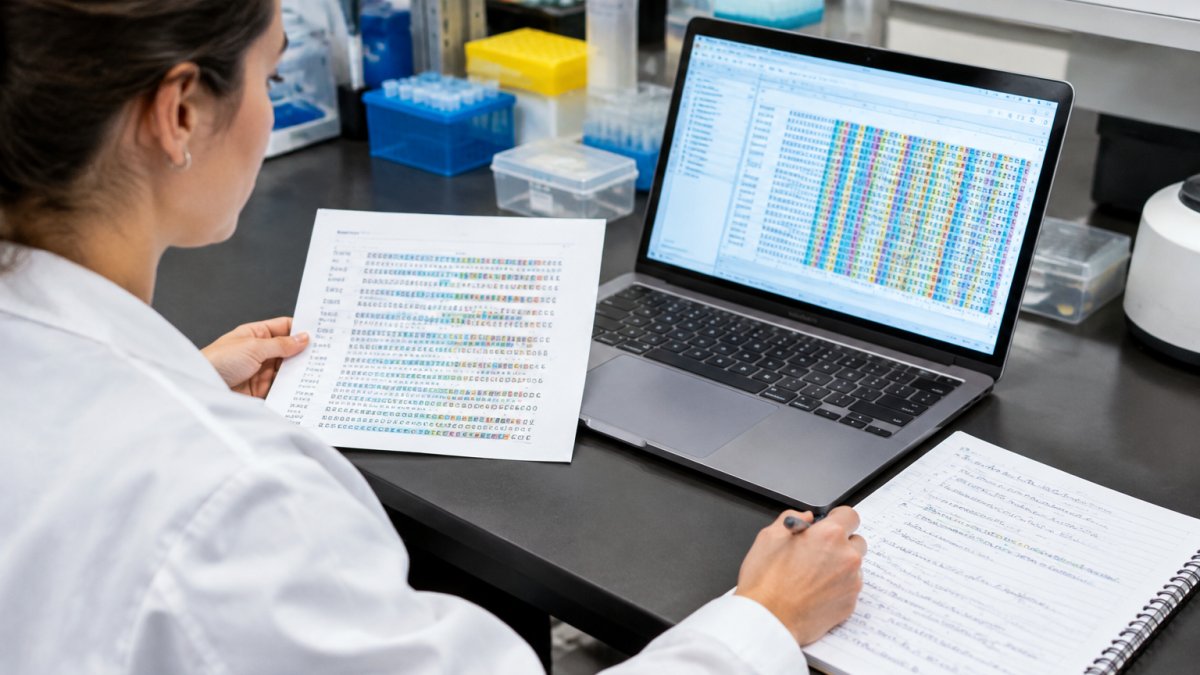
A common mistake is selecting a region because it looks distinctive on paper without checking whether it is exposed in the native structure. Cross-reference the linear sequence against structural data where available. The UniProt protein sequence database remains the standard starting point for retrieving and annotating target protein sequences. Map three to five candidate regions rather than committing to one; the comparison often reveals which region is genuinely accessible.
Homologous or Unique Sequence: Choosing Your Specificity Strategy
Specificity strategy is the decision most guides gloss over, and it is where a transparent decision framework pays for itself. A homologous sequence shares similarity with related proteins and is useful when you want broad recognition across a protein family. A unique sequence is found only in your target and is essential when cross-reactivity would invalidate the assay.
Start with a single question: what would a false positive cost? If cross-reactivity with a paralogue or a contaminant would produce an uninterpretable result, uniqueness is non-negotiable and the workflow below applies.
The verification workflow for a unique sequence has four steps. First, align the candidate against the relevant proteome using a local alignment tool such as BLAST or a Smith-Waterman implementation, and record the top hits and their identity scores. Second, set an explicit threshold for what counts as unique, most practitioners treat a candidate as target-specific when its best non-target hit falls below roughly 50-60% identity over the full peptide length, though the acceptable figure depends on the assay. Third, check the alignment against the proteins actually present in your experimental system, not just the reference database: a sequence unique across the whole proteome may still cross-react with a contaminant in your specific matrix, a cell line, or a sample type. Fourth, document the alignment output and the threshold alongside the sequence so the decision is reproducible.
A worked comparison makes the framework concrete. Suppose three candidate regions from a target protein are under consideration. Candidate A is a conserved stretch with 85% identity to a close paralogue, a good homologous choice for family-wide work, but a poor unique choice. Candidate B is a surface-exposed loop with a best non-target hit at 40% identity and a GRAVY score near zero, a strong unique candidate on both specificity and solubility grounds.
| Selection Criterion | Homologous Sequence | Unique Sequence |
|---|---|---|
| Primary use | Family-wide recognition | Target-specific detection |
| Cross-reactivity risk | Higher, often intended | Must be minimised |
| Best for | Conserved-function studies | Discriminating similar targets |
| Verification step | Family alignment | Proteome-wide alignment plus matrix check |
| Decision threshold | Conservation across target family | Best non-target hit below ~50-60% identity |
Watch out: uniqueness is relative to the sample, not the species, so an alignment against a reference database alone can miss cross-reactivity with a matrix component, always run the check against the proteins actually present in your system.
Peptide Sequence Length Considerations and Boundary Setting
Peptide sequence length considerations sit at the centre of reliable design. Short peptides of eight to twelve residues are cheaper and easier to synthesise but may lack sufficient epitope complexity for antibody recognition. Longer sequences of fifteen to twenty residues offer more binding surface but raise synthesis difficulty and cost. The practical range for most research applications falls between ten and twenty amino acids. Boundary setting matters as much as length: a candidate that cuts through a secondary structure element is less likely to represent the native conformation. Extend boundaries to natural structural breaks where possible. If you are coming from a background of ordering fixed catalogue peptides, expect custom design to demand more upfront decisions about where a sequence starts and ends.
Amino-Acid Composition, Problem Residues and Peptide Solubility Prediction Tools
Amino-acid composition determines whether a peptide behaves in your assay buffer, and it is the part of sequence selection most often done by eye when it should be done systematically. The practical approach is to screen every candidate against a short list of composition risks before committing to synthesis, because a sequence that aggregates or fails to dissolve will invalidate an assay regardless of how well it binds.
The residues that cause the most trouble fall into recognisable groups. Runs of hydrophobic residues, leucine, isoleucine, valine, phenylalanine, methionine, tryptophan and tyrosine, drive aggregation and poor aqueous solubility, and the risk rises sharply when they cluster rather than distribute across the sequence.
Solubility prediction is where composition screening becomes actionable. Several computational tools estimate hydrophobicity and solubility from sequence alone, and the most widely used is the GRAVY (grand average of hydropathy) score, which averages residue hydropathy values across the sequence.
A reproducible in-silico screening workflow makes this repeatable rather than intuitive. First, retrieve the candidate region and record its composition. Second, calculate GRAVY, net charge at assay pH, and the count of cysteine, methionine, and glutamine/asparagine residues. Third, flag any candidate with a hydrophobic run of four or more consecutive residues, two or more free cysteines, or a GRAVY score above +0.5. Fourth, rank the remaining candidates by how well their composition matches the assay buffer, a high-salt buffer tolerates more charge, a reducing environment tolerates more cysteine. Fifth, document the criteria and scores alongside the sequence so the decision is traceable if the assay fails.
Watch out: a peptide that looks clean on paper can still aggregate at working concentration, so pilot a small-scale dissolution test in the intended buffer before committing to a full batch. For a deeper look at verifying what arrives in the vial, see our guide to verifying peptide purity.
HPLC-MS Verification for Peptides: What Your Certificate of Analysis Must Show
HPLC-MS verification for peptides is the only reliable evidence that the sequence you designed is the sequence you received. A certificate of analysis should report high-performance liquid chromatography purity, mass spectrometry confirmation of molecular weight, and the batch identifier linking the vial to its test record. The mass spectrometry result is what confirms sequence identity: a purity figure alone tells you the sample is clean, not that it is the right compound. Demand batch-level traceability rather than a generic specification sheet. For a full breakdown of reading these documents, our guide to interpreting a certificate of analysis walks through each field, and the HPLC-MS testing guide for research peptides explains the methodology behind the numbers.
Ordering Verified Research Peptides for Your Next Assay
Ordering is the final checkpoint, and it is where procurement quality determines whether your design work survives contact with reality. Verify that the supplier provides independent third-party testing rather than in-house results alone, that certificates are batch-specific, and that dispatch is domestic enough to avoid customs delays that can degrade temperature-sensitive compounds. At OptiPeps, every vial is HPLC-MS verified to a 99%+ purity standard before dispatch from our Melbourne facility, with public certificates of analysis and same-day dispatch. Before you order, run through our checklist of purity checks when sourcing laboratory peptides and the five questions to ask before ordering research peptides.
Sequence selection rewards discipline over cleverness. The labs that get reliable results are the ones that define the objective first, map candidates against real structural data, and refuse to accept a certificate of analysis that does not confirm sequence identity. If your next assay depends on getting that right, OptiPeps supplies HPLC-MS verified research peptides with batch-level transparency, third-party testing, and same-day dispatch from a Melbourne facility. Get started with OptiPeps and put verified, traceable compounds behind your next experiment.
Frequently Asked Questions
What factors influence peptide sequence selection for in-vitro studies?
Five factors drive the decision: the research objective, the region of the target protein you need to interrogate, whether you want a homologous or unique sequence, the length and boundaries of the peptide, and the amino-acid composition. Composition matters because hydrophobic stretches raise aggregation risk while charged residues improve aqueous solubility. Each factor trades against the others, so document your reasoning before you order. A written selection rationale also makes it easier to defend the choice during peer review.
How do I ensure solubility when selecting a peptide sequence?
Count the hydrophobic residues first. A sequence with more than about 50% hydrophobic content, or a run of five or more consecutive hydrophobic residues, is likely to aggregate in aqueous buffer. Use peptide solubility prediction tools to screen candidates before synthesis, then confirm empirically by dissolving a small aliquot in your intended buffer. Keep a charged residue near each terminus where the sequence allows it. If the peptide is still poorly soluble, consider a shorter sequence or a different region of the target protein.
Why is HPLC-MS verification critical for research peptides?
HPLC-MS verification confirms two things at once: HPLC shows the purity percentage of the main peak, and mass spectrometry confirms the peptide has the expected molecular weight. Without both, a vial could pass a purity check while containing a truncated or modified sequence. For reproducibility, ask for a batch-specific certificate of analysis from an independent third-party laboratory, not an in-house result. OptiPeps publishes batch-level certificates and holds every vial to a 99%+ HPLC-MS verified purity standard before dispatch.
What are the common pitfalls in peptide sequence design?
The recurring mistakes are predictable. Researchers pick a region without checking whether it is surface-exposed on the native protein, ignore cross-reactivity against homologous proteins, and choose a length that is too short to form a stable epitope or too long to synthesise cleanly. N-terminal glutamine cyclising to pyroglutamate and cysteine oxidation are two composition issues that catch people out. Run a sequence alignment and a solubility screen before committing to synthesis, and keep a record of rejected candidates so the next project starts faster.