Table of Contents
- Why Peptide Purity Standards Decide Whether Your In Vitro Data Holds Up
- What Peptide Purity Actually Means and How Percentages Are Calculated
- HPLC Peptide Purity Analysis: Reading Chromatograms and Peak Areas
- Mass Spectrometry Peptide Verification: Confirming Identity, Not Just Cleanliness
- What a Peptide Certificate of Analysis Should Contain
- Research Peptide Purity Levels Mapped to In Vitro Assay Types
- Impurities, Endotoxin and Bioburden: The Risks a Purity Number Hides
- A Practical Acceptance and Rejection Workflow for Incoming Batches
- Frequently Asked Questions
Last Updated: October 21, 2026
Why Peptide Purity Standards Decide Whether Your In Vitro Data Holds Up
Peptide purity standards for in vitro work are the acceptance criteria a laboratory applies before a lyophilised peptide enters a cell culture or biochemical assay, and they determine whether the resulting data can be defended. At OptiPeps, we supply research-grade compounds where every vial is HPLC-MS verified against a 99%+ specification before dispatch. A purity figure is not a marketing badge; it is a measurement with a method, a detection wavelength and a limit of quantification behind it. When those are missing, a clean-looking certificate proves very little.
The stakes are practical. A peptide that is 85% pure by peak area may still contain truncated sequences that behave as partial agonists, or residual trifluoroacetate that shifts pH in a low-volume well. Below, we show how to read the numbers, what to demand from a certificate of analysis, and how to build a batch acceptance workflow your reviewers will accept.
What Peptide Purity Actually Means and How Percentages Are Calculated
Peptide purity is the proportion of the total UV-absorbing material in a sample that corresponds to the target sequence, expressed as a percentage of chromatographic peak area. It is a relative measure, not an absolute mass fraction.
That distinction matters. Peak-area purity is calculated by integrating the chromatogram at 214 nm and dividing the target peak's area by the sum of all integrated peaks. Two consequences follow: non-UV-absorbing contaminants are invisible to the method, and co-eluting impurities are counted as product. A supplier reporting "99% purity" without stating the method, wavelength and integration threshold has told you almost nothing.
HPLC Peptide Purity Analysis: Reading Chromatograms and Peak Areas
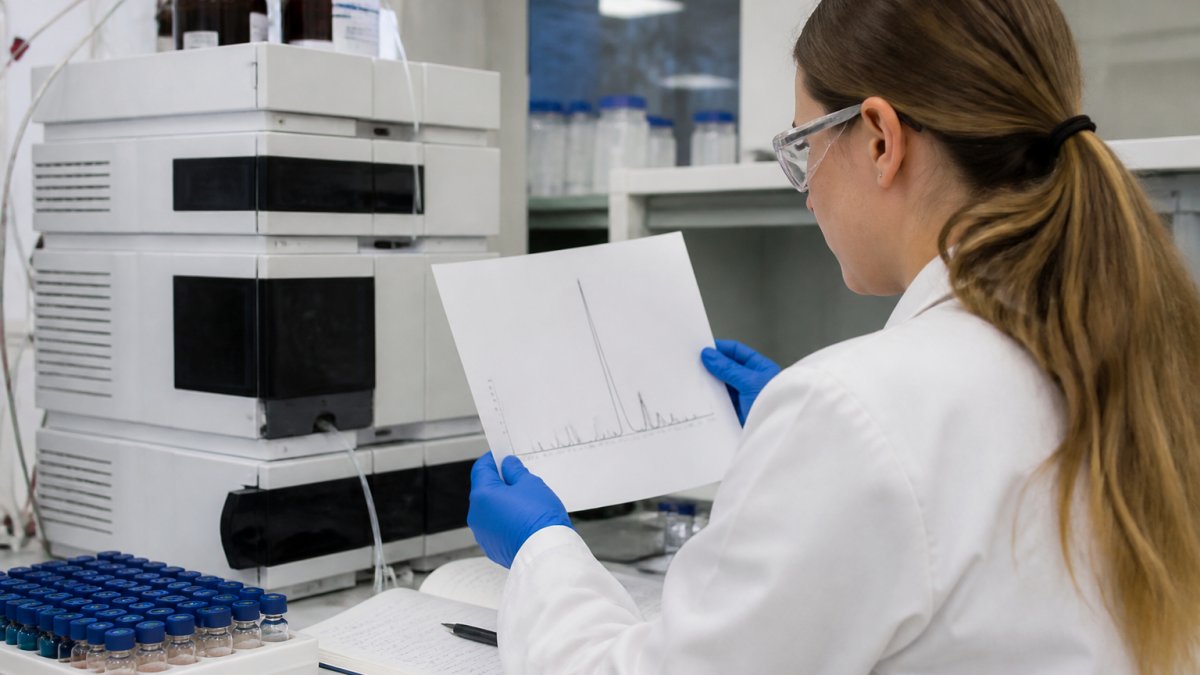
Reversed-phase HPLC with UV detection at 214 nm is the standard method for peptide purity analysis because the amide backbone absorbs strongly at that wavelength. The chromatogram you receive should show retention time, peak height, peak area percentage and the integration baseline.
Read it in this order: check the main peak's symmetry, then scan for shoulders and small peaks eluting close to the target, then confirm the reported percentage matches the areas shown. A shoulder on the leading edge usually signals a closely related deletion sequence. Baseline noise that has been integrated as peaks inflates the impurity total; a baseline that has been manually flattened hides it. Ask for the raw data file, not just the rendered image.
Mass Spectrometry Peptide Verification: Confirming Identity, Not Just Cleanliness
Mass spectrometry peptide verification answers a different question from HPLC: it confirms the observed molecular mass matches the theoretical mass of the intended sequence. A sample can be chromatographically clean and still be the wrong peptide.
Electrospray ionisation in positive mode typically returns multiply charged ions; the supplier deconvolutes these to a single mass. Compare that value against the calculated monoisotopic mass for your sequence, allowing for the counterion form. A match within a tight tolerance confirms identity. A mismatch of even a few daltons indicates a deletion, an incomplete deprotection or an oxidised residue. HPLC tells you how much; mass spectrometry tells you what.
What a Peptide Certificate of Analysis Should Contain
A peptide certificate of analysis should be lot-specific, not a generic template. The document must tie a batch number to the actual tests run on that batch, and it should include the following as a minimum.
- Batch or lot number matching the vial label
- Amino acid sequence and calculated molecular mass
- HPLC method, column, gradient and detection wavelength
- Chromatogram image with retention time and peak area percentage
- Mass spectrometry spectrum and deconvoluted observed mass
- Appearance, water content and counterion form
- Storage and reconstitution guidance
- Testing laboratory name and date of analysis
Research Peptide Purity Levels Mapped to In Vitro Assay Types
Research peptide purity levels should be matched to the sensitivity of the assay, not chosen by habit.
| Assay type | Suggested minimum purity | Mechanism behind the threshold |
|---|---|---|
| ELISA and immunoassays | 95% | Truncated sequences can cross-react with capture or detection antibodies, shifting the standard curve and inflating apparent concentration |
| Receptor binding studies | 95% | Impurities may act as partial agonists or antagonists, flattening the dose-response curve and biasing Kd estimates |
| Cell-based assays | 98% | Residual solvents, counterions and endotoxin affect viability and can confound viability-normalised readouts |
| Enzymatic kinetics | 98% | Contaminating sequences can act as alternate substrates or inhibitors, distorting Km and Vmax |
| Structural work (NMR, CD) | 98%+ | Minor species contribute their own spectra and obscure the signal of interest |
| Reference standard preparation | 99%+ | The assigned value depends on the purity of the material it is assigned from |
Why the threshold moves with concentration. A 1% impurity in a 10 µM well is a 100 nM contaminant. If that contaminant binds the same receptor with modest affinity, it is no longer negligible.
Why the readout matters. A colorimetric viability assay integrates over the whole well and is relatively tolerant of minor species. A high-content imaging assay that scores translocation per cell is sensitive to a small subpopulation of stressed cells.
Why the assay's dynamic range matters. An assay with a narrow window between baseline and maximum signal is more vulnerable to a baseline shift caused by an impurity than one with a wide window.
For cell-based work, purity alone is insufficient. Endotoxin and bioburden testing should sit alongside the HPLC result, because a chemically pure peptide can still trigger a cytokine response in culture. The threshold in the table is a floor, not a guarantee.
Impurities, Endotoxin and Bioburden: The Risks a Purity Number Hides
Impurity profiles in synthetic peptides typically include deletion sequences, truncation products, oxidised residues and residual solvents from cleavage and purification.
Deletion sequences. A peptide missing one residue may retain partial binding affinity while lacking full activity.
Truncation products. Shorter fragments often have different solubility and aggregation behaviour from the full-length sequence.
Oxidised residues. Methionine and cysteine oxidation changes both mass and conformation.
Residual solvents and counterions. Trifluoroacetate is the most common counterion from reversed-phase purification. In a low-volume well, residual TFA can measurably shift pH and affect pH-sensitive assays.
Endotoxin. Endotoxin is a lipopolysaccharide component of Gram-negative bacterial cell walls. It is not detected by reversed-phase HPLC at 214 nm, and it is not removed by sterile filtration.
Bioburden. Bioburden is the total viable microbial count.
Where the testing was done. Ask whether endotoxin and bioburden testing was performed in-house or by an independent laboratory, and whether the method used was validated.
A Practical Acceptance and Rejection Workflow for Incoming Batches
Run every incoming batch through the same sequence so that decisions are documented and repeatable. Our recommended workflow is set out below.
- Verify documentation first. Confirm the COA lot number matches the vial and the sequence matches your order.
- Check the chromatogram. Confirm the reported purity is consistent with the integrated peak areas and that the baseline is unaltered.
- Confirm identity. Compare the deconvoluted mass against your calculated theoretical mass.
- Screen for biological contaminants. Require endotoxin and bioburden results for any lot destined for cell culture.
- Reconstitute a small aliquot. Record appearance, solubility and final pH in your buffer.
- Run a pilot assay. Compare against your existing reference standard before committing the batch to a full study.
- Accept, quarantine or reject. Document the decision, the criteria applied and the reviewer.
Method validation and measurement uncertainty belong in this workflow too. A purity result carries an uncertainty band; treating 98.4% and 98.6% as meaningfully different, when the method's repeatability is wider than that gap, is a false precision that undermines the decision.
Frequently Asked Questions
What purity level is suitable for in vitro peptide research?
Most in vitro work is well served by 95% or higher, but the right threshold depends on the assay. Cell-based assays are more sensitive to trace impurities than simple binding or biochemical assays, so 98%+ is a safer starting point there. For quantitative work such as IC50 determination or reference standard use, aim for 98%+ with full HPLC and mass spectrometry documentation. Treat any purity figure as one input, not a guarantee of suitability, and check the certificate of analysis against your assay's sensitivity.
How is peptide purity measured using HPLC?
Reversed-phase HPLC separates peptides by hydrophobicity, and UV detection at 214 nm captures the amide backbone absorbance. Purity is calculated as the main peak's area divided by the total peak area, expressed as a percentage. The result depends on the column, gradient, mobile phase and wavelength used, so two suppliers can report different figures for the same material. Ask for the chromatogram, not just the number, so you can see what else was detected.
Does HPLC purity confirm a peptide's identity?
No. HPLC tells you how much of the detected material elutes as a single peak, but it cannot tell you whether that peak is the correct sequence. A deletion sequence or a peptide with the wrong modification can co-elute with the target and still produce a clean-looking chromatogram. Identity requires mass spectrometry to confirm the molecular mass, and for close variants, sequence verification by MS/MS or amino acid analysis.
What should a peptide certificate of analysis include?
A useful COA should list the batch or lot number, the peptide sequence and molecular weight, the analytical method used, HPLC purity with the chromatogram attached, mass spectrometry results with the expected versus observed mass, and the date of testing. It should also state storage conditions, appearance and any counterion or water content. Lot-specific data matters: a generic COA that does not match your vial's batch number cannot be defended in peer review.
Can a peptide with 95% purity be used in cell-based assays?
It can, but the 5% impurity fraction is a real risk in cell-based work. Truncation products, deletion sequences and residual solvents can trigger cellular responses or interfere with the pathway you are measuring. If you use 95% material, run a vehicle and impurity control where possible, and keep the batch consistent across an experiment. For dose-response studies or anything destined for publication, 98%+ with orthogonal testing is the more defensible choice.
How can peptide impurities affect in vitro results?
Impurities can act as agonists, antagonists or nonspecific binders, shifting apparent potency or producing false positives. Residual solvents and counterions can alter solubility and pH in your buffer, while endotoxin can activate immune signalling in cell-based systems. Because the impurity profile varies batch to batch, inconsistent results between experiments often trace back to a supplier change rather than your protocol. Request lot-specific impurity data and keep the same batch across a study.
Peptide quality failures rarely announce themselves; they surface months later as irreproducible results and reviewer queries you cannot answer. OptiPeps holds stock domestically in Melbourne, dispatches same-day via Australia Post Express, and publishes batch-level certificates of analysis with HPLC-MS verification by accredited third-party laboratories so every lot is traceable. Explore our current catalogue and see the documentation before you commit a batch to your next study.