Table of Contents
- Why Australian Researchers Choose Local Suppliers: The Core Trade-Offs
- How to Choose a Peptide Supplier Without Getting Burned
- Research Peptide Quality Testing: What Actually Counts
- Peptide Supplier Batch Documentation You Can Defend in Peer Review
- Research Peptide Shipping Times: Domestic Versus International
- Total Cost of Ownership: Local Versus Global Suppliers
- When Global Suppliers Still Make Sense
- Frequently Asked Questions
Last Updated: October 14, 2026
Why Australian Researchers Choose Local Suppliers: The Core Trade-Offs
For research groups running time-sensitive in-vitro studies, the decision to source peptides from local suppliers instead of international ones usually comes down to one thing: control. Domestic sourcing shortens lead times, removes customs uncertainty, and gives you a named party to hold accountable when a batch fails verification.
The trade-off is rarely about price alone. It's about what happens when an experiment is scheduled, the reagents are ready, and the vial doesn't arrive. Below, we break down the real criteria principal investigators and lab managers should weigh before committing to any supplier, local or global.
How to Choose a Peptide Supplier Without Getting Burned
The best way to choose a peptide supplier is to verify three things before you order: independent purity testing, batch-level documentation, and a clear replacement policy. Everything else, including marketing claims and catalogue size, is secondary.
A common mistake is treating a supplier's website as evidence. Anyone can print "99% pure" on a product page. What matters is whether an accredited third-party laboratory confirms it, and whether you can obtain that confirmation for the specific batch you receive.
Questions to Ask Before You Commit
Work through this checklist before your first order, not after:
- Can you provide an independent third-party Certificate of Analysis for this exact batch?
- Which analytical methods were used (HPLC, MS, or both)?
- What is your dispatch time, and which carrier do you use?
- What happens if a batch fails your own quality check on arrival?
- Can you supply a replacement within a timeframe that fits my study schedule?
- Do you hold stock locally, or is each order fulfilled from overseas?
- How long have you been operating, and can you provide referees from research institutions?
If a supplier hesitates on any of these, that hesitation is your answer.
Research Peptide Quality Testing: What Actually Counts
Research peptide quality testing is the analytical process of confirming a compound's identity, purity, and integrity before it enters your experiment.
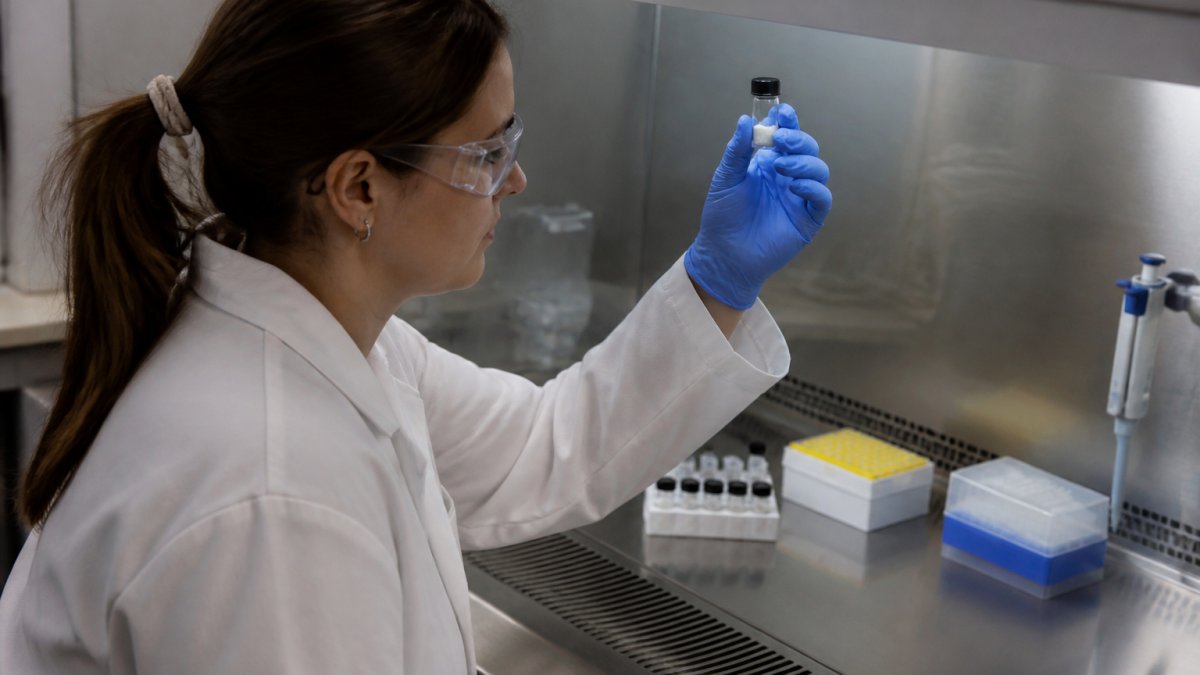
Purity percentage alone tells you very little. A 98% figure means nothing if the remaining 2% is a synthesis by-product that interferes with your assay, or if the peptide has degraded in transit because it sat in a hot warehouse for a week.
What most guides miss is that degradation is often a shipping problem, not a manufacturing one. Lyophilised peptides are relatively stable, but temperature excursions and long transit times both take a toll.
Peptide Supplier Batch Documentation You Can Defend in Peer Review
Peptide supplier batch documentation is the paper trail that lets you demonstrate, to a reviewer, an auditor, or an institutional procurement officer, exactly what went into your experiment. At minimum, it should include a batch number, an independent Certificate of Analysis, the analytical methods used, and a date of manufacture.
Reviewers increasingly ask for this. If your methods section says "peptide obtained from a commercial supplier" with no further detail, you're leaving yourself exposed. A defensible record includes the supplier's identity, the batch number, the stated purity, and the analytical method behind that figure.
What Belongs in the File for Every Batch
| Document | What it proves | Where it comes from |
|---|---|---|
| Batch number | Traceability to a specific production run | Supplier |
| Certificate of Analysis | Purity and identity results | Independent laboratory |
| Analytical method | How purity was measured | Testing laboratory |
| Date of manufacture | Age and stability context | Supplier |
| Dispatch record | Transit time and conditions | Carrier |
| Safety data sheet | Hazard and handling information | Supplier |
If a supplier can't hand you the first four without a fight, look elsewhere. Documentation you have to chase is documentation you won't have when you need it.
The Compliance Layer Most Guides Skip
Research procurement in this country sits inside a framework that shapes what your institution will accept. Under the Work Health and Safety Act 2011 and the model Work Health and Safety Regulations, hazardous chemicals must be accompanied by a current safety data sheet, and laboratories are expected to maintain a hazardous chemicals register. If your supplier cannot supply an SDS in the expected format, your chemical register has a gap before the material even reaches the bench.
Institutional purchasing adds its own requirements. Most universities and medical research institutes run procurement through a central finance or supply function, and many set thresholds above which a purchase order, a quote, or a competitive process is required. A supplier who cannot issue a compliant tax invoice, quote a valid Australian Business Number, or accept a purchase order will create friction that a cheaper unit price does not offset.
Traceability and Audit Readiness
If your work sits under a human research ethics committee approval, a gene technology licence, or a quality system such as ISO 17025 for testing laboratories, the expectation is that materials used in the study can be traced to a specific batch with documented quality. An audit or inspection may ask you to produce that chain on short notice. A local supplier with a public, batch-specific Certificate of Analysis makes that chain short and defensible; a supplier whose documentation arrives weeks later, or not at all, makes it long and fragile.
A Practical Test Before You Commit
Ask a prospective supplier for a sample batch record, a real CoA, an SDS, and a tax invoice template, before you place a paid order. A supplier who can produce all three promptly is one whose documentation will hold up when it matters. A supplier who deflects is telling you what the audit will feel like.
Research Peptide Shipping Times: Domestic Versus International
Research peptide shipping times differ dramatically between domestic and international suppliers, and the gap is usually measured in weeks, not days. A domestic order typically arrives within a few business days.
That unpredictability is the real cost. Customs delays aren't just inconvenient; they're impossible to plan around. If your study has a fixed start date, an order that might arrive in five days or five weeks is effectively unusable.
Domestic dispatch also reduces handling. Every additional transfer point, from an overseas warehouse to a freight forwarder to a customs facility, is a chance for a package to be delayed, misrouted, or exposed to temperature extremes. Fewer touchpoints means fewer failure modes.
For time-sensitive work, the practical rule is simple: if you can't afford a three-week delay, don't build your supply chain around a route that can produce one.
Total Cost of Ownership: Local Versus Global Suppliers
The total cost of ownership for a peptide order includes far more than the invoice price. It includes the cost of your time chasing documentation, the cost of a failed experiment, and the cost of holding buffer stock to protect against delays. Most guides stop at that sentence. The useful version is a calculation you can actually run before you place an order.
A Worked Structure You Can Apply to Any Quote
Build a simple spreadsheet with one column per supplier and these line items. The figures below are placeholders, substitute your own lab's rates, but the structure is what exposes the real comparison.
| Cost line | How to estimate it | Why it matters |
|---|---|---|
| Unit price | Quoted price per vial or per mg | The only number most buyers compare |
| Freight and duties | Carrier quote plus any import charges | Often omitted from overseas quotes |
| Buffer stock carrying cost | Extra units held × storage and capital cost | Ties up budget and freezer space |
| Documentation time | Hours spent chasing CoAs × staff hourly rate | Rarely billed, always incurred |
| Re-run cost | Reagents + instrument time + staff hours per failed run | The largest hidden line |
| Delay cost | Days of idle instrument or staff time × daily rate | Dominates for time-sensitive studies |
Why the Invoice Price Misleads
A cheaper unit price from an overseas supplier can look attractive until you account for what it costs to manage the risk. Holding extra inventory ties up budget and storage. Re-running an experiment because a batch degraded in transit consumes reagents, instrument time, and staff hours. Chasing a Certificate of Analysis across time zones takes time nobody bills for.
A common pattern in research labs is that the re-run cost alone exceeds the entire price difference on a typical order. If a single failed run consumes a day of instrument time and a researcher's day, the arithmetic rarely favours the cheaper vial. That is not an argument that local is always cheaper, it is an argument that the invoice price is a poor proxy for the real cost.
Inventory Carrying Cost, Concretely
Buffer stock is the quiet expense. If you hold an extra month of supply to insure against a four-week international lead time, you are paying for freezer space, capital tied up in stock, and the risk that some of it expires before use. Lyophilised peptides are relatively stable, but they are not free to store, and every vial held as insurance is a vial that could have been bought closer to the point of use.
Turning It Into a Decision Rule
A practical rule many lab managers adopt: if the total-cost difference is under roughly the cost of one re-run, buy local for the certainty. If the difference is several multiples of a re-run and the schedule has slack, the overseas option can be genuinely rational. The point is to make the comparison explicit rather than defaulting to whichever number is smaller on the quote.
When Global Suppliers Still Make Sense
Global suppliers remain the better choice in specific circumstances, and pretending otherwise doesn't help anyone. If you need a niche peptide sequence or an unusual modification that no domestic supplier stocks, an international source may be your only option.
The key is to match the sourcing route to the experiment. Routine work with fixed deadlines favours local supply. Exploratory work with slack in the schedule can tolerate the uncertainty of an international order.
For everything in between, a hybrid approach often works best: hold a domestic supplier for your standard sequences and your time-critical runs, and use international sources only for the specialist compounds that justify the wait.
At OptiPeps, we focus on the routine and time-critical end of that spectrum.
Building a research workflow around a supply chain means trusting that the supply chain will hold.
Frequently Asked Questions
Why do Australian researchers choose local suppliers for peptides?
Faster delivery, verified quality, and supply-chain security top the list. Domestic suppliers dispatch same-day and avoid customs clearance, which can delay international orders by weeks. Local suppliers also provide batch-level documentation and certificates of analysis you can reference in publications. For time-sensitive in-vitro studies, that reliability matters more than the lower headline price of overseas options.
What should researchers check before choosing a peptide supplier?
Ask for independent third-party HPLC-MS verification, not just in-house results. Request a certificate of analysis for the specific batch you will receive. Confirm dispatch location and typical shipping times. Check whether the supplier holds stock domestically or orders on demand. Finally, ask what happens if a batch fails purity or arrives degraded: replacement timelines and refund policies vary significantly between suppliers.
How can researchers verify the quality of research-grade peptides?
Quality testing should include HPLC for purity percentage and mass spectrometry for molecular weight confirmation. The certificate of analysis should come from an accredited third-party laboratory, not only the supplier's internal testing. Look for a stated purity threshold, commonly 95% or higher for research-grade material, and batch-specific data rather than a generic specification sheet.
Are local suppliers faster than international suppliers?
Domestic dispatch typically means next-day or two-day delivery via express post. International orders face customs clearance, which can add days or weeks depending on documentation and border processing. For experiments with fixed timelines, that difference often determines whether a project stays on schedule. Local suppliers also make it easier to resolve problems quickly if a shipment is delayed or damaged.