Last Updated: November 5, 2026
Quick Summary
A lyophilised peptide is a dry powder that keeps far longer than a peptide solution, which degrades once dissolved. Choose the lyophilised form for repeated or quantitative work and reconstitute only what each experiment needs. Choose a ready-made peptide solution when the assay runs within days and convenience matters more than long-term storage.
- Lyophilised peptides keep longer because water, the main degradation medium, is removed.
- Calculate concentration from net peptide content, not gross vial weight, to avoid overstating it.
- Aliquot reconstituted stocks into single-use volumes to limit freeze-thaw damage.
- Oxidation-prone sequences should stay lyophilised and be reconstituted only for one experiment.
- Confirm identity and purity with the Certificate of Analysis, HPLC and mass spectrometry before assaying.
Table of Contents
- Lyophilised Peptide vs Peptide Solution: The Core Trade-Off
- What Lyophilisation Does to a Peptide and Why It Matters
- Stability and Usable Storage Life: Powder vs Solution
- Lyophilised Peptide Reconstitution Protocol, Step by Step
- Peptide Solubility and Solvent Selection for Assays
- Peptide Stock Solution Storage, Aliquoting and Freeze-Thaw Control
- Confirming Purity and Identity Before Your Assay
- Choosing the Right Format for Your Next Assay
- Frequently Asked Questions
Lyophilised Peptide vs Peptide Solution: The Core Trade-Off
The core decision: a lyophilised peptide keeps longer and resists degradation, while a peptide solution is ready to pipette but starts degrading the moment it is dissolved.
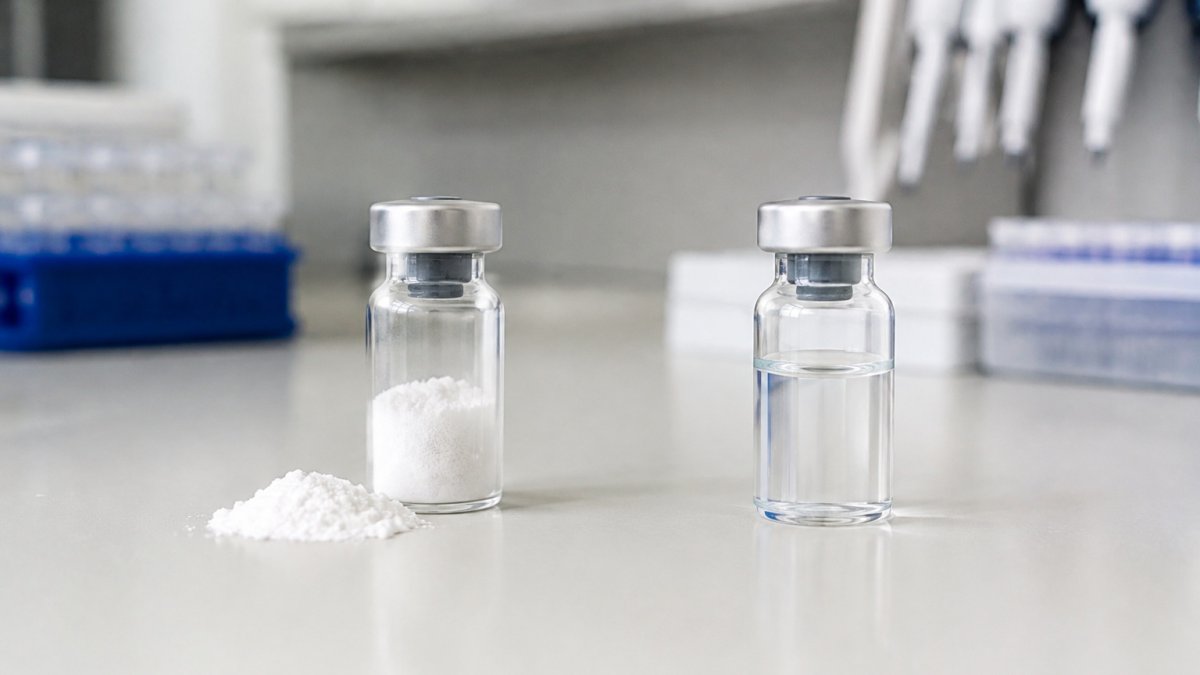
Lyophilised peptides are dry powders or cakes made by freeze-drying the peptide with the water removed.
This guide covers stability, reconstitution, concentration maths, solvent choice, storage of stock solutions and the checks to run before an assay.
What Lyophilisation Does to a Peptide and Why It Matters
Lyophilisation, or freeze-drying, freezes a peptide solution and removes the ice under reduced pressure, leaving a dry solid. Because water is removed at low temperature, the peptide structure is largely preserved while water-dependent reactions are slowed sharply.
Removing bound water matters as much as removing free water.
The format also affects what the powder contains beyond the peptide itself. Counterions such as trifluoroacetate, salts from synthesis and other by-products are carried through with the peptide.
Stability and Usable Storage Life: Powder vs Solution
Stability is where the two formats separate most clearly, but not by a single number. In the dry state, hydrolysis and many oxidation pathways are slowed because water is the reactant and the medium, so a lyophilised peptide typically keeps its integrity far longer than the same peptide dissolved.
In solution, usable storage life depends on sequence, solvent, pH, storage temperature and thaw count. Some peptides hold up for weeks frozen in well-chosen buffers; others, particularly those containing methionine, cysteine or asparagine, can degrade noticeably within days.
The practical comparison is this:
| Factor | Lyophilised peptide | Peptide in solution |
|---|---|---|
| Main degradation route | Slow, mostly moisture-driven | Hydrolysis, oxidation, aggregation |
| Storage stability | Generally longer when dry and cold | Shorter, and sequence-dependent |
| Freeze-thaw tolerance | Not applicable until reconstituted | Limited; each cycle adds risk |
| Ready to use | No, needs reconstitution | Yes |
| Concentration certainty | Depends on peptide content | Fixed at preparation, then drifts |
Qualified storage-life ranges by format and condition
No supplier can promise a shelf life that holds for every sequence, so the ranges below are planning figures to verify against your own batch and assay, not specifications. They assume a sealed container, protected from light, and a peptide with no unusual oxidation or aggregation liability.
| Condition | Lyophilised peptide | Peptide in solution |
|---|---|---|
| Desiccated, −20 °C | Multi-year stability is common for robust sequences | Not applicable |
| Desiccated, 2-8 °C | Months to a few years, depending on residual moisture | Not applicable |
| Frozen aqueous buffer, −20 °C | Not applicable | Weeks to months for robust sequences; days for oxidation-prone ones |
| Frozen aqueous buffer, −80 °C | Not applicable | Longer than −20 °C, but each thaw still costs activity |
| Refrigerated solution, 2-8 °C | Not applicable | Days at most for most peptides; shorter for methionine-containing sequences |
| Ambient solution | Not applicable | Hours; suitable only for same-day use |
Two qualifications matter more than the table. First, residual moisture in a lyophilised cake is the main limit on dry-state life, and it rises every time a vial is opened in humid air. Second, a frozen solution is not automatically stable: freeze concentration can raise local salt and peptide concentrations during ice formation, which is one reason some peptides aggregate on freezing.
Peptide-specific degradation routes
Sequence determines which route dominates, and that in turn determines whether solution storage is realistic.
- Hydrolysis cleaves the peptide backbone, most readily at aspartic acid-proline bonds and at asparagine residues, and is accelerated by heat and extremes of pH. It is the main reason aqueous stocks are kept cold and near neutral pH.
- Oxidation affects methionine, cysteine, tryptophan and histidine, and is driven by dissolved oxygen and trace metals. A methionine-containing peptide in an aerated buffer can oxidise within days even when frozen, so consider degassing and avoiding metal contact.
- Aggregation is driven by hydrophobic sequence segments and by freeze concentration, and can appear as cloudiness or as a loss of activity without visible change.
A common pattern is that a peptide robust in the dry state becomes the limiting reagent once dissolved, and the more oxidation- or aggregation-prone the sequence, the stronger the case for keeping it lyophilised and reconstituting only what a single experiment needs.
How assay format changes the stability requirement
Stability is not the only deciding factor, and for some assays it is not the main one. A 48-hour cell-based assay exposes the peptide to culture medium at 37 °C, so the relevant question is stability under assay conditions, not freezer life.
Watch out: a stability figure quoted for one buffer and temperature does not transfer to another, so validate the storage condition you actually use rather than assuming a published range applies.
Lyophilised Peptide Reconstitution Protocol, Step by Step
Reconstitution is where most avoidable errors happen. Work through the process in order and record what you did.
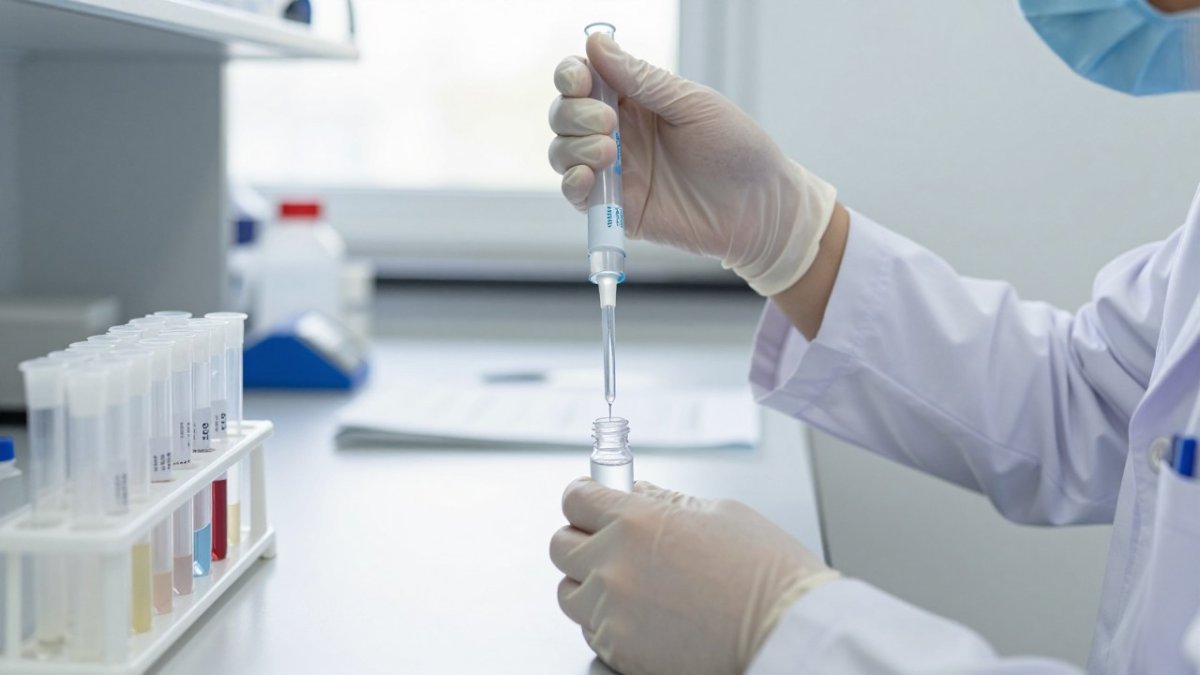
- Let the vial reach room temperature. Remove it from cold storage and leave it closed for several minutes; opening a cold vial draws condensation onto the powder.
- Briefly centrifuge the vial. A short spin brings the powder down from the cap and walls.
- Choose your solvent. Follow the solubility guidance below and confirm it suits your assay. You can buy bacteriostatic water as a sterile diluent for reconstitution. A peptide calculator can work out the BAC water volume and mg/mL concentration for your dose.
- Add solvent slowly down the side of the vial. Direct streams onto the powder can cause foaming and localised denaturation.
- Dissolve gently. Swirl or let it sit. Vigorous vortexing can shear some peptides, and sonication should be used only if the peptide is known to tolerate it.
- Check the solution. It should be clear; cloudiness or particles suggest incomplete dissolution or aggregation.
- Aliquot and store. Divide the stock into single-use portions as described later.
Calculating Concentration and Peptide Content
The concentration you calculate is only as good as the peptide content you use.
The basic calculation is:
Concentration (mg/mL) = Net peptide mass (mg) ÷ Volume of solvent added (mL)
If the Certificate of Analysis gives a peptide content of, for example, 80%, then a 5 mg vial holds about 4 mg of net peptide.
Build the peptide-content correction into your spreadsheet from the start, and record both the gross and net values so the calculation can be audited later.
Peptide Solubility and Solvent Selection for Assays
No single solvent suits every peptide. The sequence determines solubility: peptides with a high proportion of hydrophobic residues often need a small amount of organic solvent, while charged or polar peptides typically dissolve in aqueous buffer.
Start with the solvent most compatible with your assay, then test a small aliquot before committing the whole vial.
Solvent choice also affects stability. A buffer that suits solubility may not suit storage, so consider both questions together.
Peptide Stock Solution Storage, Aliquoting and Freeze-Thaw Control
Once a peptide is in solution, protect it from repeated freeze-thaw cycles, contamination and extended time at warmer temperatures.
Aliquot to single-use volumes. Divide the stock so each aliquot is used in one session.
Control contamination. Use sterile technique, sterile solvents and clean pipette tips.
Limit time at room temperature. Thaw only the aliquot you need, and return unused material to the freezer promptly.
Confirming Purity and Identity Before Your Assay
Before you rely on any peptide, confirm that it is the right sequence and that it is pure enough for your work. A practical lab guide explains how to verify peptide purity.
The Certificate of Analysis records purity and identity results for a specific batch. Our explainer on the certificate of analysis walks through each field.
High-performance liquid chromatography (HPLC) separates the peptide from impurities and reports a purity percentage. For more detail, see our HPLC-MS testing guide.
OptiPeps's products are HPLC-MS verified to a 99%+ purity standard before dispatch, with batch-level Certificates of Analysis available.
Choosing the Right Format for Your Next Assay
Use a decision framework rather than habit. The questions below are ordered so that the first answer that applies usually settles the choice.
A short decision path
- Is the peptide needed within the next few days, and will it be used once? If yes, a ready-made solution or same-day reconstitution is simplest, provided the assay tolerates the solvent and the concentration is verified.
- Will the same batch be used across multiple experiments over weeks or months? If yes, a lyophilised vial reconstituted into single-use aliquots gives the most control over concentration and freeze-thaw exposure.
- Is the assay quantitative and sensitive to concentration error? If yes, favour a lyophilised format where you calculate net peptide content from the Certificate of Analysis and prepare the stock yourself, so the dilution chain is documented.
- Does the sequence carry oxidation or aggregation liability? If yes, keep the peptide dry and reconstitute only what one experiment needs.
- Is freezer access limited, or is −80 °C unavailable? If yes, a lyophilised format stored at −20 °C or 2-8 °C may be more practical than a solution needing ultra-cold storage.
- Is the required working concentration very low? If yes, a lyophilised vial reconstituted at a higher stock concentration and then diluted avoids the stability loss of storing a dilute solution.
Matching format to common assay types
| Assay type | Typical format preference | Reason |
|---|---|---|
| Cell-based viability or signalling | Lyophilised, reconstituted fresh into assay-compatible buffer | Avoids long solution storage and lets you control final organic content |
| Enzyme kinetics | Either, if used same-day | The run is short, so assay-condition stability matters more than freezer life |
| Immunoassay or ELISA | Lyophilised, with net peptide content calculated | Concentration accuracy drives the standard curve |
| Mass spectrometry | Lyophilised, reconstituted into MS-compatible solvent | Avoids solution-format additives that interfere with ionisation |
| Binding or receptor assays | Lyophilised for storage, solution for the run | Balances storage stability against same-day convenience |
Batch size, frequency and access
A large batch used frequently justifies the handling time of reconstituting and aliquoting a lyophilised vial, because the per-experiment cost falls and concentration control pays back across many runs; a small, one-off batch rarely justifies it. Freezer access matters too: in a shared −20 °C freezer opened often, a lyophilised powder is less exposed to temperature cycling than a solution.
Concentration and peptide-content calculations
The concentration you calculate is only as good as the peptide content you use. Gross weight includes salts, counterions and water, so the net peptide mass is lower.
The basic calculation is:
Concentration (mg/mL) = Net peptide mass (mg) ÷ Volume of solvent added (mL)
Watch out: a solution supplied at a stated concentration may have been prepared from gross weight, so verify the basis of the stated value before setting up a quantitative assay.
A practical default
For most laboratories, a lyophilised peptide that is reconstituted in-house and aliquoted immediately offers the best balance of stability, cost control and concentration accuracy. A ready-made solution suits short, single-use projects where handling time matters more than long-term consistency. Pricing depends on quantity, delivery date and purity specification, so request a current quote from OptiPeps before planning your budget.
Frequently Asked Questions
What is the difference between a lyophilised peptide and a peptide solution?
A lyophilised peptide is a dry powder or cake made by freeze-drying the peptide, which removes most of the water under reduced pressure and low temperature. A peptide solution is the same peptide already dissolved in a solvent or buffer. The powder is generally more stable for long-term storage because water is what drives hydrolysis and other degradation. The solution is ready to pipette but has a shorter usable life and must be handled carefully to preserve concentration and integrity. The right choice depends on how soon the assay runs and how much handling your workflow can tolerate.
Are lyophilised peptides more stable than peptide solutions?
In most cases, yes. Removing water slows chemical degradation such as hydrolysis and oxidation, so a lyophilised peptide typically keeps its integrity far longer when stored cold and dry. Peptide solutions degrade faster, particularly when stored at room temperature or subjected to repeated freeze-thaw cycles. Stability is sequence-dependent, however: some peptides containing oxidation-prone residues such as methionine or cysteine need extra precautions even in powder form. Check the supplier's Certificate of Analysis and storage guidance for your specific peptide before assuming long-term stability.
How should a lyophilised peptide be reconstituted for a lab assay?
Allow the vial to reach room temperature before opening to prevent condensation, then add the calculated volume of an appropriate solvent slowly down the side of the vial. Gently swirl or pipette rather than vortex vigorously, which can cause foaming and aggregation. Confirm full dissolution visually, and centrifuge briefly if particulates remain. Calculate concentration using the net peptide content stated on the Certificate of Analysis, not just the gross weight, because counterions and bound water reduce the active peptide fraction. Aliquot the stock immediately to limit freeze-thaw exposure.
Which solvent should I use to dissolve a peptide for an assay?
Start with sterile water or a buffer compatible with your assay, then adjust based on the peptide's charge and hydrophobicity. Basic peptides often dissolve in dilute acetic acid, acidic peptides in dilute ammonium hydroxide or a basic buffer, and highly hydrophobic peptides may need a small amount of DMSO or acetonitrile before dilution. Always test a small aliquot first and keep the organic solvent concentration low enough not to affect cells or the readout. Record the solvent used, since it becomes part of your experimental conditions.
How long can a reconstituted peptide solution be stored?
Usable life after reconstitution depends on the peptide sequence, solvent, pH, and storage temperature. As a general guide, many peptide solutions remain usable for days to a few weeks when refrigerated, and longer when aliquoted and frozen at -20 degrees Celsius or below. Peptides with oxidation-sensitive or aggregation-prone residues degrade faster. Validate stability for your own peptide and conditions where results matter, and avoid relying on a single stored stock for long-running experiments.