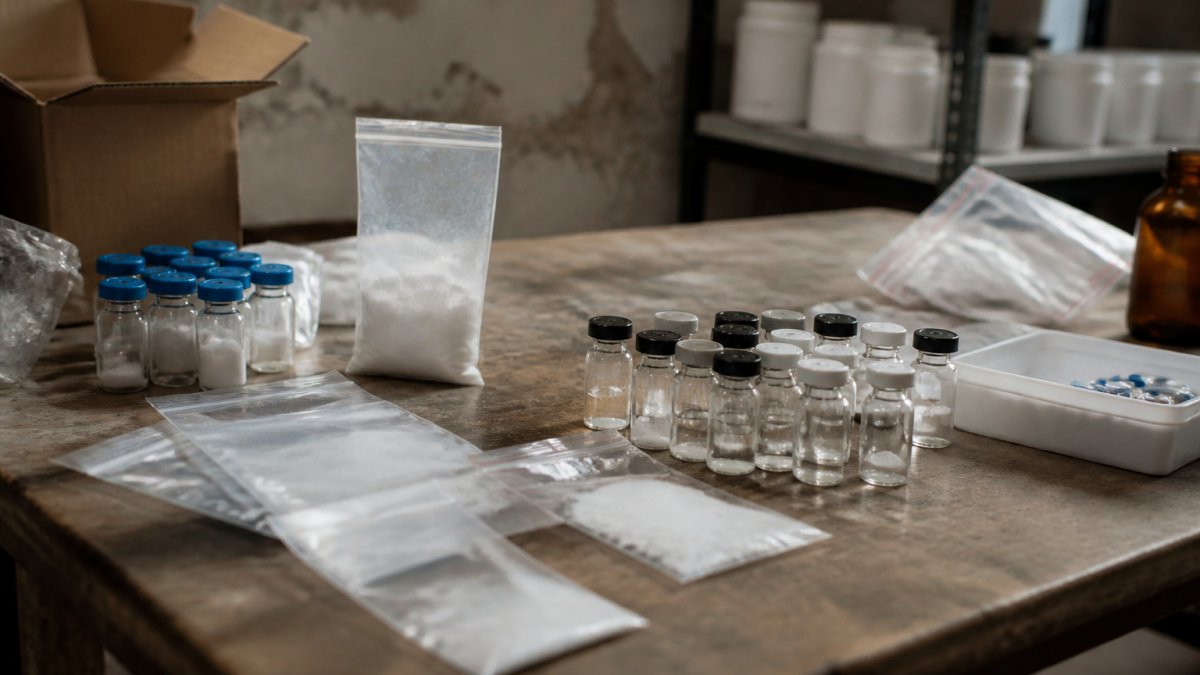
Last Updated: October 23, 2026
Quick Summary
The risks of unregulated peptide suppliers in Australia include products sold without approval, testing records or supply-chain documentation, leaving buyers with no quality oversight. Sellers market directly to consumers with no pharmacist, prescription or paper trail, and the buyer becomes the only quality control. Polished websites and copied lab reports are not evidence of quality.
- Research peptides are sold for laboratory use only, while therapeutic peptides require approval as medicines.
- Ask for a batch-specific certificate of analysis naming an independent laboratory and matching the vial's batch number.
- Peptides are sensitive to heat, light and freeze-thaw cycles, so shipping and storage conditions matter.
- If you have used a product and feel unwell, seek medical advice and report suspected reactions to the TGA.
- Report misleading claims to the ACCC and keep screenshots, receipts and chat records as evidence.
Table of Contents
- Why Unregulated Peptide Suppliers Are a Growing Concern
- Research Peptides vs Therapeutic Peptides: The Regulatory Divide
- Peptide Supplier Red Flags to Watch For
- How to Verify Peptide Purity Before You Buy
- What a Peptide Certificate of Analysis Should Actually Contain
- Supply-Chain and Product-Quality Failure Modes
- What to Do If You've Bought From an Unregulated Supplier
- Frequently Asked Questions
Why Unregulated Peptide Suppliers Are a Growing Concern
The risks of unregulated peptide suppliers in Australia start with a simple gap: many products sold online are not approved therapeutic goods, and no one checks them before they reach a buyer.
The problem is scale. Social platforms make it easy to promote vials directly to consumers, with no pharmacist, no prescription, and often no paper trail.
The concern is growing for three reasons:
- Online storefronts are cheap to build and easy to abandon
- Wellness and fitness audiences are large and receptive
- Documentation is easy to fake and rarely checked
That last point is where most buyers get caught.
Research Peptides vs Therapeutic Peptides: The Regulatory Divide
This distinction changes everything about what protections apply.
Research peptides are compounds supplied for laboratory and in-vitro work.
Therapeutic peptides are medicines.
In Australia, the Therapeutic Goods Administration oversees this framework. The dividing line is intended use, not the molecule itself.
Here is where consumers get hurt.
| Product category | Intended use | Regulatory position | Consumer protection |
|---|---|---|---|
| Research-grade peptide | Laboratory, in-vitro only | Sold as a research material | Limited; buyer must verify |
| Therapeutic peptide | Human use, treatment | Requires approval as a medicine | Full medicine framework |
| Unapproved "wellness" peptide | Marketed for human outcomes | Neither approved nor lawful to supply | Effectively none |
The practical takeaway: if a seller talks about what a peptide will do for your body, ask which approval covers it.
Peptide Supplier Red Flags to Watch For
Most bad suppliers give themselves away before money changes hands.
Vague or Missing Product Documentation
Ask for batch documentation before you order. A serious supplier answers without friction.
Warning signs:
- No certificate of analysis offered, or "we can send it later"
- A COA with no batch number, no test date, and no laboratory named
- Purity stated as a claim in marketing copy rather than a measured result
The last one is common. Real testing produces different results for different batches. Identical reports across a catalogue suggest copied paperwork, not analysis.
Pressure Tactics and Unverifiable Claims
Pressure is a substitute for evidence.
Common tactics:
- Countdown timers and "limited stock" on a product that never runs out
- Testimonials with no way to verify them
- Claims about outcomes with no study cited
If a seller cannot answer a documentation question in writing, that is your answer.
How to Verify Peptide Purity Before You Buy
Verification is a process, not a checkbox. Work through it in order and stop at the first failure.
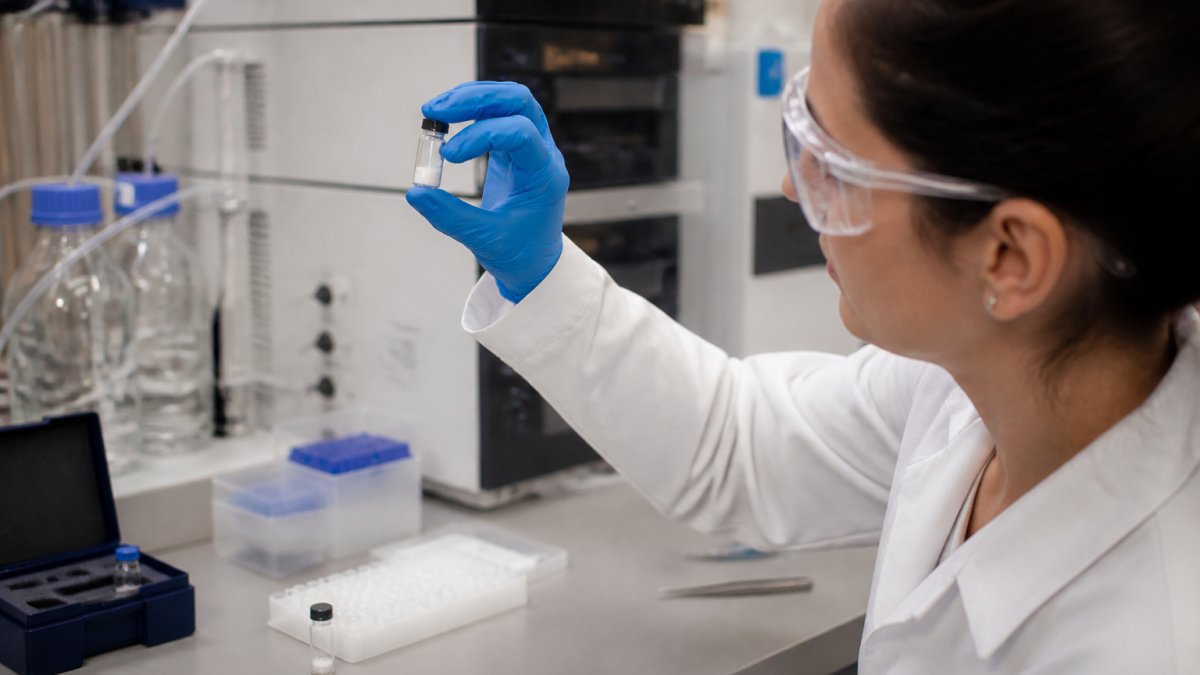
- Request the batch-specific certificate of analysis. Not a sample, not a catalogue document. The one for the batch you are buying.
- Check the laboratory name. A named, independent lab is verifiable. An unnamed "in-house facility" is not.
- Match the batch number. It should appear on the COA and on the vial label.
- Look at the method. Purity should be measured by a recognised analytical method, with the result stated as a figure.
- Confirm the test date. An old report on a current batch is a mismatch.
- Ask a follow-up question. A supplier with real documentation answers it easily.
Our own approach is to have every vial HPLC-MS verified against a 99%+ purity standard before dispatch.
For a full walkthrough of the testing process itself, see our guide on how to verify peptide purity.
What a Peptide Certificate of Analysis Should Actually Contain
A certificate of analysis is only useful if it contains enough detail to be checked.
A complete document should show:
- Product name and sequence
- Batch or lot number
- Manufacturing or test date
What most buyers miss is the link between the document and the physical product. The batch number is that link. Without it, a certificate proves a lab tested something once.
If you want to read these documents properly rather than skim them, our explainer on reading a peptide certificate of analysis breaks down each field and what a weak result looks like.
Supply-Chain and Product-Quality Failure Modes
Quality problems rarely announce themselves. They show up as results that will not repeat, or as a reaction that does not match the label. Understanding each failure mode turns a general warning into something you can actually check.
Degradation During Storage and Transit
Peptides are fragile molecules. Lyophilised (freeze-dried) powder is more stable than reconstituted solution, but both are sensitive to heat, light, and repeated freeze-thaw cycles.
What to look for: a supplier who ships with temperature control and states a storage temperature on the label and the certificate of analysis. Clumped, discoloured, or poorly dissolving powder is a visible warning sign.
Contamination and Residual Impurities
A rushed synthesis or purification process can leave behind residual solvents, counter-ions, or truncated peptide sequences. These are not always visible and are not always captured by a simple purity percentage.
What to look for: a certificate of analysis that names the method (for example, HPLC or mass spectrometry), shows the result as a measured figure, and is batch-specific.
Mislabelling and Sequence Mismatch
A vial can be labelled with one peptide and filled with another, or filled with the right peptide at the wrong concentration.
What to look for: a batch number that appears on both the vial and the certificate, and a certificate that includes an identity confirmation (such as mass spectrometry) rather than purity alone.
Underfill and Concentration Error
Less material than the label states, or a concentration that does not match, throws off any measured quantity.
What to look for: a certificate that states the measured fill or content, not just the target. A supplier who cannot tell you the measured amount per vial is asking you to trust the label.
Batch-to-Batch Inconsistency
The first order performs; the second does not. This is the hardest failure to catch and the most damaging to research, because a single good batch tells you nothing about the next one. The only real defence is a supplier who tests and documents every batch, not just a marketing sample.
How Australian Regulatory Categories Change the Risk
The failure modes above exist in any supply chain. What changes under Australian therapeutic goods law is who is responsible for catching them.
That is the practical consequence of the regulatory divide: the same failure mode is a managed risk in one category and an unmanaged one in another.
For a deeper look at the standards behind this, our article on peptide synthesis quality control standards covers what a properly controlled process looks like.
What to Do If You've Bought From an Unregulated Supplier
Act quickly, and act in writing. Most of what protects you happens in the first few days, and your records determine whether a complaint goes anywhere.
Step 1: Stop Use and Secure the Product
If the product was intended for human use, do not continue. Keep the vial, packaging, batch number, and any reconstitution or storage instructions, it is your evidence. If you have already used it, note the dates, amounts, and any symptoms.
Step 2: Seek Medical Advice If You Have Used It
If you have used the product and feel unwell, seek medical advice promptly. Take the label, batch number, certificate of analysis if you have one, and the seller's claims. A clinician cannot assess a reaction without knowing what was likely in the vial, and the label is often the only clue.
Step 3: Report Adverse Events to the Regulator
Report suspected problems with medicines and medical devices to the TGA's reporting service for problems with medicines and medical devices. Reports help regulators act on patterns rather than isolated complaints. You do not need to be certain the product caused the problem, a suspected reaction is enough to report.
Step 4: Report the Seller and the Advertising
If you believe the seller's claims were misleading, report them to the ACCC. If you believe the advertising breached therapeutic goods advertising rules, the Therapeutic Goods Administration handles complaints about advertising of therapeutic goods. Keep screenshots of the claims, the product page, and any chat messages, advertising complaints are assessed on what was actually said, and pages get taken down quickly.
Step 5: Request a Refund in Writing
Put your request in writing and keep the response. A written trail separates a complaint that can be escalated from one that disappears, and is useful for any consumer protection complaint.
Step 6: Preserve the Evidence Chain
Save every product page, chat message, payment receipt, and delivery record. Screenshot the product page as it appeared when you bought, not as it appears later, sellers edit or remove pages.
What Regulators Can and Cannot Do
Australian regulators can act on unsafe products, misleading claims, and unlawful supply, and reports feed into that. What they generally cannot do is recover your money or test an individual vial.
If you are now looking for a supplier you can verify, our guide to research-grade peptide suppliers sets out what to check. You can also contact our team about certificates of analysis, batch records, and orders.
Frequently Asked Questions
What are the risks of buying peptides from an unregulated supplier?
The main risks are product quality and safety. Unregulated peptide suppliers may sell compounds that are mislabelled, contaminated, or dosed incorrectly, and there is no independent batch testing to confirm what is in the vial. Unverified wellness and performance claims often accompany these products. Because these items sit outside the Therapeutic Goods Administration's approval pathways, there is no assurance of manufacturing standards, and adverse events are harder to trace. For laboratory buyers, an unverified batch can also invalidate experimental results and undermine reproducibility in peer review.
How can you tell whether a peptide supplier is legitimate?
Check for batch-level transparency. A legitimate supplier provides a certificate of analysis for each batch, showing HPLC-MS results from an accredited third-party laboratory, not just in-house figures. Look for clear product categorisation, such as research use only labelling, consistent documentation, and a domestic dispatch address you can verify. Red flags include missing CoAs, pressure-driven social media promotion, and claims that a product is approved for human use when it is not. Asking for a sample CoA before ordering is a quick way to separate serious suppliers from casual resellers.
What does research use only mean on a peptide label?
Research use only means the compound is supplied for in-vitro laboratory work and is not approved for human consumption. It places the product outside the therapeutic goods framework that governs medicines and medical devices, so it does not carry the same manufacturing, labelling, or efficacy requirements. For laboratory managers, this distinction matters because it defines what the supplier is accountable for. It also means the buyer carries responsibility for appropriate handling, storage, and use within a research setting rather than a clinical one.
How can you verify a peptide's purity and identity?
Ask for a batch-specific certificate of analysis that reports both high-performance liquid chromatography and mass spectrometry results. HPLC shows the purity percentage and any impurity peaks, while MS confirms the molecular identity matches the stated sequence. Check that the testing laboratory is independent and accredited, and that the batch number on the CoA matches the vial you receive. Where possible, run your own verification, such as in-house HPLC or MS, on arrival. For peer-review defensibility, retain the supplier's CoA alongside your own results.
The real risk with unregulated suppliers is not one bad vial. It is building work on a supply chain you cannot audit. At OptiPeps, we hold stock domestically, dispatch same-day from our Melbourne facility, and publish batch-level certificates for every order. Every vial is HPLC-MS verified to a 99%+ purity standard before it ships, and orders over $100 get free Express Post. Get started with OptiPeps and build your research on batches you can actually trace.