Table of Contents
- Pure Peptides vs OzPeptide: What This 2026 Comparison Covers
- Side-by-Side Comparison: Pure Peptides and OzPeptide at a Glance
- A Peptide Supplier Verification Checklist for 2026
- What a Peptide Certificate of Analysis Should Prove
- HPLC and Mass Spectrometry Peptide Testing: Batch-Level Evidence
- Research Peptide Shipping and Customs: Domestic vs International Supply
- Pricing, Policies and Total Cost of a Peptide Source
- Pure Peptides vs OzPeptide: Which Supplier Fits Your Research?
- Frequently Asked Questions
Last Updated: October 19, 2026
Pure Peptides vs OzPeptide: What This 2026 Comparison Covers
The pure peptides vs ozpeptide comparison in 2026 matters most to researchers who need traceable, verified compounds rather than marketing claims. This guide from OptiPeps breaks down supplier verification, certificate of analysis standards, HPLC and mass spectrometry evidence, shipping logistics, and total cost. We'll show you exactly how to evaluate both suppliers against a reproducible checklist, so you can defend every purchasing decision in peer review. The core argument is simple: purity claims mean nothing without batch-level documentation you can verify independently.
Side-by-Side Comparison: Pure Peptides and OzPeptide at a Glance
A useful comparison does not rank two suppliers on vibes. It scores them against criteria you can check before money changes hands, and it states plainly what the available evidence does and does not establish. The table below is a comparison framework, not a verdict: fill in each cell from the supplier's current published documentation, then weight the rows to match your workflow.
| Criterion | What to verify for Pure Peptides | What to verify for OzPeptide | Evidence that satisfies the criterion |
|---|---|---|---|
| Purity claim | Stated percentage and the batch it applies to | Stated percentage and the batch it applies to | Batch-specific certificate of analysis (CoA) naming the lot |
| Identity confirmation | Mass spectrometry result against expected molecular weight | Mass spectrometry result against expected molecular weight | Spectrum or reported observed mass, not a pass/fail line |
| Purity method | HPLC conditions and detection wavelength | HPLC conditions and detection wavelength | Chromatogram with method description |
| Testing laboratory | Named laboratory and whether it is independent of the supplier | Named laboratory and whether it is independent of the supplier | Laboratory name on the CoA plus a verifiable contact or report reference |
| Batch traceability | Batch number on the vial matches the CoA | Batch number on the vial matches the CoA | Photograph of vial label beside the matching CoA |
| Dispatch origin | Domestic stock location versus international dispatch | Domestic stock location versus international dispatch | Written confirmation of dispatch point and carrier |
| Delivery timeframe | Stated Express versus standard options | Stated Express versus standard options | Carrier tracking terms in the order confirmation |
| Replacement policy | Policy for a batch that fails incoming verification | Policy for a batch that fails incoming verification | Written policy, not a verbal assurance |
| Payment terms | Surcharges and accepted methods | Surcharges and accepted methods | Itemised checkout total before payment |
| Labelling | Compound, quantity, batch and storage guidance on the label | Compound, quantity, batch and storage guidance on the label | Vial label and accompanying product information |
How to turn the table into a score
Score each supplier from one to five on every row, then apply weights that reflect your actual constraints. A workable starting weighting for most in-vitro research programmes is:
- Documentation and batch traceability: 35%
- Identity and purity evidence: 25%
- Supply-chain reliability and dispatch origin: 20%
- Total landed cost: 15%
- Policy and labelling quality: 5%
For time-sensitive work, shift weight from cost into supply-chain reliability. For work that will be audited or submitted for peer review, shift weight into documentation. The point is to disclose the weighting before you score, so the result is reproducible rather than a post-hoc justification.
What this comparison cannot tell you
Neither supplier's marketing establishes that a product is suitable for human use. Research-use products sit outside the therapeutic goods framework that applies to approved medicines, and a supplier's purity claim is not a determination of safety, efficacy or regulatory status. Treat any comparison as a purchasing-documentation exercise, not as evidence of clinical suitability.
A common pattern is that suppliers look similar on headline purity and diverge sharply on batch traceability and dispatch origin. Those two rows usually decide the comparison.
A Peptide Supplier Verification Checklist for 2026
Supplier verification is the process of confirming that a peptide source can prove identity, purity, and traceability for every batch it sells. Use this checklist before placing any order:
- Request the batch-specific certificate of analysis, not a generic sample
- Confirm the certificate names the testing laboratory and the test methods used
- Check that the batch number on the certificate matches the vial label
- Ask whether purity is verified by HPLC and confirmed by mass spectrometry
- Verify dispatch location and expected delivery timeframes in writing
- Confirm the replacement or refund policy for failed batches
- Check payment terms and any surcharges before committing
What a Peptide Certificate of Analysis Should Prove
A peptide certificate of analysis is a batch-specific document that records identity, purity, and testing methodology for a single production lot. It should prove three things: that the compound is what the label says, that purity meets the stated specification, and that an identifiable laboratory performed the work.
What most guides miss is that a certificate without a method description is close to worthless. Look for the chromatography conditions, the detection wavelength, and the mass spectrometry result stated alongside the expected molecular weight.
HPLC and Mass Spectrometry Peptide Testing: Batch-Level Evidence
HPLC and mass spectrometry peptide testing works as a pair: chromatography separates and quantifies impurities, while mass spectrometry confirms molecular identity. Neither alone is sufficient.
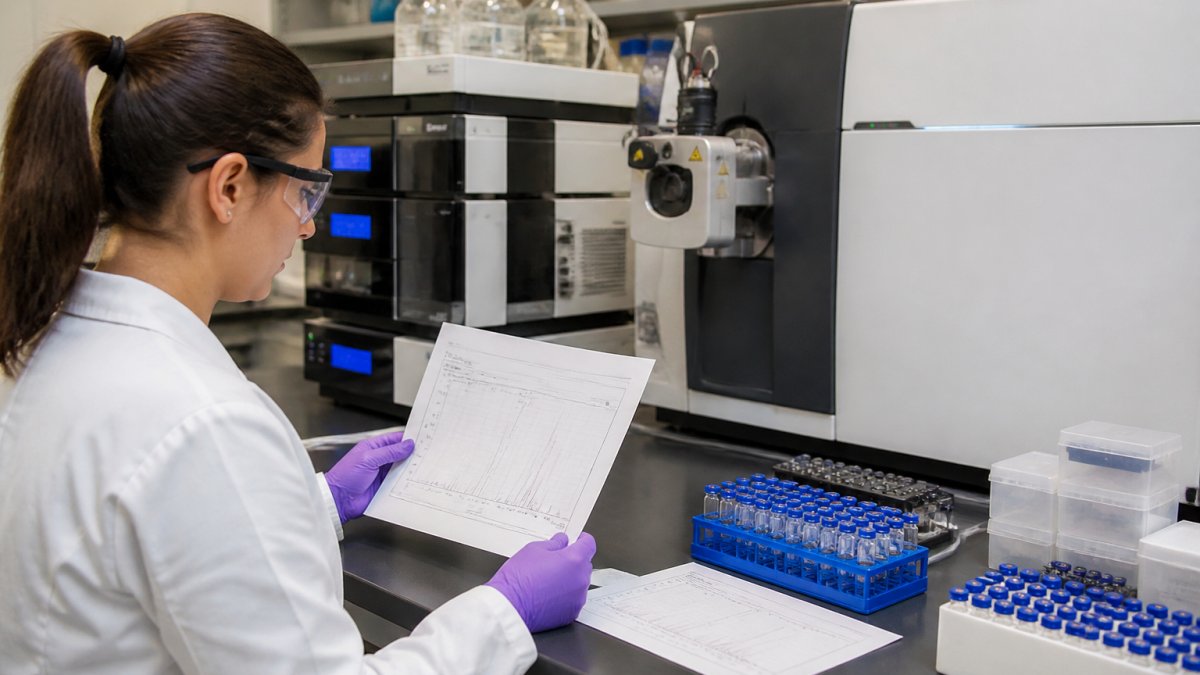
For batch-level evidence, ask for the actual chromatogram and spectrum, not just a pass or fail line.
Research Peptide Shipping and Customs: Domestic vs International Supply
Research peptide shipping and customs handling decide whether your experiment starts on schedule. International orders can stall at border clearance for unpredictable periods, and temperature excursions during extended transit add risk. Domestic supply removes both variables.
We hold stock in our Melbourne facility and dispatch same-day via Australia Post Express, with free Express Post on orders over $100. That means no customs queue between the supplier and your bench.
Pricing, Policies and Total Cost of a Peptide Source
Headline vial prices are the least useful number in a supplier comparison. What matters is the landed cost per batch that passes your incoming verification, because a cheap batch that fails verification is not cheap at all. This section sets out a like-for-like cost method you can apply to both suppliers on the same day, using the same basket.
Build a like-for-like price basket
Price comparison only works if you compare the same things. Fix the basket before you request quotes:
- The same compound and the same stated quantity per vial
- The same number of vials per order
- The same delivery service level
- The same payment method
- The same requested documentation set (batch CoA, chromatogram, mass spectrum)
Record the date of every quote. Peptide pricing and catalogue availability move, so an undated price is not evidence of anything in 2026.
The total-cost formula
Use a single formula so both suppliers are measured identically:
Cost per usable batch = (unit price × vials ordered + shipping + payment surcharges + any duties or clearance fees) ÷ number of batches that passed incoming verification
Worked example with illustrative figures only, to show the method rather than to quote either supplier:
| Cost line | Supplier A (domestic dispatch) | Supplier B (international dispatch) |
|---|---|---|
| Vial price × 5 vials | $500 | $400 |
| Shipping | $15 | $45 |
| Payment surcharge | $0 | $12 |
| Duties or clearance fees | $0 | $30 |
| Landed cost | $515 | $487 |
| Batches passing verification (of 5) | 5 | 4 |
| Cost per usable batch | $103 | $121.75 |
The cheaper sticker price becomes the more expensive option once one failed batch and the associated clearance costs are counted. Substitute current quoted figures for both suppliers and the method still holds.
Policy criteria that change the maths
Price is only half of total cost. Check these policy points in writing for each supplier:
- Minimum order value and whether it applies before or after shipping
- Replacement or refund terms for a batch that fails your incoming verification, including who pays return freight
- Dispatch cut-off times and whether same-day dispatch is guaranteed or aspirational
- Storage and transit conditions, including whether cold-chain or insulated packaging is used and at what cost
- Payment methods and surcharges, since card fees can add a measurable percentage to small orders
- Documentation turnaround, because a CoA that arrives after the experiment has started is of limited use
What to ask each supplier directly
Send both suppliers the same short request so the answers are comparable:
- Please provide the batch-specific CoA, chromatogram and mass spectrum for the lot you would ship today.
- Which laboratory performed the testing, and is it independent of your organisation?
- What is the dispatch origin and the expected delivery window to my postcode?
- What is your replacement policy if a batch fails independent verification on arrival?
- What is the itemised total, including shipping and any surcharges, for the attached basket?
Where the real cost hides
The largest hidden cost is a failed experiment. Reagent costs, instrument time and researcher hours consumed by a degraded or misidentified batch usually dwarf the difference between two vial prices. That is why the cost-per-usable-batch figure, not the catalogue price, belongs in your purchasing decision.
At OptiPeps we publish batch-level certificates and dispatch from domestic stock, which removes clearance fees and customs delay from the landed-cost calculation. Confirm current pricing and terms directly before you commit, and apply the same basket and formula to both suppliers so the comparison stays honest.
Pure Peptides vs OzPeptide: Which Supplier Fits Your Research?
Choosing between them comes down to what you can verify. Score each supplier against the checklist above, demand batch-level certificates, and confirm dispatch location in writing. Where documentation is thin, the risk transfers to your lab.
For researchers who need traceable batches, independent third-party testing, and domestic dispatch, OptiPeps is built around exactly those requirements. Compare the evidence, not the marketing.
Frequently Asked Questions
What is the difference between Pure Peptides and OzPeptide?
Both are research peptide suppliers serving Australian laboratories, but the practical difference sits in documentation and logistics. Ask each supplier for batch-specific Certificates of Analysis, the testing laboratory used, dispatch location and replacement policy. Some suppliers hold stock domestically and publish third-party HPLC-MS results; others rely on overseas dispatch or in-house testing. A direct pure peptides vs ozpeptide comparison should be based on those verifiable details rather than marketing claims, because batch-level transparency is what supports reproducible in-vitro work.
How can researchers verify a peptide supplier's purity claims?
Use a peptide supplier verification checklist: request the Certificate of Analysis for the exact batch you will receive, confirm the testing laboratory is independent, check that HPLC purity and mass spectrometry identity results are both reported, and verify the batch number matches the vial label. Ask whether the supplier publishes COAs publicly and whether it will replace a batch that fails re-testing. Purity claims that cannot be tied to a specific batch and a named laboratory are difficult to defend in peer review.
What should a peptide certificate of analysis include?
A peptide certificate of analysis should list the peptide sequence, batch or lot number, fill date, tested quantity, HPLC purity percentage with the chromatogram, mass spectrometry identity confirmation with the expected and observed molecular weight, the testing laboratory's name, and the date of analysis. Storage and handling instructions belong on the label or accompanying documentation. If a COA shows only a purity figure with no chromatogram, no mass result or no batch identifier, ask for the full report before ordering.
Are research-grade peptides approved for human use?
No. Research-grade peptides are supplied for in-vitro laboratory work and are not approved therapeutic goods. In Australia, the Therapeutic Goods Administration regulates medicines and therapeutic goods, and research compounds supplied for laboratory use sit outside that framework. Researchers should keep intended-use boundaries explicit in procurement records, store compounds according to the supplier's instructions, and never represent research-grade material as suitable for human consumption. This distinction matters when documenting supplier due diligence for institutional review.
The real challenge in any supplier comparison is proving purity after the vial arrives, not before you order. OptiPeps supports that with 99%+ HPLC-MS verified purity, public batch-level certificates of analysis, and same-day dispatch from our Melbourne facility. Get started with OptiPeps and build your next study on compounds you can trace and defend.