Last Updated: October 29, 2026
Quick Summary
Peptide alternatives are the routes a researcher takes when a peptide is unavailable, unverifiable or unsuitable: a different sequence with comparable activity, a non-peptide compound acting on the same pathway, or a supplier change with better traceability. Judge them on evidence and documentation, not marketing, and verify each batch with HPLC-MS and a matching certificate of analysis.
- HPLC-MS is the standard combination for verifying peptide purity and identity.
- A certificate listing a batch number different from your vial proves nothing.
- A standard research-grade CoA usually does not test for endotoxin or sterility.
- Local suppliers avoid customs delays that can degrade temperature-sensitive material.
- A product labelled for research use only does not make personal administration lawful.
Table of Contents
- What Peptide Alternatives Actually Means for Researchers
- How to Verify Peptide Purity Before You Buy
- What a Peptide Certificate of Analysis Should Contain
- Local Versus Overseas Peptide Suppliers: What Changes
- The Peptide Supplier Quality Checklist
- Regulatory Status and Safety for Australian Research Use
- Choosing Your Peptide Supplier for 2026
- Frequently Asked Questions
What Peptide Alternatives Actually Means for Researchers
Search for peptide alternatives and you will find a muddle of skincare serums, weight-loss marketing and grey-market vials. That is not what the term should mean in a laboratory context.
The distinction matters because peptide alternatives for research should be judged on evidence and documentation, not marketing. A milder plant-derived alternative or a retinol-based cosmetic serum is a consumer product, not a research reagent. An experimental injectable sold without medical oversight is a safety problem, not an alternative.
That is the throughline of this guide: substitution is a documentation exercise before it is a chemical one.
How to Verify Peptide Purity Before You Buy
Verification starts with the certificate, not the label. Ask three questions of any supplier: which analytical method was used, who ran it, and can you see the raw data for your specific batch.
High-performance liquid chromatography paired with mass spectrometry (HPLC-MS) is the standard combination. HPLC separates the sample and reports purity as a percentage of the main peak; MS confirms the molecular weight matches the expected sequence.
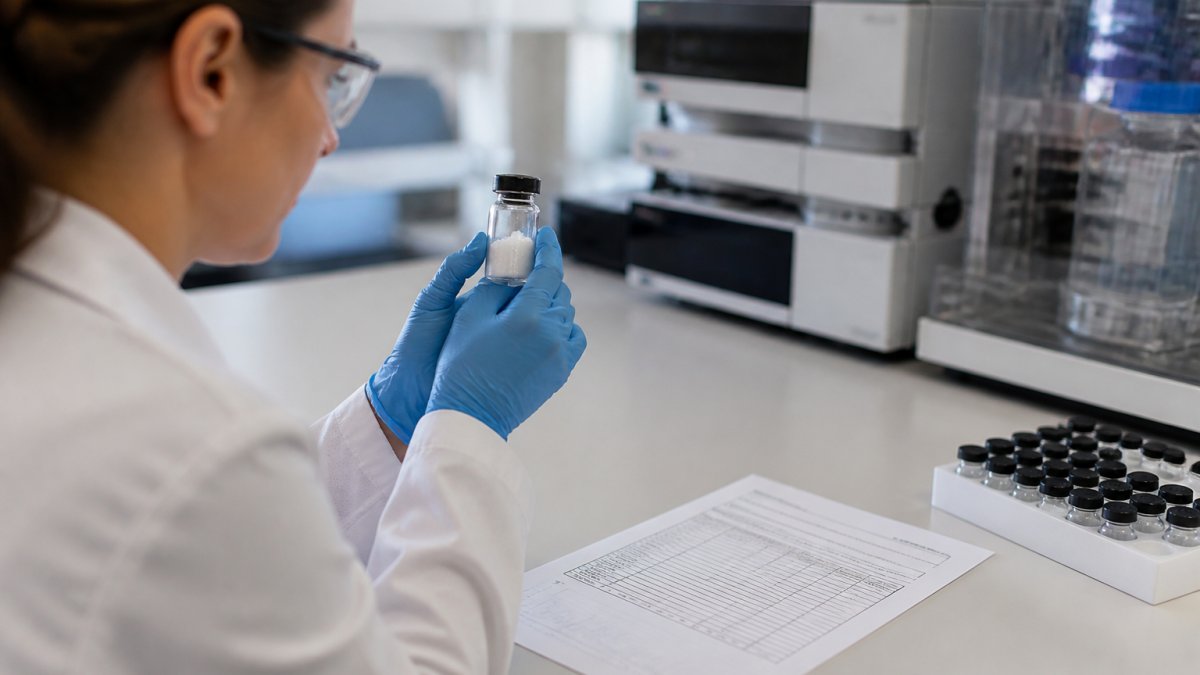
Watch out: a certificate that lists a batch number different from the vial in your hand is worse than no certificate at all, because it looks like assurance while proving nothing. For a step-by-step walkthrough of the testing methods themselves, see our guide on how to verify peptide purity.
What a Peptide Certificate of Analysis Should Contain
A peptide certificate of analysis (CoA) is a batch-specific document recording identity, purity and testing method for a defined lot. It is not proof on its own that the vial in your hand contains what the certificate describes, so understanding that limit matters for a defensible purchase.
The fields that must be present
A usable certificate should include:
- The peptide name and full sequence
- Lot or batch number matching the vial
- HPLC purity result with the chromatogram attached
- Mass spectrometry confirmation of the expected molecular weight
- Testing laboratory name, method and date
- Storage and handling notes
- Where relevant, residual solvent, water content and endotoxin results
What each field can and cannot prove
Identity. Mass spectrometry confirms the molecular weight matches the expected sequence. It does not confirm the sequence order, two isomers can share a mass.
Purity. The HPLC percentage is the area of the main peak as a share of total peak area. It says nothing about what the impurities are.
Sterility and endotoxin. A standard research-grade CoA usually does not test for bacterial endotoxin or sterility.
Batch traceability. The certificate is only meaningful if the lot number matches the vial. A certificate for a different batch is worse than none, because it looks like assurance while proving nothing.
Independent testing versus in-house testing
A certificate issued by the supplier's own laboratory is a starting point, not an independent verification. Third-party testing adds a layer of separation, and it is worth asking which accreditation body and which methods are in scope.
What a certificate cannot tell you
A CoA cannot tell you whether the product is lawful to import, whether it is safe for human use, whether the supplier's storage chain preserved the material, or whether the batch you receive matches the batch that was tested. Those are supply-chain and regulatory questions, covered in our sections on how to verify peptide purity and how to interpret a certificate of analysis.
A practical verification checklist
- Request the CoA before payment, not after.
- Match the lot number on the certificate to the vial on arrival.
- Confirm the chromatogram is attached and legible.
- Check whether testing was in-house or third-party, and by whom.
- Ask what the certificate does not cover, endotoxin, sterility, residual solvents.
- Keep the certificate with your batch records so the verification survives an audit or peer review.
A supplier that answers all six clearly is worth a trial order. One that deflects on lot linkage or chromatogram access is a documentation risk, however competitive the price.
Local Versus Overseas Peptide Suppliers: What Changes
The difference between local and overseas peptide suppliers comes down to three things: transit time, customs exposure and accountability.
Overseas orders can sit in customs for weeks, and some compounds face import restrictions that put the shipment, not just the schedule, at risk. Temperature-sensitive material that spends days in transit may arrive degraded, and pursuing a replacement across borders is slow.
Local suppliers can hold stock domestically and dispatch more quickly, which for time-sensitive experiments can be worth weighing alongside headline price.
The Peptide Supplier Quality Checklist
Run every prospective supplier through the same checklist before you commit budget:
- Certificate of analysis available before purchase, not after
- Batch number on the certificate matches the vial
- HPLC chromatogram supplied, not just a purity percentage
- Mass spectrometry confirmation included
- Testing performed by an independent third-party laboratory
- Storage and shipping conditions stated clearly
- Domestic stock held, with dispatch times confirmed
- Replacement or refund policy stated in writing
A supplier that passes all eight checks is worth a trial order. One that fails on independent testing or batch traceability is a risk you cannot defend in peer review, however competitive the pricing looks.
Regulatory Status and Safety for Australian Research Use
Most ranking pages either skip the regulatory picture or wave at it in a sentence. That is the single biggest gap on this query, because the word "alternative" only means something once you know what is legally and clinically available. Here is the framework a researcher or clinician actually needs.
Three categories, three different rules
Australian regulation does not treat "peptides" as one thing. It separates them into groups with different consequences:
- Registered therapeutic goods. A small number of peptide-based medicines are approved and listed on the Australian Register of Therapeutic Goods (ARTG). These have been assessed for quality, safety and efficacy, and are supplied on prescription.
- Prescription-only unapproved medicines. Some peptides are not registered but can be lawfully supplied to a patient under the prescriber's responsibility, typically through the Special Access Scheme or an authorised prescriber pathway administered by the Therapeutic Goods Administration (TGA). The prescriber carries the clinical and legal weight.
- Research-grade material. Sold for laboratory use only, not for human consumption. This is a lawful category, but it is not a back door to personal use, the label defines the permitted purpose, and using it otherwise shifts the risk onto the buyer.
Many popular research peptides sit in the second or third bucket, and some are scheduled poisons whose supply is restricted. The TGA's Poisons Standard is the instrument that determines scheduling, and the TGA's guidance on unapproved therapeutic goods sets out the access pathways. TGA guidance on unapproved therapeutic goods and the Special Access Scheme is the starting point, not a supplier's FAQ page.
What this means for import and purchase
Importing a scheduled or unapproved peptide without the correct permit or prescription can result in the shipment being seized, and in some cases penalties for the importer. Import controls are administered by the regulator, so confirm current requirements with the official source before ordering. A supplier that promises "discreet shipping" is describing a workaround, not a lawful pathway.
For laboratory work, the practical questions are narrower: is the compound scheduled, does the institution's chemical register permit it, and does the supplier's documentation survive an audit? If the answer to any of those is unclear, the material is not an alternative, it is an unquantified risk.
Safety risks that are specific to unapproved products
The clinical literature and regulator warnings converge on a consistent set of problems: identity errors (a different peptide or a truncated sequence), purity that is lower than advertised, contamination with residual solvents or endotoxins, and no pharmacovigilance pathway if something goes wrong. Because these products bypass the ARTG, there is no recall mechanism, no batch-linked adverse event reporting, and no manufacturer accountability chain in the way there is for a registered medicine.
If your work involves human participants, the requirements sit entirely outside what any supplier can provide: a medical consultation, ethics approval, and, for clinical trials, TGA oversight under the clinical trial framework. No certificate of analysis substitutes for those.
The honest comparison
When readers ask for the "best alternative", the answer depends on the intended use. For a registered clinical treatment, the alternative is another registered treatment chosen by a clinician. For laboratory research, the alternative is a verified reagent from a supplier whose documentation holds up. For personal use of an unapproved peptide, there is no lawful consumer alternative, only a prescription pathway or a decision not to proceed. Our article on the risks of unregulated peptide suppliers covers what goes wrong in practice.
Choosing Your Peptide Supplier for 2026
For research use, OptiPeps is a supplier you can evaluate. Every vial is HPLC-MS verified against a 99%+ purity standard, and each batch carries a public certificate of analysis you can check before ordering. Stock is held in our Melbourne facility, with same-day dispatch and free Express Post on orders over $100. Australian bank transfers carry no card surcharge.
| Criterion | What to Check | Why It Matters |
|---|---|---|
| Purity verification | HPLC-MS result per batch | Confirms identity and purity |
| Documentation | Public certificate of analysis | Defensible in peer review |
| Testing source | Independent third-party lab | Removes in-house bias |
| Dispatch | Domestic stock, same-day | Avoids customs delays |
| Payment | Bank transfer, no surcharge | Predictable cost |
Pricing depends on the sequence, quantity and modification, so check current pricing with OptiPeps directly.
Frequently Asked Questions
What is the closest thing to peptides for research use?
For in-vitro work, the closest alternatives are non-peptide small molecules and plant-derived compounds that act on similar pathways, plus established actives such as retinol in skin biology studies. None replicate a peptide's exact mechanism, so treat them as comparative controls rather than substitutes. If your protocol needs a specific sequence, the practical alternative is sourcing a verified research-grade peptide locally rather than switching compound class.
Can I buy peptides legally in Australia?
Legality depends on the specific compound and its scheduling status, not on the word peptide. Many research compounds fall under scheduling controls that restrict supply to legitimate research or prescription channels. Before ordering, confirm the compound's current scheduling status and check that the supplier can provide batch documentation and a certificate of analysis. If a supplier cannot tell you the compound's regulatory status, treat that as a red flag.
What should a peptide certificate of analysis include?
A defensible peptide certificate of analysis should name the compound and batch number, state the purity result with the analytical method used (HPLC and mass spectrometry identification), and identify the testing laboratory. Look for a chromatogram and mass spectrum, not just a purity percentage. Independent third-party testing carries more weight in peer review than in-house results, so check who signed the report and whether the batch number matches your vial.
Why choose a local peptide supplier over an overseas supplier?
Local supply can avoid customs delays that leave time-sensitive experiments waiting weeks. Overseas suppliers may offer lower unit costs, but factor in freight, holding time and the risk of degradation in transit. Pricing varies by quantity and compound, so confirm current costs directly with the supplier.
The real test of any supplier is whether you can defend the material in a review panel six months from now. Build your sourcing around traceable batches, independent testing and domestic dispatch, and that question answers itself. Get started with OptiPeps and source HPLC-MS verified peptides with certificates you can check before you buy.