Last Updated: November 6, 2026
Quick Summary
Research peptides made from amino acid chains are most often built by solid-phase synthesis, where each residue is added one at a time to a resin bead. The crude product is then cleaved from the resin, purified by reverse-phase HPLC, and tested for purity and identity.
- Peptides are short chains of amino acids joined by peptide bonds, and their sequence sets their identity.
- Solid-phase synthesis is the most common route for short research peptides, with excess reagents washed away after each step.
- Crude synthesis product contains truncated chains and leftover reagents, so purification by reverse-phase HPLC is essential.
- Each batch should be checked by analytical HPLC for purity and by mass spectrometry for molecular weight.
- Peptides are for in-vitro laboratory research only and are not medicines or suitable for human use.
Table of Contents
- What Research Peptides Are and How Amino Acids Link Together
- Overview of Peptide Production Methods: Chemical, Solution-Phase and Biological
- Solid-Phase Peptide Synthesis Step by Step
- Peptide Purification Methods After Synthesis
- Peptide Purity Testing, Characterisation and Certificate of Analysis
- Common Synthesis Failures, Storage and Research-Use Boundaries
- Checking a Supplier's Certificate of Analysis Before You Order
- Frequently Asked Questions
What Research Peptides Are and How Amino Acids Link Together
Research peptides made from short chains of amino acids are built one link at a time in a controlled process. Every peptide begins as a simple sequence of amino acids joined by peptide bonds, and the order of those amino acids sets the compound's identity. Small differences in how a chain is built can change the final result.
Peptides sit between single amino acids and full proteins. They are usually between two and about fifty residues long. For laboratory work, the length and sequence must be exact, because even one wrong residue can alter how a compound behaves in an in-vitro study.
- Amino acids are the building blocks, each with a shared backbone and a unique side chain.
- Peptide bonds form when the carboxyl group of one amino acid reacts with the amino group of the next.
- Sequence is the order of residues, and it defines the peptide's identity.
Here is the practical point for researchers. The process that builds a peptide is also the process that decides its purity, so understanding how research peptides made this way are produced helps you judge the quality of what you receive.
Overview of Peptide Production Methods: Chemical, Solution-Phase and Biological
There are three main routes for making peptides, and the right choice depends on length, sequence complexity, modifications, scale and the documentation you need. Chemical synthesis builds the chain residue by residue; solution-phase synthesis joins protected fragments in liquid; biological production uses living cells to express a peptide from a gene. Solid-phase chemical synthesis is the most common route for short research peptides. Longer sequences and proteins are more often produced recombinantly, while solution-phase or hybrid fragment approaches suit certain long or poorly soluble sequences and larger batches.
A practical decision guide looks like this:
-
Peptide length. Short sequences (roughly 2-30 residues) are usually straightforward by solid-phase synthesis. As length increases, coupling efficiency and purification losses compound, so recombinant expression or fragment condensation becomes more attractive.
-
Complexity and modifications. Non-natural amino acids, D-residues, cyclisation, lipidation, PEGylation and fluorescent labels are typically introduced chemically. Recombinant systems struggle with many of these unless the host is engineered.
-
Scale. Solution-phase and recombinant routes can be more economical at larger scale, though development time is longer.
-
Purity and documentation needs. Chemical synthesis gives a defined sequence with predictable impurity profiles that HPLC and mass spectrometry can characterise. Recombinant products can carry host-cell proteins, cleavage tags and glycosylation heterogeneity that require different analytical methods.
-
Solid-phase synthesis: the most common route for short research peptides, with easy automation and well-understood impurity profiles.
-
Solution-phase synthesis: useful for scale-up and certain fragments, but slower to purify and harder to automate.
-
Biological expression: suited to long sequences, but harder to control for exact modifications and host-derived impurities.
When you choose a supplier, ask which method they use and why. The answer tells you what purity problems to watch for and whether the analytical methods on the certificate of analysis actually fit the product.
Solid-Phase Peptide Synthesis Step by Step
Solid-phase peptide synthesis, often called SPPS, is the workhorse of research peptide production. The chain grows on an insoluble resin bead, so excess reagents and by-products can be washed away after each step. This makes the process fast and repeatable. Most short research peptides are made this way.
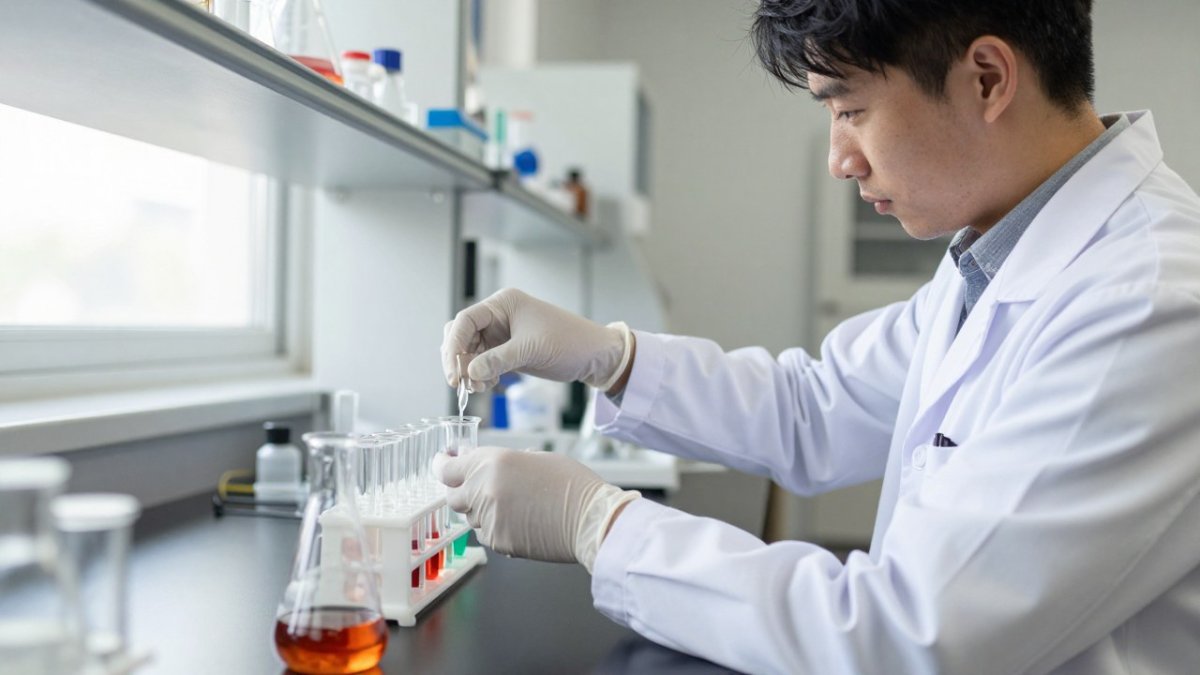
The process follows a clear cycle. Each residue is added, checked, and then the next one begins. Skipping or repeating a step leaves a flaw that shows up later in purity testing.
Choosing and Sequencing Amino Acids
The first job is to plan the sequence exactly. Each amino acid is selected for its position, and the order is written out residue by residue before any reagent is opened. Many failures start here, when a sequence is entered with a single typo that the chemist never catches.
A good practice is to double-check the sequence against the order document before synthesis begins. Watch out: a sequence error at this stage is invisible until analysis, and by then the batch is already spent.
Protecting Reactive Groups and Coupling Each Residue
Amino acids carry reactive groups that must be shielded so they only bond where intended. Temporary protecting groups cover these sites, leaving only the correct amino group free to react. The protected residue is then coupled to the growing chain using an activating reagent.
Coupling is the step where the peptide bond forms, and it is often repeated to push the reaction to completion. Incomplete coupling leaves gaps, which is one of the most common sources of impurities in finished peptides.
Cleavage and Removal of Protecting Groups
Once the full chain is assembled, the peptide is cleaved from the resin using a strong acid cocktail. This step also removes the side-chain protecting groups. The crude peptide is then precipitated and collected, ready for purification.
Cleavage needs careful timing. Too short and the peptide stays partly protected, too long and it can degrade. Small changes in this step can change the final purity, so it matters how the process is run.
The article's stages of solid-phase synthesis, each with what happens at that point, are summarised below.
| Stage | What happens | Key check |
|---|---|---|
| Choosing and sequencing amino acids | Sequence is planned residue by residue before synthesis | Double-check sequence against the order document |
| Protecting reactive groups and coupling | Protected residues bond to the growing chain | Repeat coupling to push reaction to completion |
| Cleavage and deprotection | Peptide is cut from resin and protecting groups removed | Control timing; too long can degrade the peptide |
Peptide Purification Methods After Synthesis
The crude product from synthesis is never pure enough for research. It contains truncated chains, deletion sequences and leftover reagents. Purification removes these unwanted materials and isolates the target peptide.
Reverse-phase high-performance liquid chromatography is the standard method. The crude mixture passes through a column, and the target peptide separates from its impurities based on how strongly it binds. Fractions are collected, checked, and pooled.
- Collect fractions across the main peak only.
- Check each fraction by analytical HPLC before pooling.
- Freeze-dry the pooled product to create a stable powder.
Good purification is what turns a crude synthesis into a usable research compound. Skipping it or rushing it is one of the surest ways to end up with unreliable data.
Peptide Purity Testing, Characterisation and Certificate of Analysis
After purification, every batch should be tested to confirm both purity and identity. Analytical HPLC measures how much of the sample is the target peptide. Mass spectrometry confirms that the molecular weight matches the expected sequence. Together, these two tests give a clear picture of what you are buying.
The certificate of analysis, or CoA, is the document that records these results. A useful CoA lists the batch number, the purity percentage, the measured molecular weight, and the testing method used. Learn how to interpret a certificate of analysis for peptides to make sense of each field. OptiPeps publishes Certificates of Analysis for each batch, which lets researchers trace each order back to a specific test result.
- HPLC purity: the percentage of the main peak in the chromatogram.
- Mass spectrometry: confirms the molecular weight against the expected value.
- Batch number: links the CoA to the exact vial you receive.
Read the CoA with care. A high purity figure means little if the identity test is missing or the batch number does not match your vial.
Common Synthesis Failures, Storage and Research-Use Boundaries
Even well-run syntheses can fail, and the failure patterns are predictable. Incomplete coupling leaves deletion sequences that appear as earlier-eluting peaks on analytical HPLC and as a mass lower than expected. Oxidation of methionine, cysteine or tryptophan residues adds 16 Da per oxygen and shows as a later-eluting shoulder. Aggregation during synthesis or cleavage can bury reactive sites and reduce yield. Poor cleavage or incomplete deprotection leaves protecting groups attached, adding mass and complicating purification.
Storage and handling decide whether a correctly made peptide stays fit for purpose. Lyophilised peptides are hygroscopic, so weigh them quickly and equilibrate vials to room temperature before opening to avoid condensation. Most practitioners store dry powder at -20 °C or lower, protected from light and moisture, and store reconstituted stock aliquoted at -80 °C. Repeated freeze-thaw cycles cause aggregation and loss of activity, so aliquot working stocks rather than refreezing the parent vial.
Research peptides are for in-vitro laboratory use only. They are not medicines, and a manufacturing explanation does not establish safety, sterility, absence of endotoxin or suitability for human or veterinary use. In Australia, therapeutic goods are regulated by the Therapeutic Goods Administration, and materials supplied for research are distinct from approved medicines. Handle peptides under your institution's safety and ethics rules, use appropriate personal protective equipment, and follow local requirements for disposal of sharps, solvents and biological waste.
Checking a Supplier's Certificate of Analysis Before You Order
Before placing an order, check the supplier's CoA against a short list of questions. This protects your experiment and your budget, and it gives you something defensible to show in peer review.
- Is the purity figure backed by a chromatogram, not just a single number?
- Does the molecular weight match the sequence you ordered?
- Is there a batch number that links the CoA to your vial?
- Were the tests run by an independent laboratory?
- Does the supplier explain the method used for each result?
If any answer is unclear, ask the supplier before you buy. A reputable supplier will answer these questions openly. OptiPeps publishes Certificates of Analysis for each batch, and our Melbourne-based stock ships same-day, so you can check the data first and receive your order quickly through Australia Post Express.
Frequently Asked Questions
How are research peptides made?
Most research peptides are made by chemical synthesis, where amino acids are joined one at a time in a defined sequence. The most common approach is solid-phase peptide synthesis, in which the growing chain is anchored to an insoluble resin. Each cycle couples a protected amino acid, removes the temporary protecting group, and rinses away excess reagents. Once the full sequence is built, the peptide is cleaved from the resin, purified, and tested. Some longer peptides use biological expression in bacteria, yeast or mammalian cells instead, but chemical synthesis remains the usual route for short research sequences.
How is peptide purity tested?
Peptide purity is usually assessed with high-performance liquid chromatography (HPLC), which separates the target peptide from synthesis by-products such as truncated or incompletely deprotected chains. Mass spectrometry (MS) then confirms that the main peak has the expected molecular weight, so the sequence is verified as well as the purity. Results are reported as a percentage of the main peak area. Researchers should check the test method, the date and whether the analysis was done by an independent laboratory before relying on the figure in a peer-reviewed study.
What should a peptide certificate of analysis include?
A certificate of analysis should identify the peptide sequence, batch or lot number, net peptide content where relevant, the HPLC purity figure with chromatogram, the mass spectrometry result, and the date of testing. It should also state the testing laboratory and whether the results are independent or in-house. Researchers assessing a supplier can ask for batch-specific documents rather than generic templates, and confirm that the stated purity matches the batch they received. Pricing for analysis services depends on quantity and scope, so request a current quote directly from the supplier.
What is the difference between research peptides and therapeutic peptides?
Research peptides are supplied for in-vitro laboratory use, such as cell-based or biochemical experiments, and are not approved for human consumption or clinical treatment. Therapeutic peptides are manufactured under regulated good manufacturing practice, with formal clinical evidence and regulatory approval. Their quality standards, documentation and intended use are therefore different. Researchers should use research-grade materials only within the scope of approved laboratory work and follow their institution's ethics and biosafety requirements.