Table of Contents
- What to Check Before You Buy Research Grade Peptides With Express Shipping
- Research Peptides vs Therapeutic Peptides: Why the Distinction Changes What You Can Buy
- How to Verify Peptide Supplier Quality Before You Commit
- The Peptide Certificate of Analysis: What a Defensible COA Contains
- Research Peptide Shipping and Delivery: Express Options Compared
- How OptiPeps Handles Express Dispatch, Pricing and Batch Traceability
- Returns, Damaged Parcels and Delivery Support
- Conclusion
- Frequently Asked Questions
Last Updated: October 21, 2026
What to Check Before You Buy Research Grade Peptides With Express Shipping
Speed means nothing if the vial that arrives is the wrong compound, degraded, or undocumented. At OptiPeps, we see the same pattern repeatedly: researchers prioritise delivery time, then discover the batch paperwork is thin.
Buying research grade peptides with express shipping is a two-part decision: the compound must be verified, and the parcel must arrive intact and traceable. Neither half works alone.
The Five-Point Pre-Order Checklist
Run this before you commit to any order:
- Purity claim stated numerically. "High purity" is marketing. Look for a stated figure and the method used to reach it.
- COA available before purchase. If you have to ask after paying, that is a warning sign.
- Batch or lot number on the listing. No lot number means no traceability.
Research Peptides vs Therapeutic Peptides: Why the Distinction Changes What You Can Buy
Research peptides are compounds supplied for laboratory and in-vitro investigation only. Therapeutic peptides are medicines evaluated and approved for treating patients.
That difference governs everything about the transaction. Research-grade material is sold as a laboratory reagent, not a treatment.
The practical consequence: you are not comparing medicines. You are comparing reagents, and reagents are judged on documentation, purity, and handling.
How to Verify Peptide Supplier Quality Before You Commit
Verification is a paperwork exercise, not a trust exercise. Four checks do most of the work:
- Ask for the COA for the exact lot you will receive, not a sample certificate from a previous run.
- Confirm the testing laboratory is independent of the supplier. In-house results are a starting point, not a defence.
- Check the analytical method. HPLC gives you a purity figure; mass spectrometry confirms identity. You want both.
- Look for a published dispatch policy with a stated cut-off and carrier.
Reading a Purity Report Without Being Misled
A purity percentage is only meaningful alongside its method. A figure quoted without HPLC or MS backing is unverifiable. Check that the chromatogram shows a single dominant peak, that the retention time matches the expected compound, and that the mass-to-charge result is consistent with the expected molecular weight.
If a supplier publishes a number but no chromatogram, you have a claim rather than evidence.
The Peptide Certificate of Analysis: What a Defensible COA Contains
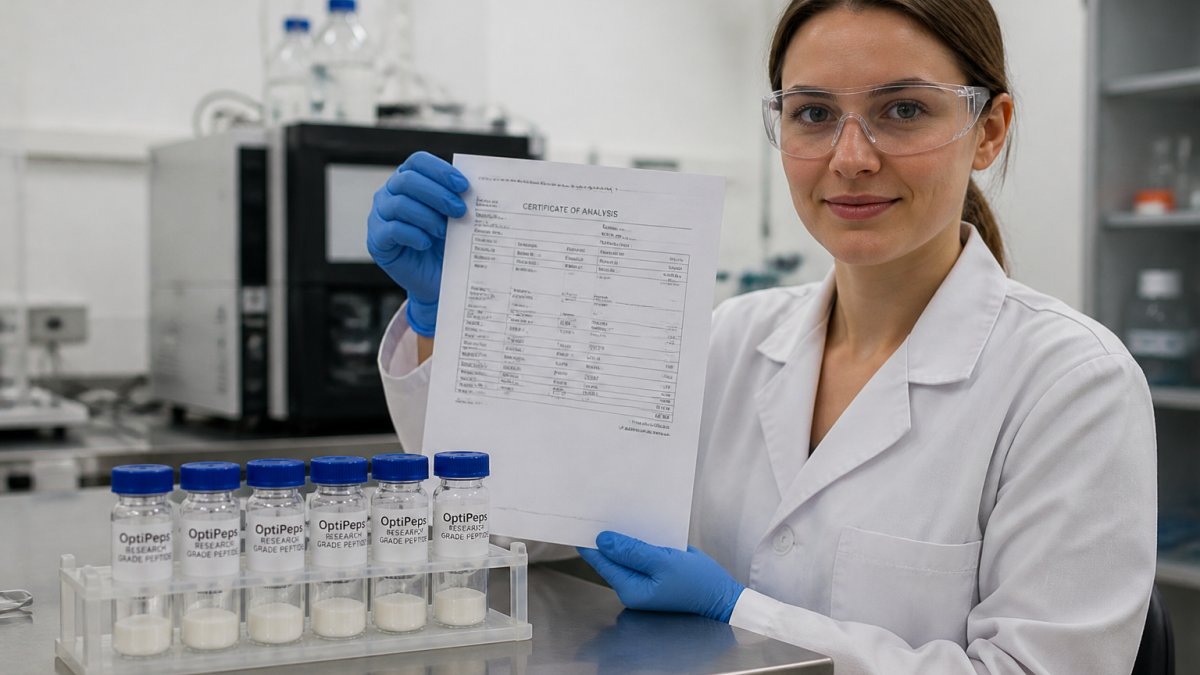
A defensible COA ties a specific batch to specific test results. It should state the compound name, the lot or batch number, the date of analysis, the testing laboratory, the analytical methods used, the measured purity, and the identity confirmation result.
Research Peptide Shipping and Delivery: Express Options Compared
Express shipping is defined by three things: dispatch cut-off, carrier, and transit time. A supplier can only control the first two. Anything beyond that sits with the carrier. The table below sets out what to compare across suppliers, followed by the practical detail that determines whether an express order actually arrives when you need it.
| Shipping Element | What to Look For | Why It Matters |
|---|---|---|
| Dispatch cut-off | Published same-day time (for example, orders placed before 2pm AEST) | Determines whether day one counts |
| Carrier | Named, trackable service such as Australia Post Express Post | Untracked parcels cannot be chased |
| Transit time | Stated by destination and postcode | Sets realistic experiment dates |
| Packaging | Insulated, discreet, sealed, with cold-chain protection where required | Protects compound integrity in transit |
| Free threshold | Published order value, quoted in AUD | Changes the true cost per order |
| Signature requirement | Stated at checkout | Affects delivery to unattended addresses |
State-by-State Delivery Estimates and What Can Delay a Parcel
Metro addresses in most states typically sit within the carrier's next-business-day network. The practical approach is to check the Australia Post Express Post network guide for your postcode before ordering, because the national next-business-day guarantee applies only within the defined Express Post network (Express Post guarantee - business).
Common delays come from incomplete addresses, orders placed after the dispatch cut-off, public holidays, and carrier network disruptions. Temperature extremes in transit are a separate concern, which is why insulated packaging matters for lyophilised material.
Transit Safeguards: What Protects the Compound Between Dispatch and Delivery
Packaging is the part of express shipping suppliers most often describe vaguely. A defensible approach covers four things:
- Insulation and phase-change materials. For lyophilised compounds, a sealed vial in a padded outer is usually sufficient for short domestic transit. For anything requiring cold chain, look for a stated temperature range and a phase-change pack rated for the expected transit time.
- Tamper evidence. A sealed outer and a vial cap that shows interference give you a way to tell whether the parcel was opened in transit.
- Discreet outer labelling. The outer should not describe the contents. This is standard practice for research reagents and reduces the risk of opportunistic interference.
A Practical Express Ordering Sequence
- Confirm the compound and lot are in domestic stock.
- Download the COA for that lot and check the batch number matches the listing.
- Note the dispatch cut-off and place the order before it.
- Keep the tracking number and the dispatch confirmation.
- Inspect the outer packaging and vial on arrival before discarding anything.
That sequence takes a few minutes and removes most of the avoidable delay from an express order.
How OptiPeps Handles Express Dispatch, Pricing and Batch Traceability
We built our operation around the two failure points researchers describe most: customs delays and unverifiable purity claims.
Every vial is HPLC-MS verified against a 99%+ purity standard before dispatch, tested by accredited third-party laboratories.
Pricing depends on the compound, vial size, and quantity, so we publish current figures on each product listing rather than quoting from memory. Australia Post Express Post delivery network publishes the current transit guidance by postcode.
Returns, Damaged Parcels and Delivery Support
Things go wrong in transit. A vial can arrive cracked, a parcel can be misrouted, and a cold chain can be stressed by an unexpected delay. What separates suppliers is what happens next, and the gap in most supplier pages is the absence of a clear process. The sequence below is what a defensible post-purchase process looks like.
What to Do When a Parcel Arrives Damaged or Incomplete
- Do not discard the outer packaging. Keep the box, the insulation, the packing slip and the vial exactly as received.
- Photograph everything. Take clear images of the outer packaging, the shipping label, the internal packing, the vial and any visible damage. Carrier claims are decided on evidence, and photographs taken before disposal are the evidence.
- Check the lot number against the COA. If the vial lot does not match the certificate supplied with the order, report it as a documentation discrepancy as well as a damage claim.
- Contact the supplier with the order number, the tracking number and the photographs. A supplier who holds batch-level records can match the parcel to the dispatch record and the COA for that lot.
- Keep the parcel until the claim is resolved. Carriers may require inspection or collection of the damaged item.
What a Supplier Should Be Able to Tell You
A supplier with traceable batches can answer four questions without guesswork: which lot was dispatched, which carrier service was used, what the dispatch timestamp was, and what the COA for that lot reports.
Australia Post damaged or missing item claims guidance sets out the evidence the carrier expects, including proof of posting, packaging condition and photographs. The same evidence supports a supplier-side investigation, which is why keeping the packaging matters for both routes.
Delays, Misroutes and Undelivered Parcels
A tracked parcel that has not moved for several business days is a carrier issue, not a supplier issue, but the supplier is the party who can open a carrier enquiry. Report the delay with the tracking number and the dispatch confirmation. If the parcel is confirmed lost, the remedy is a replacement or a refund, and the supplier's dispatch record is what establishes that the parcel left the facility in the first place.
What Is Not Covered
Research reagents are sold for laboratory use, and a supplier's returns policy typically excludes change-of-mind returns once a vial has left the controlled storage environment. The reason is integrity: a vial that has been in an uncontrolled environment cannot be verified on return. Damage, misroute and documentation discrepancies are the categories that a defensible policy does cover, and those are the ones to raise promptly.
Conclusion
Sourcing verified compounds quickly is a documentation problem disguised as a logistics problem. Suppliers who publish batch-level COAs, state a dispatch cut-off, and hold stock domestically remove most of the risk before the parcel leaves the building.
OptiPeps supplies HPLC-MS verified research-grade peptides with a 99%+ purity standard, public batch certificates, same-day dispatch from our Melbourne facility, and free Express Post on orders over $100.
Frequently Asked Questions
What should you check before buying research-grade peptides?
Confirm the supplier sells strictly for laboratory use, then check four things: a published purity figure backed by HPLC-MS, a batch-specific certificate of analysis you can download before ordering, domestic stock so customs cannot stall your parcel, and a written dispatch cut-off for express orders. Ask whether testing is done by an independent laboratory rather than in-house. If any of those four is missing or vague, treat the listing as unverified and request documentation in writing before you commit budget.
How can you verify a peptide supplier's purity claims?
Request the certificate of analysis for the exact lot number on the vial you will receive, not a sample COA from a different batch. Check that the document names the testing laboratory, the analytical method (HPLC and mass spectrometry), the purity percentage and the date of testing. Then confirm the lot number on the certificate matches the label. A supplier publishing batch-level COAs that anyone can look up before purchase is giving you something checkable; a supplier quoting a single headline purity figure across the whole catalogue is not.
How quickly can express shipping deliver research peptides?
Domestic express post typically lands in one to two business days for metropolitan addresses and two to four business days for regional areas, depending on the carrier and the dispatch cut-off. The variable that matters most is dispatch, not transit: a supplier that ships same day from local stock beats a faster carrier service that only collects the next morning. International orders add customs clearance, which can stretch to weeks and is outside the supplier's control.
What is the difference between research-grade and therapeutic peptides?
Research-grade peptides are manufactured and sold for in-vitro laboratory work and analytical research only. They are not registered therapeutic goods, are not assessed for sterility, endotoxin or human safety, and carry research-use-only labelling. Therapeutic peptides are pharmaceutical products that have passed the regulatory approval process for human use. The two are not interchangeable: a research-grade vial belongs on a laboratory bench, and buying one does not give you a medicine.
How should research peptides be stored after delivery?
Lyophilised peptide vials should go into a freezer at around -20°C on arrival, protected from light and kept dry. Check the vial and packaging for damage before you store it, and photograph anything that looks compromised so you can raise it with the supplier promptly. If a vial arrives warm, note it and contact the supplier before reconstituting. Once reconstituted, follow the storage guidance specific to that compound and keep a record of the reconstitution date alongside the batch number.