
Last Updated: October 26, 2026
Quick Summary
To avoid customs delays lab supplies, prepare accurate documentation including commercial invoices and packing lists, classify products correctly using Harmonized System codes, obtain required import permits before shipment, and coordinate with a customs broker. Most delays stem from missing paperwork, incorrect product classification, or undeclared permits, all of which are preventable with a structured checklist.
- Missing or incomplete documentation is the most common reason for customs holds on laboratory shipments.
- Biological materials, GMOs, controlled chemicals and blood-derived reagents require import permits with 2-4 week approval lead times.
- Temperature-sensitive materials like peptides need insulated packaging, data loggers and expedited inspection to prevent cold-chain degradation during clearance.
- Harmonized System codes differ by material type; peptides typically fall under HS 2904 or HS 2934 depending on purity and structure.
- A customs broker prevents delays by reviewing documentation 48 hours before arrival and responding to customs requests within 24 hours.
Table of Contents
- Why customs delays happen for lab supplies
- Step 1: Prepare accurate laboratory supplies import documentation
- Step 2: Classify products correctly using Harmonized System codes
- Step 3: Obtain import permits for laboratory chemicals and biological materials
- Step 4: Use a customs clearance checklist for research materials
- Step 5: Coordinate with your freight partner and customs broker
- How to track a parcel held in customs and resolve the hold
- Sourcing lab supplies domestically to eliminate customs risk
- Frequently Asked Questions
Why customs delays happen for lab supplies
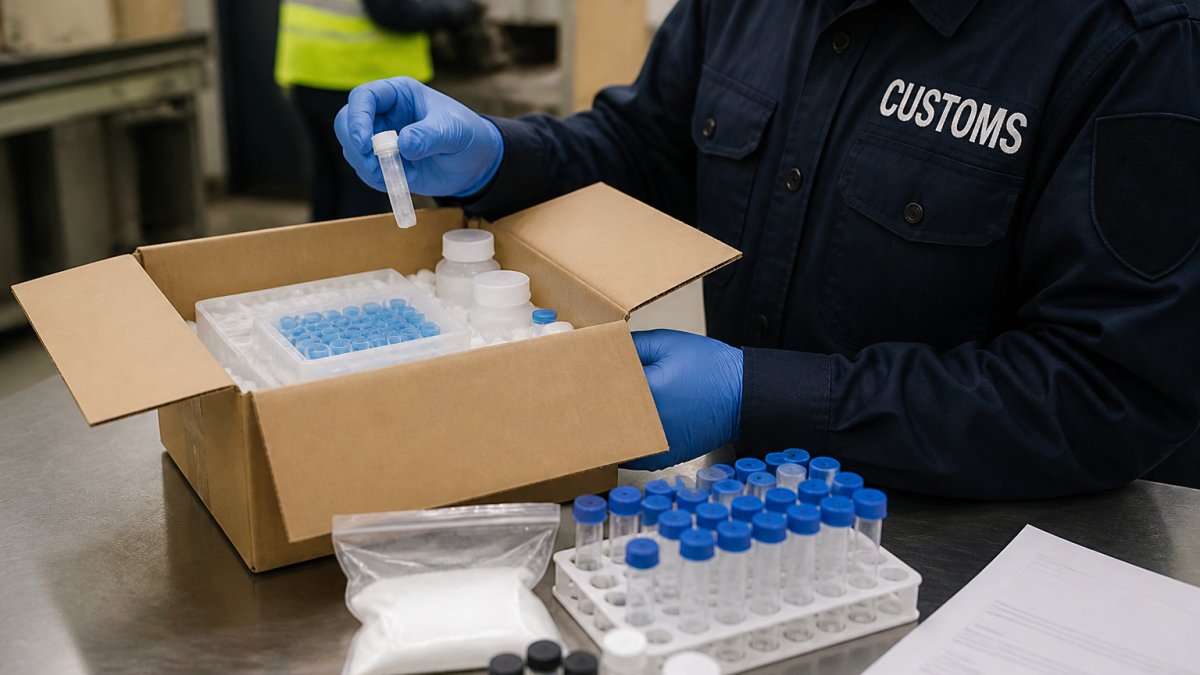
Customs delays lab supplies represent one of the most frustrating obstacles researchers face when importing laboratory materials internationally. The delays stem from a handful of recurring issues: missing documentation, incorrect product classification, missing permits, and inadequate packaging for border inspection. Similar customs challenges affect research chemicals, which face comparable documentation and classification requirements at the border.
Most delays are preventable. A single missing form or mislabelled carton can trigger a hold, and temperature-sensitive materials like peptides face extra scrutiny if the cold chain isn't documented.
Customs delays lab supplies can cost researchers weeks of lost time when preparation is poor. The good news is that understanding the process, and following a structured checklist, eliminates most holds. The Australian Border Force customs information portal outlines the core requirements, but lab-specific materials need extra attention.
Step 1: Prepare accurate laboratory supplies import documentation
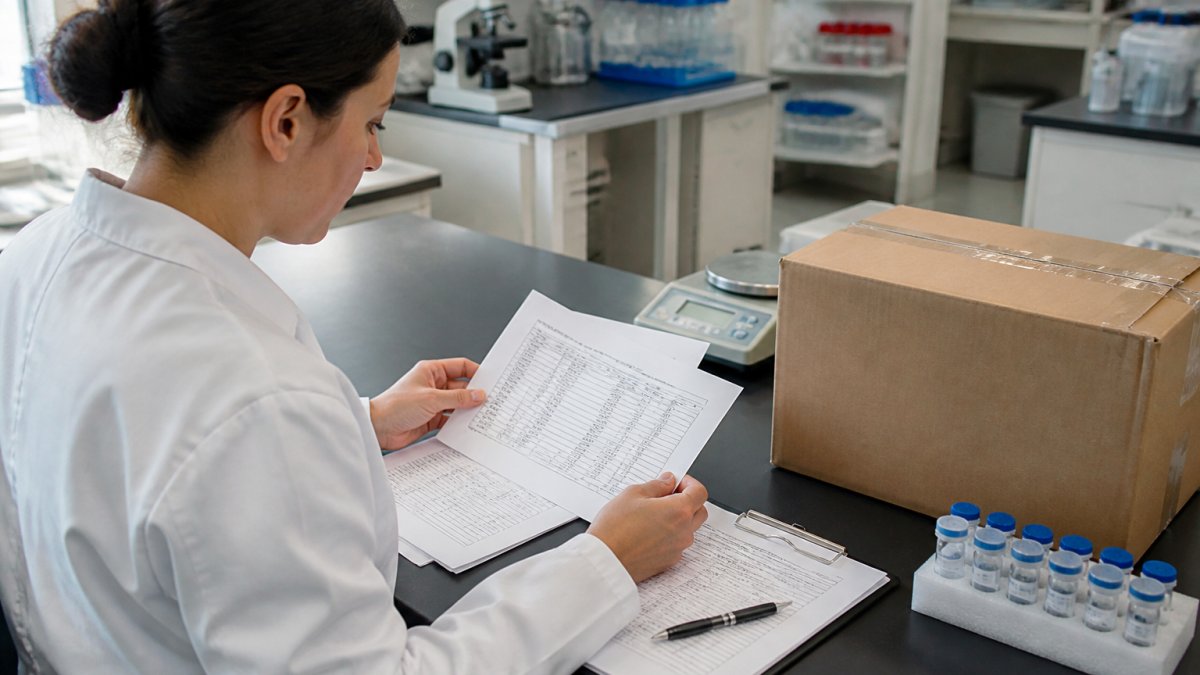
Accurate documentation is your first line of defence against customs delays. Missing or incomplete paperwork is the most common reason for holds.
Essential documents for every shipment
Every laboratory supplies shipment needs these core documents:
- Commercial invoice - states the item description, quantity, unit price, and total value
- Packing list - itemises contents by box or container, with weights and dimensions
- Customs declaration - formally declares the goods being imported
For peptides and research chemicals, add:
- Safety Data Sheet (SDS) - hazard classification and handling instructions
- Import permit - if required for your specific material (see Step 3)
- Shipper's declaration of dangerous goods - if the material is classified as hazardous
Customs officials cross-check these documents against the physical shipment. Discrepancies trigger holds. A packing list that says "10 vials" but the box contains 12 will cause a delay while officials investigate.
Common documentation errors that trigger holds
Incomplete or contradictory documentation is the fastest way to trigger a hold. Common mistakes:
- Vague item descriptions - "chemicals" or "lab supplies" instead of specific product names and chemical formulas; customs cannot classify vague descriptions.
- Mismatched quantities - the invoice lists 5 units but the packing list shows 6, forcing officials to verify which is correct.
- Missing batch or lot numbers - research materials need traceability, and omitting lot numbers raises biosecurity concerns.
Accuracy takes time but saves weeks later. Double-check every field before the shipment leaves the supplier.
Step 2: Classify products correctly using Harmonized System codes
Every product imported into Australia needs a Harmonized System (HS) code, which tells customs what the item is and what tariff rules apply.
The Australian Tariff Classification system provides the official codes and the Australian Border Force's tariff classification guidance. For laboratory supplies, the relevant codes typically fall under HS 2934 (nucleic acids and their salts; heterocyclic compounds) or HS 2941 (antibiotics and derivatives).
Classification by laboratory supply type
Most customs guides treat "lab supplies" as a single category, but classification, permit and handling requirements differ sharply by material type. Use the table below as a starting point, then confirm the exact code with your supplier and broker.
| Supply type | Typical HS families | Classification drivers | Extra border considerations |
|---|---|---|---|
| Synthetic research peptides | HS 2904 or HS 2934 | Purity, sequence, salt form, whether recombinant | Certificate of Analysis; SDS if hazardous; intended-use statement |
| Organic reagents and fine chemicals | HS 29xx series | Chemical composition, concentration, hazard class | SDS; dangerous goods declaration if applicable |
| Biological materials (cell lines, strains, viral samples) | HS 3002 or chapter-specific | Source organism, whether live, whether GMO | Biosecurity import permit; quarantine inspection |
| Antibodies and immunoassay reagents | HS 3002 or HS 3822 | Whether blood-derived, whether diagnostic-grade | Biosecurity conditions; cold-chain documentation |
| Laboratory instruments and equipment | HS 90xx series | Function, whether electrical, whether calibrated | Electrical safety marking; calibration certificates |
| Temperature-sensitive supplies (enzymes, kits, media) | Depends on composition | Active ingredient, whether biological, cold-chain needs | Dry ice declaration; temperature logger records |
| Consumables (tips, tubes, plates) | HS 3926 or 3923 | Polymer type, whether sterile | Sterility claims; packaging integrity |
This is not a substitute for a formal ruling, but a way to ask your supplier and broker the right questions before shipment.
How to confirm and document the code
Confirm the correct HS code with your supplier before shipment and include it on the commercial invoice and customs declaration. If customs disagrees, they may reclassify the goods and reassess duties, delaying clearance.
A practical pattern that reduces reclassification risk:
- Ask the supplier for the code in writing and keep the email or specification sheet on file.
- Match the code to the physical description on the invoice, the words should support the code, not contradict it.
- Record the reasoning in a short classification note (product name, composition, purity, intended use, code, source of advice) so you can supply it immediately if customs queries the shipment.
When in doubt, ask your customs broker or freight forwarder, or request a formal tariff classification ruling from the Australian Border Force. Misclassification is easier to fix before shipment, and a documented ruling gives you certainty for repeat orders.
Step 3: Obtain import permits for laboratory chemicals and biological materials
Some laboratory materials require import permits before entry; importing without one results in an automatic hold and potential confiscation. The permit landscape is material-specific, and the most common mistake is assuming a permit for one product covers a related product from the same supplier.
Which lab supplies require permits
Research materials that commonly require permits or pre-shipment conditions include:
- Biological materials, cell cultures, bacterial strains, viral samples, tissue and blood-derived reagents
- Controlled chemicals, precursors or regulated compounds listed under Commonwealth chemical controls
- Genetically modified organisms (GMOs), including recombinant peptides and modified cell lines
High-purity peptides used for in-vitro research may require a permit if recombinant or derived from restricted sources. Standard synthetic peptides for non-pharmaceutical research typically do not, but verify with your supplier or the relevant authority before ordering.
The Department of Agriculture's biosecurity import requirements details which materials need permits and the conditions attached to them. Apply for permits well before ordering.
Material-specific permit pathways
Different laboratory materials follow different pathways. The table below summarises common patterns; confirm the specific conditions for your product before shipment.
| Material | Likely permit or condition | Typical lead time | Key documentation |
|---|---|---|---|
| Synthetic research peptides | Usually no permit; SDS and CoA required | None | Commercial invoice, CoA, SDS |
| Recombinant peptides and proteins | Biosecurity permit may apply | 2-4 weeks | Permit, CoA, SDS, intended-use statement |
| Cell lines and microbial strains | Biosecurity import permit | 2-4 weeks | Permit, culture statement, packaging declaration |
| Blood-derived reagents | Biosecurity conditions; possible permit | 2-4 weeks | Permit or conditions, SDS, CoA |
| GMOs | Permit and containment conditions | 2-4 weeks or longer | Permit, containment statement, handling plan |
| Controlled chemicals | Commonwealth chemical control requirements | Varies | Import authorisation, SDS, end-use declaration |
| Soil, plant and animal material | Biosecurity permit and inspection | 2-4 weeks | Permit, phytosanitary or health certificate |
Biosecurity and quarantine requirements
Australia's biosecurity regime is strict.
Temperature control during quarantine inspection is critical: if the cold chain breaks during a biosecurity hold, the material may degrade. Ensure packaging includes temperature-monitoring labels and that the shipper notifies customs of temperature-sensitive contents.
Request an expedited biosecurity inspection if your material is time-sensitive, and label it clearly: "Temperature-sensitive research material, maintain 2-8°C" or as appropriate.
Step 4: Use a customs clearance checklist for research materials
A structured checklist prevents oversights. Use this before every shipment:
| Checklist Item | Status | Notes |
|---|---|---|
| Commercial invoice completed with HS code | ☐ | Include supplier contact details |
| Packing list matches physical contents | ☐ | Verify quantities and lot numbers |
| Customs declaration form filled and signed | ☐ | Declare actual value |
| Certificate of Analysis or batch certificate included | ☐ | Confirms purity and composition |
| Safety Data Sheet (SDS) attached if hazardous | ☐ | All hazard classes listed |
| Import permit obtained (if required) | ☐ | Attached to shipment documentation |
| Shipper's declaration of dangerous goods (if applicable) | ☐ | Correct hazard classification |
| Packaging labelled with contents and handling instructions | ☐ | "Keep cool" or temperature range if needed |
| Carton markings include lot/batch number | ☐ | For traceability |
| Shipper and receiver contact details on all documents | ☐ | Customs may need to contact either party |
| Cold chain documentation (if temperature-sensitive) | ☐ | Temperature logs or data loggers |
Complete this checklist with your supplier or freight forwarder before shipment. A few minutes here saves weeks later.
Step 5: Coordinate with your freight partner and customs broker
Your freight forwarder and customs broker are your allies in avoiding delays.
A customs broker submits your documentation, answers questions, and coordinates clearance. For laboratory materials, a broker is worth the fee, they prevent delays that cost far more than brokerage charges.
Provide your broker with all documentation at least 48 hours before arrival so they can review forms, flag gaps, and submit pre-clearance notifications.
How to track a parcel held in customs and resolve the hold
If your shipment is held, act quickly, a hold unresolved for a week can degrade time-sensitive materials.
What to do when customs requests additional information
Customs will contact your broker or freight forwarder if they need more information. Common requests include:
- Clarification on product classification
- Proof of permit (if required)
- Additional SDS or safety documentation
Respond within 24 hours; delays extend the hold. If you don't understand the request, ask your broker to clarify. Do not guess or provide incomplete answers, customs will reject unclear responses and ask again.
If customs disputes your HS classification, ask your broker to request a formal ruling from the Australian Border Force. It takes longer but provides certainty, and customs may release the shipment under bond while the classification is resolved.
Temperature control and sample integrity during customs clearance
Cold-chain continuity is critical. If your shipment sits in a warm port facility for hours, peptides and other temperature-sensitive materials degrade.
Inform your shipper and freight forwarder that the material is temperature-sensitive. Request:
- Insulated packaging with ice packs or phase-change materials
- Temperature data loggers that record the temperature throughout transit and clearance
- Cold storage at the port if the shipment is held
If the cold chain breaks during clearance, the material may no longer meet specification.
Document the hold duration and temperature exposure. If the material is compromised, you can claim against the shipper or freight forwarder for breach of cold-chain protocol.
Sourcing lab supplies domestically to eliminate customs risk
The simplest way to avoid customs delays is to source lab supplies domestically: no hold, no temperature risk, no import documentation burden.
OptiPeps operates a Melbourne-based facility and stocks high-purity peptides for immediate dispatch. Every batch is HPLC-MS verified to 99%+ purity before shipment.
When you source domestically, you also gain traceability and accountability. Research from the Australian Academy of Science on supply chain resilience emphasises the value of local sourcing for time-sensitive research.
For researchers who need reliable, fast delivery without customs risk, learn more about our peptide supply service. For additional context on why domestic sourcing matters for your research, explore why Australian researchers choose local suppliers.
Frequently Asked Questions
What documents are needed to import lab supplies without customs delays?
Every shipment requires a commercial invoice, packing list, and customs declaration form. For regulated materials, you'll also need import permits from the Department of Agriculture, Water and the Environment (now part of the Department of Climate Change, Energy, Environment and Water), certificates of analysis, and safety data sheets. Accuracy is critical: mismatched descriptions between documents trigger holds. Include the Harmonized System code, quantity, unit price, and country of origin for each item. Missing or conflicting information is one of the top causes of customs delays.
How long does customs clearance typically take for laboratory supplies?
Standard clearance takes 1-3 business days if documentation is complete and correct. Biosecurity checks for biological materials add 2-5 days. If customs flags an issue, incorrect classification, missing permits, or undeclared contents, the hold can extend to 2-4 weeks while you provide clarification. Temperature-sensitive samples may face additional delays if cold-chain continuity is questioned. Advance planning and accurate pre-shipment documentation can reduce clearance time to the lower end of this range.
What happens if a laboratory shipment is held at customs?
Customs will contact your freight forwarder or broker with a notice of hold, specifying the reason: missing documents, incorrect classification, biosecurity concerns, or permit requirements. You then have a limited window (typically 5-10 business days) to provide the requested information or documentation. If the shipment contains temperature-sensitive samples, prolonged holds risk sample degradation. Contact your customs broker immediately to understand the exact issue, provide missing documents quickly, and arrange expedited clearance if the shipment is time-critical for your research.
Do laboratory supplies from local suppliers avoid customs delays?
Yes. Sourcing lab supplies domestically eliminates international customs clearance entirely, removing the risk of delays, biosecurity holds, and sample degradation during transit. Local suppliers operating within the country dispatch from domestic facilities and use domestic shipping partners, ensuring same-day or next-day delivery without border inspection. This is particularly valuable for time-sensitive research, temperature-sensitive compounds, and high-purity materials where international transit and customs holds pose a contamination or stability risk.
Customs delays are frustrating, but they're predictable. Accurate documentation, correct classification, proper permits, and coordination with your freight partner prevent most holds. When delays do occur, rapid response and cold-chain monitoring protect your materials. But the most reliable solution is sourcing lab supplies domestically. OptiPeps provides verified, same-day peptides without the customs risk. Get started today and eliminate delays from your research workflow.