Last Updated: November 10, 2026
Quick Summary
Peptide research stability and storage tips start with the freezer: store lyophilised powder at −20°C for routine work and −80°C for long-term archiving, kept dry, dark and sealed. Once reconstituted, store stock at 4°C short-term or aliquot and freeze at −20°C or −80°C, thawing only single-use aliquots and never refreezing them.
- Store lyophilised peptide powder at −20°C for routine work and −80°C for long-term archiving.
- Let vials equilibrate to room temperature before opening to reduce condensation inside the vial.
- Add solvent down the vial wall and swirl gently; avoid shaking, which drives aggregation.
- Aliquot into single-use volumes sized to one experiment, then freeze once and thaw once.
- Record storage temperature, duration, freeze-thaw count, solvent and concentration for every batch.
Table of Contents
- Why Peptide Stability Fails Before the Experiment Starts
- Lyophilised Peptide Storage: Temperature, Light and Moisture Control
- Reconstituted Peptide Stability: What Changes Once You Add Solvent
- Peptide Reconstitution Best Practices for Sterile, Accurate Work
- Managing Peptide Freeze Thaw Cycles With Aliquoting
- Handling Temperature Excursions and Contamination Risks
- Documenting Stability So Your Results Survive Peer Review
- Ordering Verified Peptides for Your Next Study
- Frequently Asked Questions
Why Peptide Stability Fails Before the Experiment Starts
Most failed assays don't fail at the bench. They fail weeks earlier, in the freezer. Peptide research stability and storage tips matter because a peptide that has degraded before you open the vial will give you clean, confident, wrong results, and these peptide research stability and storage tips start with the freezer.
Peptide stability is the ability of a peptide to keep its structure, purity and biological activity under defined storage and handling conditions. It is not a fixed property. It depends on temperature, moisture, light, solvent and how many times the vial changes state.
Degradation Pathways That Matter in Practice
Four pathways do most of the damage:
- Hydrolysis, water splits peptide bonds, especially at aspartate and asparagine residues
- Oxidation, methionine and cysteine residues react with oxygen
- Deamidation, asparagine converts to aspartate over time, shifting charge
- Aggregation, peptides clump into insoluble forms that won't dissolve properly
A common mistake is assuming a sealed vial is a protected vial. It isn't. Moisture and oxygen creep in over months.
Guide to peptide handling and stability from the European Pharmacopoeia sets out general storage principles worth knowing before you design your own protocol.
Lyophilised Peptide Storage: Temperature, Light and Moisture Control
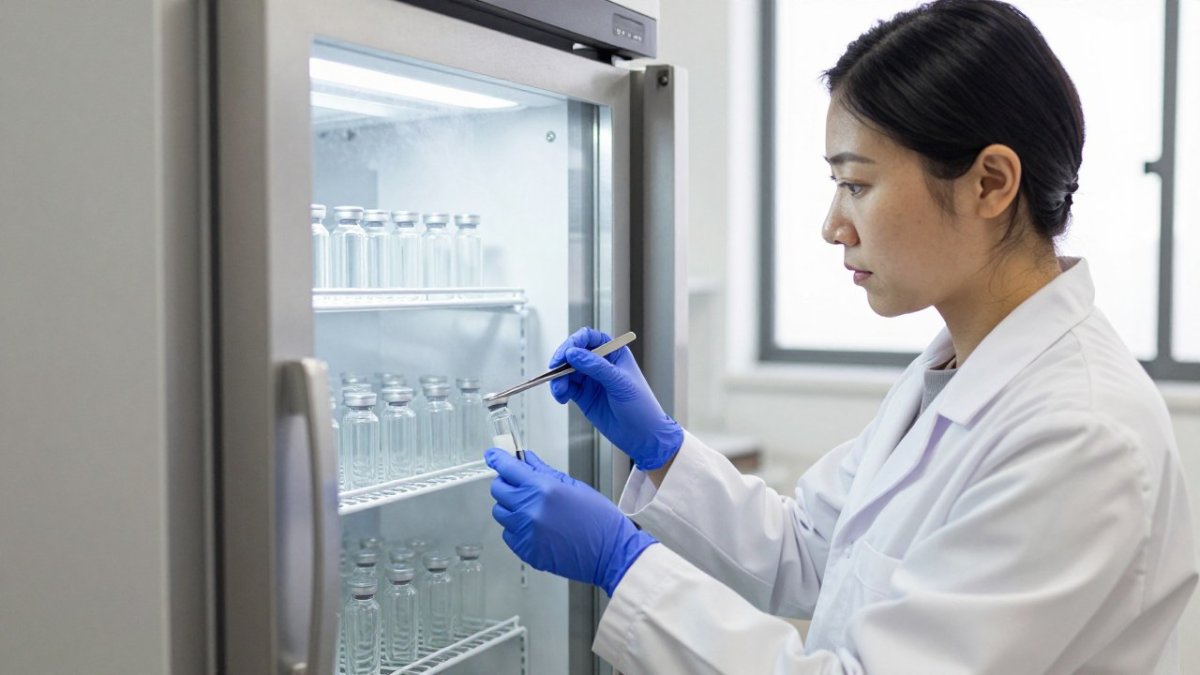
Store lyophilised peptide powder at −20°C for routine work and −80°C for long-term archiving. Keep it dry, dark and sealed. That single sentence covers most of what you need.
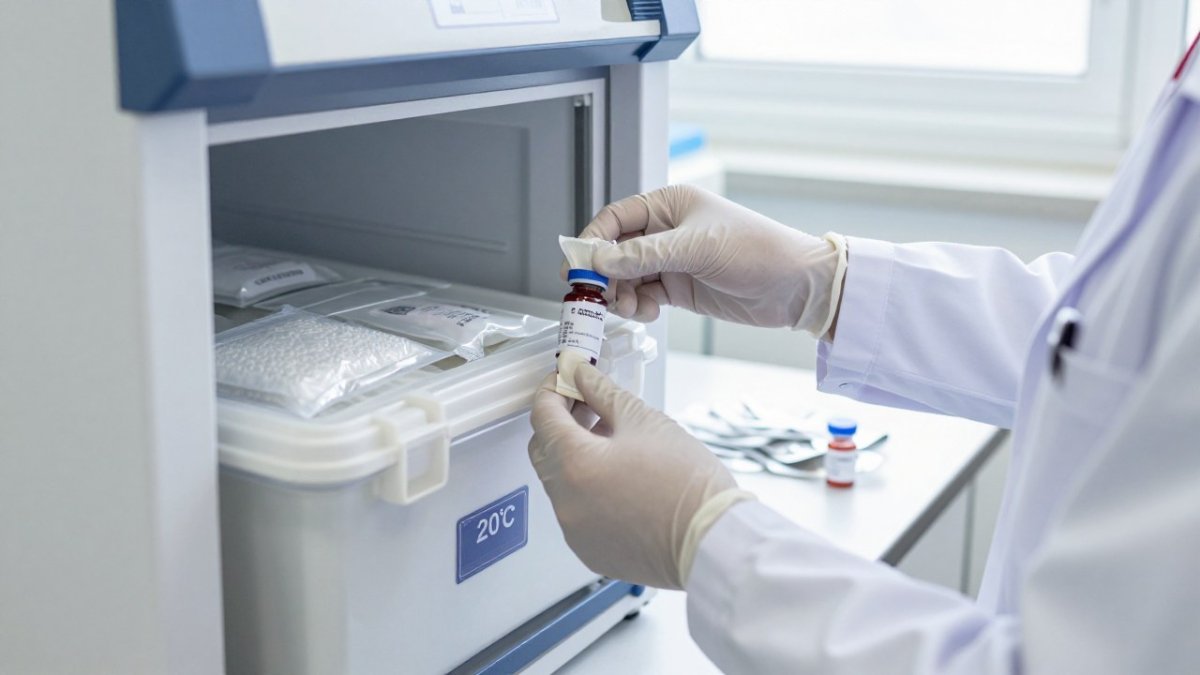
The dry state is more forgiving than solution, but not invincible. Desiccant in the container helps. Foil wrap or an amber vial blocks light exposure. Let vials equilibrate to room temperature before opening to reduce condensation inside the vial.
Lyophilised peptide storage rules in short:
- Keep vials sealed until the moment of use
- Avoid repeated warming and cooling of the whole stock
- Store in a dry environment
- Protect from direct sunlight at all times
If you're weighing lyophilised powder against a reconstituted solution for a specific assay, our comparison of lyophilised peptide vs peptide solution for lab assays covers how each format behaves.
Reconstituted Peptide Stability: What Changes Once You Add Solvent
Reconstituted peptide stability differs from the dry powder, and the difference is not uniform. Once you add solvent, hydrolysis, oxidation, deamidation and microbial growth all become live risks, and the rate at which each proceeds depends on the solvent, the pH, the peptide concentration and the container. Reconstituted peptide stability depends on the sequence, solvent, pH and concentration, so check the product documentation for guidance on a specific peptide.
The practical baseline:
- Store reconstituted stock at 4°C for short-term use
- Aliquot and freeze at −20°C or −80°C for longer storage
- Avoid aqueous buffers at neutral pH for extended periods where the sequence allows
- Check for visible particles, cloudiness or colour change before each use
Why Solvent Choice Changes the Clock
Solvent is not a neutral carrier. Sterile water suits many hydrophilic peptides, but it offers no buffering capacity, so small amounts of acidic or basic residues can shift pH unpredictably. Dilute acetic acid can help dissolve some basic peptides.
A common pattern is to match the solvent to the peptide's character and then keep the final concentration high enough to allow clean aliquoting without excessive dilution.
Watch out: a solvent that dissolves the peptide cleanly is not automatically a solvent that preserves it.
pH and Concentration Effects
pH is one of the strongest single levers on reconstituted stability. Deamidation of asparagine is base-catalysed and accelerates as pH rises toward neutral and above. Hydrolysis is both acid- and base-catalysed, so extremes in either direction carry risk.
Concentration matters in two directions. Higher concentration reduces adsorptive loss and makes aliquoting more accurate, but it also raises the chance of aggregation for sequences prone to self-association. Lower concentration preserves solubility but increases surface adsorption and makes small volume errors more consequential.
Container Compatibility
Not every plastic is inert. Some peptides adsorb to certain polymer surfaces, and some solvents leach compounds from containers that then interfere with assays. Low-binding tubes are worth considering for dilute solutions of hydrophobic or sticky sequences. Glass can be preferable for some solvents but brings its own adsorption behaviour. Whatever container you choose, keep it consistent across a study so that container effects do not become a hidden variable.
Sequence-Specific Stability
What most guides miss is that sequence matters enormously. A peptide with multiple methionines oxidises faster than one without. A sequence rich in asparagine deamidates faster at neutral pH. Peptides with N-terminal glutamine can cyclise to pyroglutamate. Sequences prone to beta-sheet formation aggregate more readily in aqueous solution.
If you are weighing a dry format against a solution for a specific assay, our comparison of lyophilised peptide vs peptide solution for lab assays covers how each format behaves.
Peptide Reconstitution Best Practices for Sterile, Accurate Work
Good peptide reconstitution best practices start before the solvent touches the powder. Work cleanly, work slowly, and never shake.
- Wipe the vial septum with 70% ethanol and let it dry
- Use sterile technique throughout
- Add solvent down the vial wall, not directly onto the powder
- Swirl gently to dissolve; avoid shaking, which drives aggregation
- Let it sit for a few minutes before judging whether it has dissolved
Solvent, pH and Concentration Choices
Solvent choice changes stability. Sterile water suits many hydrophilic peptides. Dilute acetic acid helps dissolve basic peptides. DMSO works for hydrophobic sequences but needs care with freeze-thaw. Match your solvent to the peptide's character, and keep the final concentration high enough to allow clean aliquoting.
Managing Peptide Freeze Thaw Cycles With Aliquoting
Every freeze-thaw cycle costs you peptide. Ice crystal formation, transient concentration shifts at the thawing edge and repeated exposure to condensation all damage the molecule, and the damage is cumulative. The fix is simple in principle: aliquot once, freeze once, thaw once. The execution is where most labs lose material.
A Workflow That Holds Up
- Reconstitute the full vial according to the peptide-specific protocol, using the solvent and concentration that suit the sequence.
- Let the solution equilibrate briefly so that concentration is uniform before you divide it.
- Aliquot into single-use volumes sized to one experiment, not to one week of experiments.
- Label each aliquot with peptide identity, lot number, concentration, solvent, date of reconstitution and the initials of the person who prepared it.
- Freeze immediately at −20°C or −80°C, flat, so that aliquots freeze evenly.
- Thaw only the aliquot you need, on ice or at 4°C, and never refreeze the remainder.
Single-use aliquots are a useful control for limiting freeze-thaw damage. They convert an uncontrolled variable into a known one, because each aliquot has exactly one thaw event in its history.
Labelling and Access Control
A label that says only the peptide name is not a label. Without lot number and reconstitution date, you cannot reconstruct the aliquot's history when a result looks odd months later.
Access control matters as much as labelling. Repeated opening of a freezer box raises the temperature of everything inside, and repeated handling of individual vials adds contamination risk. Keep the working stock small and the archive stock untouched.
Watch out: thawing a large stock vial, taking what you need, and refreezing it repeatedly is the most common way researchers quietly destroy a batch.
Thawing Technique
Thaw on ice or at 4°C, not at room temperature and not in a warm water bath unless the peptide-specific protocol calls for it. Rapid warming can promote aggregation for some sequences, and a water bath introduces a contamination route. Once thawed, keep the aliquot cold and use it within the working day where the assay allows.
When Aliquoting Is Not Enough
Aliquoting controls freeze-thaw, but it does not control everything. If a peptide is prone to adsorption, the aliquot container matters. If it is prone to aggregation, the concentration and solvent matter. If it is sensitive to oxidation, headspace and dissolved oxygen matter. Treat aliquoting as one control among several, and record the others alongside it so that the handling history is complete.
Handling Temperature Excursions and Contamination Risks
Temperature excursions happen. A freezer door left open, a courier delay, a power failure. What matters is how you respond.
- Note the duration and estimated peak temperature of any excursion
- For brief excursions of a sealed dry vial, the risk is usually low
- For reconstituted peptide, treat a significant excursion as a stability event and re-check purity before use
- Quarantine affected vials rather than guessing
Contamination control runs alongside this. Use sterile technique, filter where appropriate, and never reuse a needle across vials. Handling consistency across your team matters as much as any single step.
Documenting Stability So Your Results Survive Peer Review
Documentation is where good lab work either holds up or falls apart. Record storage temperature, duration, number of freeze-thaw cycles, solvent and concentration for every batch.
Keep a simple stability log:
| Record | Why it matters |
|---|---|
| Storage temperature and duration | Shows conditions were controlled |
| Freeze-thaw count per aliquot | Flags cumulative handling stress |
| Solvent, pH and concentration | Explains dissolution behaviour |
| Purity check date and method | Supports result validity |
Our guide to verifying peptide purity in the lab walks through the checks that make this documentation defensible. If you want to understand how impurities skew results in the first place, read how to stop peptide impurities skewing your assays.
Ordering Verified Peptides for Your Next Study
Storage discipline only protects a peptide that arrived intact. If the starting material is degraded or mislabelled, no amount of careful handling will save the experiment.
At OptiPeps, every vial is HPLC-MS verified to a 99%+ purity standard before dispatch, with batch-level Certificates of Analysis you can pull and check yourself. You can browse batch-level Certificates of Analysis for any product before ordering. When you're ready, you can shop our research-grade peptides.
Getting storage right is unglamorous work, but it's the difference between data you can publish and data you have to throw away. Build a simple protocol around temperature control, single-use aliquots and honest documentation, and your peptides will do what you paid for.
Frequently Asked Questions
Do peptides need to be refrigerated or frozen?
It depends on the state of the peptide. Lyophilised peptide powder is best held at -20°C for long-term storage, with -80°C used for sequences known to degrade quickly. Short-term holding at 4°C is acceptable for vials in active use. Once reconstituted, most peptides are kept at 4°C and used within days to a few weeks, or aliquoted and frozen at -20°C or below for longer work. Always follow the supplier's certificate of analysis and handling notes for the specific sequence.
Can repeated freeze-thaw cycles damage peptides?
Yes. Each freeze-thaw cycle stresses the peptide through ice crystal formation and concentration shifts in the remaining liquid, and the damage accumulates. The practical fix is to aliquot the reconstituted solution into single-use volumes before the first freeze, then thaw only what you need for that day's work. Keep aliquots small, label them with concentration and date, and discard any aliquot that has been through more than one thaw.
How should lyophilised research peptides be stored?
Keep lyophilised peptide storage conditions dry, cool and dark. Store sealed vials at -20°C in a desiccator or with desiccant, away from direct sunlight and humidity. Let a vial reach room temperature before opening it, so condensation does not form on the powder. Once opened, minimise air exposure, reseal tightly and return it to the freezer promptly. Record the date of first opening so you can track shelf life against the batch documentation.
How long do peptides remain stable after reconstitution?
There is no single answer because stability depends on the sequence, solvent, pH and concentration. Many reconstituted peptides hold up for a few weeks at 4°C, while others lose potency within days. Rather than assume, check the supplier's documentation, keep the solution sterile and protected from light, and run a small pilot to confirm activity over your intended use window. Document the reconstitution date on every vial so you can trace any drop in performance back to age.