

Last Updated: November 13, 2026
Quick Summary
Research peptide payment usually runs through card processing, bank transfer or cryptocurrency, and you should match the method to your institution's procurement rules before checkout. Confirm batch documentation and cancellation terms first, because peptide payment methods differ in fees, settlement speed and how cleanly refunds can be reconciled.
- Card networks treat research chemicals as higher-risk, so some processors add scrutiny or surcharges.
- Bank transfer suits institutions needing a clean invoice trail and purchase order reference.
- Cryptocurrency complicates reconciliation and is often unsuitable for institutional purchasing.
- Ask whether testing is by an accredited third-party laboratory and references your exact batch.
- OptiPeps holds stock in Melbourne and dispatches same day before the daily cutoff via Australia Post Express.
Table of Contents
- Why Research Peptide Payment and Ordering Needs More Care Than a Standard Online Purchase
- The Research Peptide Ordering Checklist Before You Reach Checkout
- Research Peptide Payment Methods: What Each One Means for Your Lab
- How the Peptide Certificate of Analysis Verifies What You Paid For
- Why Peptide Suppliers Face High-Risk Merchant Account Scrutiny
- Research Peptide Shipping and Returns: What to Expect After Payment
- Payment Security, Privacy and Legal Considerations for Buyers
- Placing Your First Order with OptiPeps
- Frequently Asked Questions
Why Research Peptide Payment and Ordering Needs More Care Than a Standard Online Purchase
A research peptide payment and ordering process carries risks a normal online purchase does not.
Researchers often focus hard on the science and treat checkout like buying a book online. That is where problems start.
Below, we break down the full research peptide payment and ordering process, from the pre-checkout checklist to what happens if something goes wrong after payment.
The Research Peptide Ordering Checklist Before You Reach Checkout
A research peptide ordering checklist forces the quality questions to the front of the process, before money changes hands.
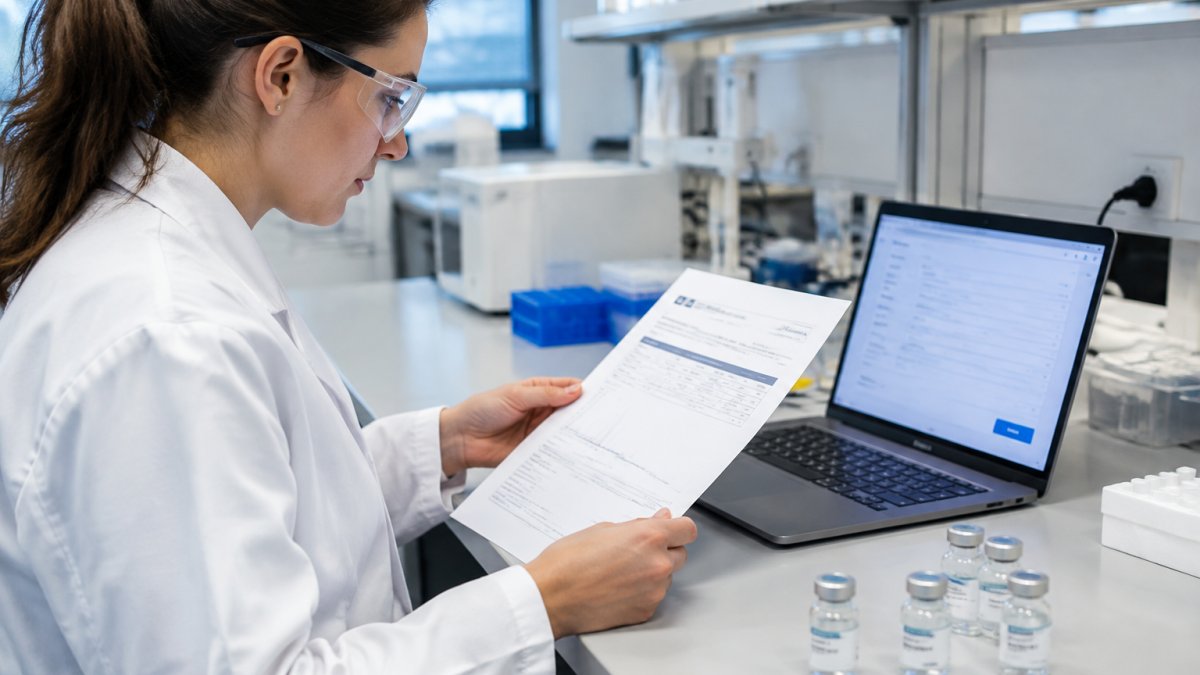
Researchers who get burned often skip this step. They find a supplier, like the price, and pay before checking documentation.
Confirming the compound, quantity and batch documentation
Start with the specification. Confirm the exact sequence, quantity, and any modifications your protocol requires. Niche modifications are where suppliers quietly fall short, so ask whether the compound is stocked or made to order.
Then ask for batch documentation before you pay. A legitimate research-use-only supplier should point you to a certificate of analysis for the specific batch you will receive, not a generic sample.
- Sequence and modifications confirmed in writing
- Quantity and vial format match your protocol
- Batch-specific certificate of analysis available
Matching the supplier's terms to your institution's procurement rules
Universities and CROs rarely let you buy whatever you like from whoever you like. Purchase orders, approved supplier lists and record-keeping requirements usually apply.
Check the supplier's terms against those rules before checkout. If you need a formal quote, an invoice with an ABN, or audit-ready documentation, confirm it upfront. For more, see our guide to research peptide procurement compliance requirements.
Research Peptide Payment Methods: What Each One Means for Your Lab
Research peptide payment methods fall into three groups: card processing, bank transfer, and cryptocurrency. Each carries different implications for fees, speed, privacy and reconciliation.
Match the method to your institution's accounting rules first and personal preference second. A payment that cannot be reconciled against a purchase order creates work for someone else and delays your order.
Card processing, bank transfer and cryptocurrency compared
Card payments are familiar and easy to reconcile against a statement, but card networks treat research chemicals as higher-risk, so some processors add scrutiny or surcharges. A supplier may pass on a card surcharge, which is lawful in Australia provided it does not exceed the reasonable cost of acceptance (Businesses reminded to review their card surcharges and pricing information).
Bank transfer suits institutions needing a clean invoice trail and a purchase order reference. It is usually the cheapest method for the supplier to accept, which is why some discount it or waive card surcharges on bank-transfer orders.
Cryptocurrency offers a different privacy profile but complicates reconciliation and is often unsuitable for institutional purchasing. Network fees vary with congestion, the AUD value can move between quote and confirmation, and most university finance systems have no clean way to record the transaction.
| Method | Typical settlement | Best for | Main drawback |
|---|---|---|---|
| Card processing | Near-instant authorisation; funds settle to the supplier in days | Individual researchers, small orders | Higher scrutiny from processors; possible surcharge |
| Bank transfer | Same to next business day | Institutions needing an invoice trail | Manual setup, slower reconciliation |
| Cryptocurrency | Varies with network congestion | Buyers prioritising privacy | Hard to reconcile, limited institutional support |
What the supplier's side of the transaction costs, and why it reaches you
Even though you are the buyer, the supplier's processing costs shape your experience.
Rolling reserves are the term most buyers never see until it affects a refund.
Payout timing matters for the same reason.
Watch out: if a supplier quotes a card price and a bank-transfer price that differ by more than a modest surcharge, ask what the difference represents.
Matching the method to your institution's rules
Before choosing a method, check three things with your finance team: whether the supplier must be on an approved list, whether a purchase order number must appear on the invoice, and whether the institution can pay by card at all. Many universities prefer invoice-and-bank-transfer because it ties payment to a purchase order and an ABN, and some cards carry restrictions on higher-risk merchant categories.
If you are paying personally and reclaiming, keep the tax invoice and the payment confirmation together. A card statement line alone is usually not enough for reimbursement.
If you decide card or crypto wallet checkout is right for you, our step-by-step guide to topping up a crypto wallet with a credit card walks through the process from start to finish.
How the Peptide Certificate of Analysis Verifies What You Paid For
A peptide certificate of analysis connects the vial in your hand to the specification you ordered. It should list the batch number, the testing method, the measured purity, and the identity of the testing laboratory.
What most buyers miss is that a certificate is only as good as its specificity. A generic document with no batch number tells you nothing about your vial.
Ask two questions before you order: is the testing done by an accredited third-party laboratory, and does the certificate reference the exact batch being dispatched? If either answer is vague, treat it as a warning sign. Our article on how to interpret a certificate of analysis for peptides explains what each section of the document actually means.
Why Peptide Suppliers Face High-Risk Merchant Account Scrutiny
Payment processors often classify research chemical suppliers as a higher-risk merchant category. That classification is not an accusation; it reflects chargeback patterns, regulatory ambiguity and the difficulty of verifying what is being sold.
Watch out: suppliers running payments through personal accounts or informal channels often cannot process refunds cleanly when something goes wrong. If the payment page looks improvised, the after-sales process usually is too.
Research Peptide Shipping and Returns: What to Expect After Payment
Research peptide shipping and returns terms should be read before checkout, not after a problem appears. Domestic dispatch removes the customs variable entirely, which matters when your experiment has a fixed start date.
International orders can sit in customs for extended periods, and no supplier can guarantee otherwise. Our guide to avoiding customs delays for lab supplies covers the practical steps that reduce the chance of a hold-up.
The sequence after you pay: confirmation, dispatch and tracking
A well-run order follows a predictable sequence, and you should know what each step looks like before you pay.
- Order confirmation. Within minutes of payment you should receive an email confirming the items, quantities, batch numbers where allocated, the total charged in AUD, and an order reference. If you do not receive one, check your spam folder before assuming the order failed, then contact the supplier with your payment reference.
- Tax invoice. For institutional purchasing you need a tax invoice showing the supplier's ABN, the GST treatment, and your purchase order number if one was required. Ask for it at checkout rather than after the fact.
- Dispatch notification. This should state the carrier, the tracking number, and the dispatch date. Same-day dispatch usually depends on a daily cut-off time, so confirm what that cut-off is if your timeline is tight.
- Tracking updates. Domestic express services generally provide scan events from pickup through to delivery. A tracking number that never updates beyond 'label created' is a signal to contact the supplier rather than wait.
- Delivery and inspection. Inspect the packaging on arrival. If the vial is damaged, the cold chain has failed, or the batch number does not match your documentation, photograph the packaging and the vial before opening anything further and contact the supplier the same day.
Watch out: if a supplier cannot tell you the batch number at dispatch, only at delivery, you cannot verify the certificate of analysis against your vial until it is too late to query it.
Delays, cancellations and changes before dispatch
Delays happen for reasons outside a supplier's control, including carrier disruptions and weather. What matters is the supplier's process for telling you.
Cancellation terms depend on order status. Before dispatch, most suppliers will cancel and refund, sometimes less a payment-processing cost.
If your experiment has a fixed start date, order with enough lead time that a one or two day carrier delay does not derail the schedule. Domestic express is faster but not guaranteed to the day.
Returns, refunds and what to do when a batch fails verification
On returns, be specific about what you need. Ask what happens if a batch fails purity verification on arrival, what the replacement turnaround is, and whether the supplier covers reshipment.
A workable returns policy should state, in writing:
- the window in which a problem must be reported, counted from delivery;
- what evidence is required, such as photographs of packaging, labels and batch numbers;
- whether the remedy is replacement, credit or refund, and who chooses;
Refund timing is where payment method matters. A card refund usually appears within a few business days of the supplier processing it, but the supplier may not process it until the original transaction has settled.
Escalation: what to do when the supplier stops responding
Start with the supplier's published complaints contact, in writing, and keep the thread. If that fails, your options depend on how you paid.
For consumer purchases, the consumer guarantees under the Australian Consumer Law may apply, and your state or territory consumer affairs body can advise on disputes.
Keep every document: the order confirmation, the tax invoice, the certificate of analysis for your batch, the tracking record, and all correspondence.
Payment Security, Privacy and Legal Considerations for Buyers
Payment security comes down to a simple test: does the checkout use a recognised payment gateway with encrypted processing, and does the supplier publish clear terms and conditions?
Privacy matters too. Your order history, delivery address and institutional affiliation are data. Check what the supplier states about how that data is stored and shared.
On the legal side, research peptides sit in a category where rules depend on the compound, its stated use, and the jurisdiction.
Placing Your First Order with OptiPeps
OptiPeps verifies batches by HPLC-MS to a 99%+ purity standard, and publishes Certificates of Analysis at batch level.
Stock is held in our Melbourne facility, so orders placed before the daily cutoff dispatch the same day via Australia Post Express.
Before you commit, run our five questions to ask before ordering research peptides against any supplier, including us.
The difference between a smooth order and a costly one is almost always the checks made before payment.
Frequently Asked Questions
Which payment methods do research peptide suppliers accept?
Most research peptide suppliers accept card processing, bank transfer and, increasingly, cryptocurrency. Each carries different trade-offs: cards are convenient but can attract surcharges, bank transfers often avoid card fees and suit institutional procurement, and cryptocurrency offers privacy but little recourse if something goes wrong. Check whether the supplier charges a card surcharge before you commit, and confirm the payment method fits your institution's purchasing rules. OptiPeps, for example, does not apply card surcharges to Australian bank transfers.
How can I verify a research peptide supplier is legitimate?
Start with the peptide certificate of analysis: it should be batch-specific, list the testing method (such as HPLC-MS), and come from an independent third-party laboratory rather than in-house only. Cross-check that the batch number on the certificate matches the vial you receive. Also review the supplier's terms and conditions, refund policy and shipping arrangements, and confirm whether stock is held domestically to avoid customs delays. A supplier that publishes batch-level transparency is easier to defend in peer review.
What should I do if a research peptide order is delayed or incorrect?
Contact the supplier as soon as you notice the delay or discrepancy, quoting your order number and batch details. Ask for a clear resolution timeline in writing. A reputable supplier will confirm whether a replacement or refund applies under its returns policy. Keep the original packaging and any documentation, because purity or contamination claims usually require the batch certificate and the unopened vial. For time-sensitive experiments, ask upfront what happens mid-shipment before you place the order.
What should I check in a supplier's shipping and returns policy?
Look for dispatch timeframes, the courier used, whether cold-chain or protective packaging is included, and who bears the risk if a parcel is lost or delayed. Check the returns window and whether opened vials can be returned at all, since most suppliers restrict returns on opened product for safety reasons. Confirm how refunds or replacements are handled for purity issues and what evidence you need to supply. Clear, written terms on research peptide shipping and returns protect your lab's budget and your experiment timeline.