Last Updated: November 14, 2026
Quick Summary
To prepare peptides for HPLC-MS, first check the Certificate of Analysis and calculate concentration from net peptide content, then dissolve a small test aliquot in a solvent matched to the peptide's charge and hydrophobicity. Desalt if salts are present, dry down and reconstitute in a solvent matching the starting mobile phase, and inject a small volume.
- Calculate concentration from net peptide content, not the gross label weight.
- Match the dissolving solvent to the peptide's charge and hydrophobicity, testing on a small aliquot first.
- Desalt with C18 when the sample contains sodium, phosphate, Tris, urea, or high buffer concentrations.
- Reconstitute in a solvent matching the starting mobile phase to avoid broad or split peaks.
- Use low-bind tubes and vials, because hydrophobic peptides can stick to glass and plastic surfaces.
Table of Contents
- What You Need Before You Start: Materials, Solvents and Sample Checks
- How to Dissolve Synthetic Peptides Before Analysis
- Peptide Sample Preparation for LC-MS: A Step-by-Step Workflow
- Peptide Desalting for Mass Spectrometry: Removing Salts and Contaminants
- Concentration, Reconstitution and Injection Volume
- Troubleshooting Poor Recovery, Carryover and Matrix Effects
- Booking Your Next Peptide Batch With OptiPeps
- Frequently Asked Questions
What You Need Before You Start: Materials, Solvents and Sample Checks
Successful work on prepare peptides for HPLC-MS starts before you open a vial.
You will need LC-MS grade water and acetonitrile, formic acid, low-bind microcentrifuge tubes, and a calibrated pipette set.
Check the Certificate of Analysis for stated purity, net peptide content, and salt form (usually TFA or acetate), which affects how the peptide dissolves and how much you should weigh out. To understand what each entry means, read How to Interpret a Certificate of Analysis for Peptides.
Note the sample's expected properties before you begin:
- Molecular weight and sequence length
- Net charge at neutral pH
- Hydrophobic residues such as Leu, Ile, Phe and Trp
A quick sample check tells you which solvent to use and whether the peptide needs extra care during desalting.
Watch out: Do not assume the label weight equals the peptide weight.
How to Dissolve Synthetic Peptides Before Analysis
Dissolving the peptide fully is the foundation of a reliable HPLC-MS run, and it is the first real step when you prepare peptides for analysis. Partly dissolved peptide gives low, variable signal and can clog the column.
Add a small volume of suitable solvent first, then mix gently. Vortexing hard can cause foaming and material loss, so use gentle pipetting or a brief spin. Brief sonication can help stubborn samples.
Choosing a Solvent by Peptide Charge and Hydrophobicity
Match the solvent to the peptide's character. Basic peptides with many lysine or arginine residues usually dissolve well in dilute acidic water.
Hydrophobic peptides need an organic component. Start with a small amount of acetonitrile or DMSO, then dilute with water to the working concentration, keeping organic content compatible with your LC mobile phase.
Use this as a starting point:
| Peptide type | Starting solvent | Notes |
|---|---|---|
| Basic (net positive) | 0.1% formic acid in water | Usually dissolves easily |
| Acidic (net negative) | Dilute ammonium bicarbonate | Confirm pH compatibility |
| Hydrophobic | 10-20% acetonitrile in water | Add organic first, then dilute |
| Neutral and mixed | 0.1% formic acid, then add acetonitrile | Test a small aliquot first |
Always test on a small aliquot before committing the whole sample. Losing a vial to the wrong solvent costs far more than a few minutes of testing.
Peptide Solubility Troubleshooting
If the peptide does not dissolve, work through a simple sequence; a few targeted changes often solve the problem without wasting material.
- Check for cloudiness or particles. Cloudiness usually means aggregation or incomplete dissolution.
- Adjust the pH. Move away from the peptide's isoelectric point, where solubility is lowest.
- Add organic solvent. Acetonitrile or DMSO can break up hydrophobic clusters.
Common mistakes include using too much organic solvent, which distorts peaks, skipping the test aliquot, and leaving the peptide in solution too long before analysis, which encourages aggregation.
Peptide Sample Preparation for LC-MS: A Step-by-Step Workflow
Once the peptide is dissolved, a consistent workflow keeps results comparable from run to run. The sequence below is a practical template you can adapt.
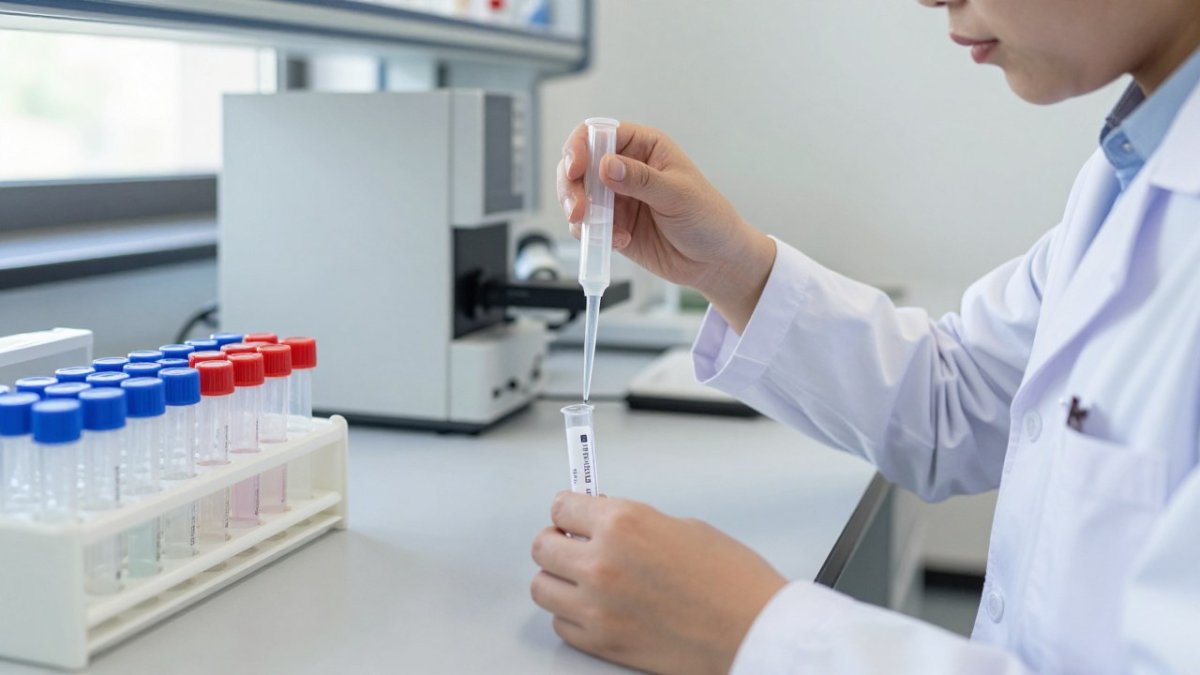
- Calculate the target concentration. Work from the net peptide content and the injection volume your method requires.
- Dissolve a test aliquot. Confirm the solvent works before committing the full sample.
- Dissolve the full sample at the chosen concentration, mixing gently.
- Clean up the sample if salts or contaminants are present (see the desalting section below).
- Dry down and reconstitute if you concentrated the sample, using your LC mobile phase or a compatible solvent.
- Centrifuge briefly to pellet any particulates before transferring to a vial.
- Transfer to a labelled autosampler vial with a low-volume insert if the sample amount is small.
Keep a written record of each step, including solvent lots and dates, for traceability and troubleshooting.
Store prepared samples cold, avoid repeated freeze-thaw cycles, and run samples as soon as practical since peptides can degrade or adsorb to surfaces.
Peptide Desalting for Mass Spectrometry: Removing Salts and Contaminants
Salts suppress ionisation and foul the source, but desalting is also where peptides are most often lost. Decide first whether you need it: a TFA or acetate salt injected at low concentration into a volatile mobile phase may only need dilution and a spin. Desalt when the sample contains sodium, phosphate, Tris, guanidine, urea, or high buffer concentrations, or when the peptide was eluted from an affinity or digestion step.
Choosing the cleanup format
C18 solid-phase extraction is a common default for synthetic peptides, but the format should match the sample volume and the amount of peptide. A common pattern is:
| Situation | Suitable format | Practical note |
|---|---|---|
| Small volume, low peptide mass | C18 pipette tip or micro-spin column | Minimises transfer losses; check recovery on a test aliquot |
| 0.1-1 mL sample | 1 mL C18 cartridge, 50-100 mg sorbent | Load slowly; do not exceed sorbent capacity |
| Larger volume or dilute sample | 3-6 mL cartridge or online trapping | Consider loading onto a trap column if the peptide is very dilute |
| Very hydrophobic peptide | C8 or C4 sorbent, or higher organic in elution | C18 may bind too tightly and elute incompletely |
| Very hydrophilic peptide | Mixed-mode or porous graphitic carbon | C18 may not retain the peptide at all |
Sorbent capacity is a real constraint. Once you have desalted, you can check whether the peptide is pure and correctly identified with a method for checking peptide purity in the lab in How to Verify Peptide Purity: A Lab Guide. A 50 mg C18 sorbent typically retains a few hundred micrograms to about 1 mg of peptide, depending on hydrophobicity; overloading causes breakthrough.
A reproducible C18 desalting protocol
- Condition the sorbent with 1-2 column volumes of acetonitrile or methanol containing 0.1% formic acid.
- Equilibrate with 2-5 column volumes of 0.1% formic acid in water. Do not let the sorbent dry out between steps.
- Acidify the sample to roughly 0.1-1% formic acid so peptides carry a positive charge and bind efficiently. Check that the peptide does not precipitate at low pH first.
- Load the sample slowly, ideally at 1-2 mL/min for a cartridge, and collect the flow-through so you can check for breakthrough.
- Wash with 2-5 column volumes of 0.1% formic acid in water, or 5% acetonitrile in 0.1% formic acid for more hydrophobic peptides, to remove salts.
- Elute with 50-80% acetonitrile containing 0.1% formic acid, in two or three small fractions rather than one large volume.
- Dry the eluate under vacuum centrifugation and reconstitute in starting mobile phase.
Watch out: Too strong an organic wash can elute the peptide before you collect it, and letting the sorbent run dry introduces air that reduces binding. Keep the wash weak enough to remove salts but not the peptide.
Volatile salts and LC-MS compatibility
If the peptide must stay in a salt-containing buffer for stability, choose a volatile salt compatible with the mass spectrometer. Ammonium acetate and ammonium bicarbonate are the usual choices; ammonium formate is also common. Avoid sodium and phosphate buffers, which are non-volatile and cause adducts and source contamination. Keep volatile salt concentrations as low as the peptide allows, typically below about 10-20 mM, and confirm the salt does not suppress the peptide signal in a test injection.
Checking recovery
Recovery tells you whether the cleanup is acceptable. Run a known amount of peptide through the full procedure and compare peak area with a directly injected standard; a common target is at least 80% for routine work.
For very hydrophobic peptides, incomplete elution is more common than poor binding: try a stronger elution solvent, larger volume, or a less retentive sorbent such as C8 or C4.
Concentration, Reconstitution and Injection Volume
Concentration and reconstitution decide whether the peptide reaches the column in a form the method can separate. Two failure modes dominate: injecting in a solvent too strong for the starting gradient, which broadens or splits early-eluting peaks, and losing dilute peptide to surfaces before injection. Both are avoidable with a few concrete choices.
Setting the working concentration
Work backwards from the detector and column. A typical starting point for synthetic peptides is 0.1-1 mg/mL, adjusted to instrument sensitivity and injection volume.
Column capacity sets the upper limit. For a typical 2.1 mm internal diameter analytical column, peptide mass on column is usually kept in the low microgram range to avoid overload and peak distortion; a 4.6 mm column tolerates more.
Drying down without losing material
Vacuum centrifugation is the standard way to remove acetonitrile and water after desalting. Keep the sample cool and stop as soon as the solvent is gone; over-drying makes hydrophobic peptides harder to redissolve.
If the peptide is very dilute, consider adding a small amount of sacrificial protein or low-bind carrier before drying to reduce adsorption losses, then remove it during cleanup if the method allows.
Reconstitution and the solvent-strength effect
Reconstitute in a solvent that matches the starting mobile phase as closely as possible.
Keep the injection solvent at or below the starting mobile phase organic content where possible.
Watch out: Reconstituting a hydrophobic peptide in pure acetonitrile or DMSO and injecting a large volume can cause the peptide to precipitate at the head of the column, giving low and variable recovery.
Injection volume and sample loss
Keep injection volumes small when the reconstitution solvent is stronger than the mobile phase. For a typical 2.1 mm column, 1-10 microlitres is common; larger volumes are acceptable only when the solvent matches the mobile phase.
Use low-bind autosampler vials and inserts, and minimise time in the autosampler. Adsorption to vial walls is concentration-dependent and worst for hydrophobic peptides in mostly aqueous solvents.
Measurable checks before injection
Before committing a batch, confirm four things: the peptide is fully dissolved, the concentration is known from net peptide content, the injection solvent is compatible with the starting mobile phase, and a test injection gives acceptable peak shape and response.
Troubleshooting Poor Recovery, Carryover and Matrix Effects
Most problems fall into three groups: low recovery, carryover between injections, and matrix effects that suppress or distort signal. Diagnose the pattern before changing the method.
Low recovery usually means the peptide stuck to surfaces, precipitated, or was lost during cleanup. Switch to low-bind plastics, recheck solubility, and recheck the elution step.
Carryover shows up as peaks in blank injections run after a sample. Hydrophobic peptides are the usual cause.
Matrix effects appear when co-eluting contaminants change ionisation. Improve cleanup, dilute the sample, or adjust the gradient so the peptide separates from interfering material.
A simple checklist helps:
- Blank injection run before and after samples
- Fresh standard compared with processed sample
- Spike-in test to check for suppression
Booking Your Next Peptide Batch With OptiPeps
Good sample preparation starts with good material. OptiPeps supplies research-grade peptides with batch-level Certificates of Analysis, and every batch is HPLC-MS verified for purity before dispatch.
Stock is held in our Melbourne facility, so same-day dispatch and Express Post shipping across Australia are straightforward. Free Express Post applies to orders over $100.
If you are planning a new batch, check the Certificate of Analysis against your method's needs and contact our team with any questions about solubility or salt form before you order.
Frequently Asked Questions
How do you dissolve peptides for HPLC-MS?
Start with a small aliquot of the peptide rather than the whole vial, and test solubility first. Begin with high-purity water or a dilute aqueous solvent, typically 0.1% formic acid in water. If the peptide is hydrophobic, add a small volume of acetonitrile or a weak organic solvent, then dilute to your working concentration. Sonication for short bursts can help break up aggregates. Avoid high concentrations of DMSO if the sample is destined for LC-MS, as it can interfere with ionisation and chromatography. Pricing and quantities depend on your order, so check OptiPeps for current options.
Do peptides need to be desalted before HPLC-MS?
Usually yes, particularly when the peptide was synthesised with trifluoroacetic acid salts or when it has been buffered in phosphate or other non-volatile salts. Salts suppress ionisation, foul the column and reduce sensitivity. Solid-phase extraction with a C18 cartridge is a common approach for desalting small peptides. Samples that already come from a verified, HPLC-MS-tested batch may need less cleanup, but confirm the solvent system matches your method before injection.
What solvent should be used to prepare peptides for LC-MS?
Most LC-MS workflows use a final solvent that matches the starting mobile phase, commonly water with 0.1% formic acid, sometimes with a low percentage of acetonitrile. Avoid non-volatile buffers and high concentrations of detergents. The right choice depends on peptide charge, hydrophobicity and your column chemistry, so run a small test injection before committing a full sample set.
How do you prevent peptide loss during sample preparation?
Peptide loss usually comes from adsorption to plastic and glass surfaces, incomplete elution from SPE cartridges, or over-drying. Use low-binding tubes, pre-wet C18 cartridges according to the manufacturer's instructions, and avoid drying to complete dryness when reconstitution is difficult. Keep samples cold and store them in a sealed, appropriate solvent. For OptiPeps stock and current availability, contact the team directly.