Last Updated: November 17, 2026
Quick Summary
To prepare peptide solutions for cell culture, dissolve the lyophilised powder in the simplest suitable solvent, starting with sterile water, then make a concentrated stock and dilute it into medium. Calculate concentration from the net peptide content on the certificate of analysis, and always include a vehicle control.
- Start with sterile water and move to buffer or DMSO only if the peptide will not dissolve.
- Test solubility on a small aliquot before dissolving the whole vial.
- Calculate stock concentration using net peptide content, not gross vial weight.
- Filter-sterilise with a low-binding membrane, since peptide can be lost to the filter.
- Include a vehicle control with the same final solvent concentration as treated samples.
Table of Contents
- Before You Start: What You Need and Why Solvent Choice Matters
- Choosing a Solvent: A Decision Path for Cell Culture Work
- Reconstituting the Lyophilised Peptide Step by Step
- Calculating Stock Concentration and Working Dilutions
- Sterile Preparation and Filtration Trade-offs
- Diluting into Culture Medium Without Precipitation, with Vehicle Controls
- Storing Aliquots and Keeping Peptide Solutions Stable
- Booking Your Next Peptide Order with OptiPeps
- Frequently Asked Questions
How you prepare a peptide solution before it touches cells shapes the data you get back. Poor dissolution, a wrong stock concentration, or a solvent that is toxic at your chosen dose can skew an assay before the experiment starts.
Peptide solutions for cell culture are usually built in three stages: dissolve the lyophilised powder, make a concentrated stock, then dilute that stock into culture medium. Each stage carries its own risks, covered below in order.
Before You Start: What You Need and Why Solvent Choice Matters
Gather your materials before you open the vial: sterile water or an appropriate buffer, a sterile solvent for hydrophobic sequences, sterile microcentrifuge tubes, calibrated pipettes with filter tips, a vortex mixer, a benchtop centrifuge, and a biosafety cabinet.
Check the certificate of analysis before you dissolve the peptide. Our guide to reading a certificate of analysis for peptides explains what each figure means. It shows the net peptide content, purity and molecular weight, all needed for accurate concentration calculations.
Solvent choice affects three things at once: whether the peptide dissolves, whether the solvent is safe for your cells, and whether it changes what you are measuring. To see how purity standards for in vitro research bear on that choice, read the dedicated article. A solvent that dissolves the peptide well but kills cells at your working dose will ruin the experiment, so keep this trade-off in mind through every step below.
Choosing a Solvent: A Decision Path for Cell Culture Work
Start with the simplest option and move on only when it fails:
- Step 1: Try sterile water. Many short, charged peptides dissolve fully in water.
- Step 2: If the peptide is hydrophobic or does not dissolve, try a dilute aqueous buffer such as 0.1 M ammonium bicarbonate, which is a common choice for difficult sequences.
- Step 3: If the peptide still will not dissolve, use a small volume of a water-miscible organic solvent such as dimethyl sulfoxide (DMSO), then dilute it into aqueous buffer.
- Step 4: Confirm the final solvent concentration will be tolerated by your cells before committing to the stock.
Most cell culture work tolerates DMSO only at low final concentrations, often at or below 0.1 to 0.5 per cent, but the right ceiling depends on your cell line, so check it in your own system. The solvent becomes part of your experimental design and needs its own controls, covered below.
Testing solubility on a small aliquot first
Never dissolve your whole vial on the first attempt. Remove a small portion, dissolve it in a tiny volume, and check by eye for clarity. A cloudy solution or visible particles means the peptide has not dissolved. Brief sonication or gentle vortexing can help, but avoid heating unless the peptide's data sheet says it is safe.
Testing on an aliquot protects the rest of your material. If a solvent fails on the test portion, you have lost very little.
When pH adjustment helps and when it hurts
Peptides with a net positive charge often dissolve better in slightly acidic conditions. Peptides with a net negative charge often dissolve better in slightly basic conditions. Adjusting pH can therefore rescue a stubborn peptide.
The risk is that extreme pH can damage the peptide, and any acid or base must be compatible with your cells once diluted. Make small adjustments, keep the final buffer close to physiological pH, and only adjust after confirming the peptide's charge.
Reconstituting the Lyophilised Peptide Step by Step
Lyophilised peptides arrive as a dry, often fluffy powder under vacuum. Reconstitution turns that powder into a liquid stock. Follow these steps in order:
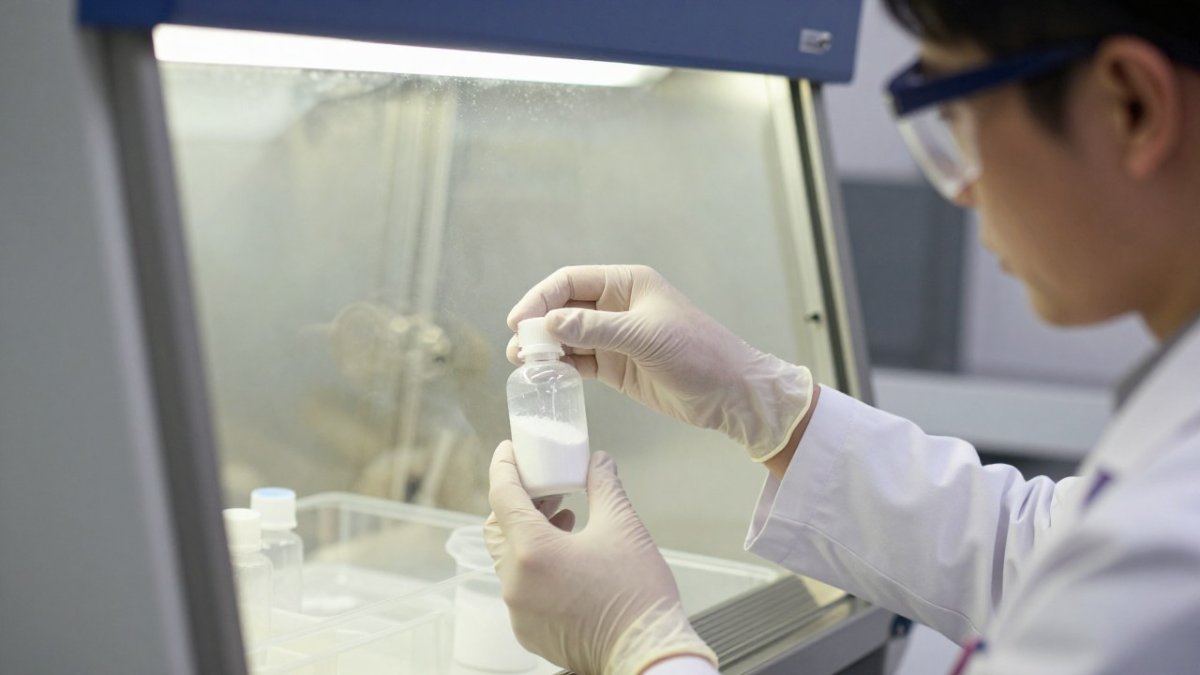
- Bring the vial to room temperature before opening to prevent condensation.
- Centrifuge the vial briefly so all the powder settles at the bottom.
- Work inside a biosafety cabinet and wipe the vial stopper with 70 per cent ethanol.
- Add the chosen solvent slowly down the side of the vial, not directly onto the powder.
- Let the solution sit for a minute, then swirl or gently vortex until clear.
- Check for particles or cloudiness and repeat the solubility test if needed.
Add solvent in measured volumes so you know the exact concentration. For diluent suited to reconstituting lyophilised peptides, you can buy bacteriostatic water for shipping across Australia. Record the volume and the date on the vial and in your lab notebook.
Calculating Stock Concentration and Working Dilutions
Accurate concentration is the foundation of reproducible results, and most failed cell-culture peptide experiments trace back to an arithmetic slip here rather than to the peptide itself. You can have the arithmetic done for you with our free peptide calculator for mg/mL concentration and syringe units.
The basic formula is:
Stock concentration (mg/mL) = Net peptide mass (mg) ÷ Solvent volume (mL)
Then convert to molar concentration using the molecular weight from the certificate:
Stock concentration (M) = Stock concentration (mg/mL) ÷ Molecular weight (g/mol) ÷ 1000
Once you have a stock, every working dilution follows C1 × V1 = C2 × V2, where C1 is the stock concentration, V1 the volume of stock you take, C2 the target concentration and V2 the final volume.
Worked example: from a 1 mg vial to a 3X working solution
Suppose you have a 1 mg vial with a stated net peptide content of 80 per cent. The usable peptide mass is 0.8 mg. Dissolve it in 200 µL of solvent to make a stock of 4 mg/mL (0.8 mg ÷ 0.2 mL).
Now suppose your experiment needs a final well concentration of 10 µM in a 2 mL well, and you want to prepare a 3X working solution so that adding one part working solution to two parts medium gives the target. The 3X concentration is 30 µM. Using C1 × V1 = C2 × V2 with C1 = 2.67 mM (2670 µM), C2 = 30 µM and V2 = 1 mL:
V1 = (30 µM × 1 mL) ÷ 2670 µM ≈ 11.2 µL
So you add 11.2 µL of stock to 988.8 µL of medium to make 1 mL of 3X working solution; adding 1 mL of that to 1 mL of medium in the well gives a final concentration of 10 µM.
Serial dilutions and a plate layout that avoids edge effects
For dose-response work, prepare a 3X working solution at the top dose, then serially dilute it in medium at a fixed ratio (commonly 1:3 or 1:10) to build the curve.
A workable 96-well layout: column 1 as medium-only blanks, column 2 as vehicle controls, columns 3 to 10 as the dilution series in duplicate, and column 11 as a positive control.
The table below summarises the three calculation steps covered in this section, so you can check each one against your own numbers.
| Step | Formula or action | Watch for |
|---|---|---|
| Stock concentration (mg/mL) | Net peptide mass ÷ solvent volume | Use net content, not gross vial weight |
| Stock concentration (M) | mg/mL ÷ molecular weight ÷ 1000 | Molecular weight from the certificate |
| Working dilution | C1 × V1 = C2 × V2 | V2 is the volume after adding stock |
| Serial dilution | Fixed ratio, e.g. 1:3 or 1:10 | Keep vehicle concentration constant |
Sterile Preparation and Filtration Trade-offs
Cell culture demands sterility, but sterilising peptide solutions carries trade-offs that most protocols gloss over.
Peptides adsorb to filter membranes through hydrophobic and electrostatic interactions: hydrophobic sequences bind readily to hydrophobic membranes, and cationic peptides bind to negatively charged membranes.
Filter material compatibility is the first decision.
Practical steps to limit losses:
- Pre-wet the filter with a small volume of the same solvent or buffer, then discard the pre-wet volume.
- Filter the solution once, not repeatedly, and avoid pushing the last few microlitres through the membrane.
- Use the smallest filter and syringe that will hold your volume, because dead volume and membrane area both drive loss.
- Filter a small test portion first, then measure concentration by absorbance at 280 nm (if the sequence contains tryptophan or tyrosine) or by the certificate's stated extinction coefficient, and compare it with the unfiltered stock to estimate recovery.
Whatever you choose, work in a biosafety cabinet, use sterile filter tips and tubes, and avoid touching anything that will enter the culture.
Diluting into Culture Medium Without Precipitation, with Vehicle Controls
The final dilution into culture medium is where many experiments fail.
To avoid precipitation:
- Warm the medium to 37 °C before adding the peptide.
- Add the stock slowly while gently mixing, rather than dumping it in at once.
- Keep the organic solvent fraction as low as possible.
- Inspect the medium under a microscope for crystals or cloudiness before adding it to cells.
Every experiment needs a vehicle control: culture medium containing the same final concentration of solvent, with no peptide. Impurities can confound these controls too, so see how to stop peptide impurities skewing your assays.
A common mistake is comparing peptide-treated cells against untreated cells and assuming any difference is the peptide's doing. The vehicle control is what makes the comparison valid.
Storing Aliquots and Keeping Peptide Solutions Stable
Stock solutions degrade over time, and repeated freezing and thawing speeds that up.
Store aliquots at the temperature recommended on the product's documentation, typically frozen.
Working solutions made in culture medium should be used promptly and are generally not kept for later use.
If you are planning repeat experiments, buy enough peptide to cover them and keep a record of lot numbers. Check the OptiPeps website for current availability and a quote before you order.
Booking Your Next Peptide Order with OptiPeps
Planning ahead keeps your experiments on schedule. Reorder before your stock runs low so you never have to prepare a fresh batch under time pressure. OptiPeps stocks research-grade peptides with batch-level Certificates of Analysis and dispatches from a Melbourne-based facility. Visit the OptiPeps website to check availability and current pricing for your order.
Frequently Asked Questions
How do you dissolve peptides for cell culture experiments?
Start with a small test aliquot rather than your whole vial. Try sterile water first, since most peptides dissolve in it. If the peptide is hydrophobic or stays cloudy, use a small volume of an organic solvent such as DMSO, then dilute slowly into your aqueous buffer while mixing. Check that the final DMSO concentration in your culture stays below the tolerance of your cell line, usually 0.1 to 0.5 percent, and always include a vehicle control. Avoid vigorous vortexing, which can cause aggregation, and sonicate briefly only if needed.
Should peptide stock solutions be filter-sterilised?
Often yes, but with trade-offs. Passing a stock through a 0.22 micrometre low protein-binding filter removes microbial contamination without heat. However, hydrophobic or high-concentration peptides can adhere to the membrane, lowering the effective concentration. If you filter, use a low protein-binding membrane such as PVDF or PES, pre-wet it, and consider measuring concentration afterwards. Where a peptide is already prepared aseptically from sterile solvent, filtration may not be necessary, so check your peptide's behaviour before deciding.
How should peptide stock solutions be stored?
Divide the stock into single-use aliquots to avoid repeated freeze-thaw cycles, which promote degradation and precipitation. Store aliquots at minus 20 degrees Celsius for short-term use, or at minus 80 degrees Celsius for longer periods. Use low protein-binding tubes and label each aliquot with the peptide name, concentration, solvent, and preparation date. Keep a record of each aliquot's history so your experiments remain reproducible. Check the OptiPeps website or request a quote for current details.
Why might a peptide precipitate in cell culture medium?
Precipitation usually happens when a concentrated stock is added too quickly to aqueous medium, when the final pH moves near the peptide's isoelectric point, or when serum proteins and salts interact with the peptide. Dilute stepwise, add the stock dropwise while swirling the medium, and warm the medium to room temperature first. Compare solubility in serum-free and serum-containing medium on a small scale, and check the Certificate of Analysis for the lot you are using.